
Adding and Subtracting Integers
Adding and subtracting integers follows three rules. If the signs are the same, add the absolute values and keep the sign. If the signs are different, subtract the smaller absolute value from the larger one and keep the sign of the larger. To subtract, add the opposite: 5 - (-2) = 5 + 2 = 7.
Before this lesson: You should know how to use negative numbers on a number line and how to find absolute value.
Adding Integers on a Number Line
Think of each number as a move on the number line. Start at the first number. Adding a positive number moves you right. Adding a negative number moves you left.
Here is 3 + (-5). Start at 3, then move 5 to the left. You land on −2.
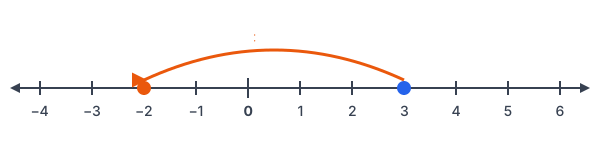
You can also think about money. A positive number is money you get, and a negative number is money you spend. If you have $3 and spend $5, you end up $2 short, which is −2.
Rules for Adding Integers
A number line works well for small numbers. For bigger numbers, use these rules.
| Signs | Rule | Example |
|---|---|---|
| Both positive | Add. The answer is positive. | 4 + 6 = 10 |
| Both negative | Add the absolute values. The answer is negative. | (-4) + (-6) = -10 |
| One positive, one negative | Subtract the smaller absolute value from the larger. Use the sign of the number that is farther from 0. | (-9) + 4 = -5 |
| A number and its opposite | The answer is 0. | (-7) + 7 = 0 |
Rule for Subtracting Integers
Subtracting a number is the same as adding its opposite. In the rule below, a and b stand for any two integers.
a - b = a + (-b)
Many students remember this as keep, change, change:
- Keep the first number as it is.
- Change the minus sign to a plus sign.
- Change the second number to its opposite.
Then use the adding rules. Here are two examples:
\begin{aligned}
4 - 9 &= 4 + (-9) = -5 \\
2 - (-3) &= 2 + 3 = 5
\end{aligned}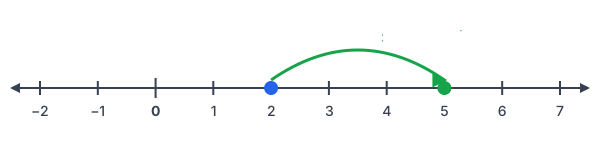
So subtracting a negative number moves you right, just like adding a positive number.
Worked Examples
Example 1: Add two negative numbers
Find (-8) + (-5).
Step 1. Both numbers are negative, so the signs are the same.
Step 2. Add the absolute values: 8 + 5 = 13.
Step 3. Keep the sign. Both numbers are negative, so the answer is negative.
Answer: (-8) + (-5) = -13.
Example 2: Add numbers with different signs
Find 6 + (-14).
Step 1. The signs are different. The absolute values are 6 and 14.
Step 2. Subtract the smaller absolute value from the larger: 14 − 6 = 8.
Step 3. −14 is farther from 0 than 6, so the answer takes its sign. The answer is negative.
Answer: 6 + (-14) = -8.
Example 3: Subtract a positive number
Find -7 - 9.
Step 1. Keep −7. Change the minus to a plus. Change 9 to −9.
-7 - 9 = (-7) + (-9)
Step 2. Both numbers are negative. Add the absolute values: 7 + 9 = 16.
Answer: -7 - 9 = -16.
Example 4: Subtract a negative number
Find -3 - (-10).
Step 1. Keep −3. Change the minus to a plus. Change −10 to 10.
-3 - (-10) = (-3) + 10
Step 2. The signs are different. Subtract the absolute values: 10 − 3 = 7.
Step 3. 10 is farther from 0 than −3, so the answer is positive.
Answer: -3 - (-10) = 7.
Example 5: Word problem
At 6 a.m. the temperature was −8°F. By noon it had gone up 15 degrees. By midnight it had dropped 11 degrees from the noon temperature. What was the temperature at midnight?
Step 1. Going up 15 degrees means adding 15.
Step 2. Dropping 11 degrees means subtracting 11.
\begin{aligned}
-8 + 15 &= 7 \\
7 - 11 &= 7 + (-11) = -4
\end{aligned}
Answer: The temperature at midnight was −4°F.
Common Mistakes
| Mistake | What it looks like | How to fix it |
|---|---|---|
| Using the multiplying rule to add | (-4) + (-6) = 10 | “Two negatives make a positive” is for multiplying. When you add two negatives, the answer is negative: -10. |
| Keeping the wrong sign | (-9) + 4 = 5 | Use the sign of the number farther from 0. That is −9, so the answer is -5. |
| Changing only one thing when subtracting | 5 - (-2) = 5 + (-2) = 3 | Change the minus to a plus and −2 to 2: 5 + 2 = 7. |
| Changing the first number | -6 - 3 = 6 + (-3) | Keep the first number as it is: (-6) + (-3) = -9. |
| Thinking subtracting always gives a smaller answer | 4 - (-3) = 1 | Subtracting a negative makes the answer bigger: 4 + 3 = 7. |
Adding and Subtracting More Than Two Integers
When a problem has several numbers, first change each subtraction into adding the opposite. Then you can add the positives together and the negatives together.
Find -3 + 10 - (-4) - 15.
\begin{aligned}
-3 + 10 - (-4) - 15 &= -3 + 10 + 4 + (-15) \\
&= (10 + 4) + \big((-3) + (-15)\big) \\
&= 14 + (-18) \\
&= -4
\end{aligned}
You can also just work from left to right: −3 + 10 = 7, then 7 + 4 = 11, then 11 − 15 = −4. Both ways give −4.
You’ll use these skills all through algebra. For example, the slope formula often has you subtract a negative number.
Practice Problems
Find each sum or difference.
- 7 + (-3)
- (-5) + (-9)
- (-12) + 8
- (-6) + 6
- 3 - 10
- -4 - 7
- 8 - (-5)
- -15 - (-6)
- -2 + 9 - (-3) - 12
- A submarine is at −120 feet. It rises 45 feet, then dives 70 feet. Where is it now?
Show answers
- Different signs: 7 − 3 = 4, and 7 is farther from 0. 7 + (-3) = 4
- Same signs: 5 + 9 = 14, and both are negative. (-5) + (-9) = -14
- Different signs: 12 − 8 = 4, and −12 is farther from 0. (-12) + 8 = -4
- A number plus its opposite is 0. (-6) + 6 = 0
- 3 - 10 = 3 + (-10) = -7
- -4 - 7 = (-4) + (-7) = -11
- 8 - (-5) = 8 + 5 = 13
- -15 - (-6) = (-15) + 6 = -9
- -2 + 9 + 3 + (-12). Positives: 9 + 3 = 12. Negatives: (−2) + (−12) = −14. Then 12 + (-14) = -2.
- Rising means adding and diving means subtracting: -120 + 45 = -75, then -75 - 70 = -145. The submarine is at −145 feet.
Adding and Subtracting Integers FAQ
What is the rule for subtracting integers?
Add the opposite. Keep the first number, change the minus to a plus, and change the second number to its opposite. For example, 6 - (-2) = 6 + 2 = 8.
What is a negative plus a negative?
A negative plus a negative is always negative. Add the absolute values and keep the minus sign: (-3) + (-4) = -7.
Does subtracting a negative always give a positive answer?
No. Subtracting a negative is the same as adding a positive, so the answer gets bigger. But it can still be negative: -8 - (-2) = -6.
What is a positive plus a negative?
It depends on which number is farther from 0. 9 + (-4) = 5 is positive, but 4 + (-9) = -5 is negative.
Summary
- Adding a positive number moves right on the number line. Adding a negative number moves left.
- Same signs: add the absolute values and keep the sign.
- Different signs: subtract the absolute values and use the sign of the number farther from 0.
- To subtract, add the opposite: a - b = a + (-b).
- Subtracting a negative is the same as adding a positive.
Previous lesson: Absolute Value
Next lesson: Multiplying and Dividing Integers
Back to the Pre-Algebra (Math Basics) Index