
Percent Change
Percent change tells how much an amount went up or down, compared to where it started. Subtract to find the change, divide by the original amount, then multiply by 100. If a price goes from $50 to $60, the change is $10, and 10 ÷ 50 = 0.20. That is a 20% increase.
Before this lesson: You should know how to find the percent of a number from percentages.
What Percent Change Means
A change of $10 can be big or small. On a $50 shirt, it is a lot. On a $500 bike, it is not much. Percent change compares the change to the starting amount, so you can tell how big it really is.
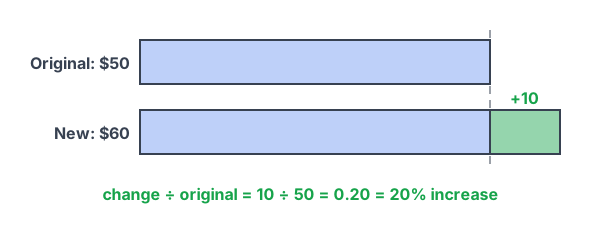
- If the amount goes up, it is a percent increase.
- If the amount goes down, it is a percent decrease.
The Percent Change Formula
\text{percent change} = \frac{\text{new amount} - \text{original amount}}{\text{original amount}} \times 100\%- Subtract: new amount minus original amount. This is the change.
- Divide the change by the original amount.
- Multiply by 100 to get a percent.
- A positive answer is an increase. A negative answer is a decrease.
To find a new amount after a percent change, multiply by a multiplier. For a 25% increase, multiply by 1.25. For a 30% decrease, multiply by 0.70.
Worked Examples
Example 1: Percent increase
A ticket price goes from $50 to $60. What is the percent change?
Step 1. Find the change: 60 − 50 = 10.
Step 2. Divide by the original: 10 ÷ 50 = 0.20.
Answer: 0.20 × 100 = 20%. The price went up 20%.
Example 2: Percent decrease
A plant was 80 cm tall. After pruning, it is 68 cm tall. What is the percent change?
Step 1. Find the change: 68 − 80 = −12. The height went down by 12 cm.
Step 2. Divide by the original: −12 ÷ 80 = −0.15.
Answer: −0.15 × 100 = −15%. The height decreased by 15%.
Example 3: Find the new amount after an increase
A class has 40 students. Next year it will grow by 25%. How many students will there be?
Step 1. A 25% increase means the new amount is 100% + 25% = 125% of the old one. As a decimal, that is 1.25.
Step 2. Multiply: 40 \times 1.25 = 50.
Answer: There will be 50 students.
Example 4: Find the new amount after a decrease
A game costs $120. Its price drops by 30%. What is the new price?
Step 1. A 30% decrease leaves 100% − 30% = 70% of the price. As a decimal, that is 0.70.
Step 2. Multiply: 120 \times 0.70 = 84.
Answer: The new price is $84.
Example 5: Word problem
A town had 2,400 people. Five years later it has 2,760 people. By what percent did the population grow?
Step 1. Find the change: 2,760 − 2,400 = 360.
Step 2. Divide by the original: 360 ÷ 2,400 = 0.15.
Answer: The population grew by 15%.
Common Mistakes
| Mistake | What it looks like | How to fix it |
|---|---|---|
| Dividing by the new amount | 50 to 60: 10 ÷ 60 = 16.7% | Always divide by the original (starting) amount: 10 ÷ 50 = 20%. |
| Reporting the change, not the percent | “The price went up 10%” for a $10 increase | $10 is the amount of change. Divide by the original to get the percent. |
| Forgetting to multiply by 100 | The change is 0.15% | 0.15 as a percent is 15%. |
| Thinking equal ups and downs cancel | Up 10%, then down 10%, gets back to the start | The second change uses a new starting amount: 100 → 110 → 99. |
Percent Error
Percent error tells how far an estimate is from the actual value. It uses the absolute value of the difference, so it is never negative.
\text{percent error} = \frac{|\text{estimate} - \text{actual}|}{\text{actual}} \times 100\%If you guess a box weighs 48 pounds and it really weighs 50, the percent error is \frac{|48 - 50|}{50} \times 100\% = 4\%. Percent change also shows up in discounts and markups, covered in Percent Word Problems (coming soon).
Practice Problems
For problems 1–4, find the percent change. Say whether it is an increase or a decrease.
- 20 to 25
- 50 to 35
- 8 to 10
- 250 to 200
- Increase 60 by 15%.
- Decrease 90 by 40%.
- A puppy grew from 1.5 pounds to 3 pounds. What is the percent change?
- A shirt’s price rose from $45 to $54. What is the percent increase?
- You estimate that a jar holds 48 marbles. It really holds 50. What is your percent error?
- A club had 120 members last year and has 150 this year. What is the percent change?
Show answers
- Change 5, and 5 ÷ 20 = 0.25. A 25% increase.
- Change −15, and −15 ÷ 50 = −0.30. A 30% decrease.
- Change 2, and 2 ÷ 8 = 0.25. A 25% increase.
- Change −50, and −50 ÷ 250 = −0.20. A 20% decrease.
- 60 \times 1.15 = 69
- 90 \times 0.60 = 54
- Change 1.5, and 1.5 ÷ 1.5 = 1. A 100% increase, which means the weight doubled.
- Change 9, and 9 ÷ 45 = 0.20. A 20% increase.
- \frac{|48 - 50|}{50} = \frac{2}{50} = 0.04, so the percent error is 4%.
- Change 30, and 30 ÷ 120 = 0.25. A 25% increase.
Percent Change FAQ
How do you calculate percent increase?
Subtract the original amount from the new amount, divide by the original amount, and multiply by 100. A positive answer is a percent increase.
Can percent change be more than 100%?
Yes, for an increase. If an amount triples, from 10 to 30, the change is 20 and the increase is 200%. A decrease can’t be more than 100%, because you can’t lose more than all of it.
Why do you divide by the original amount?
Percent change compares the change to where you started. The original amount is the starting point, so it goes on the bottom.
What is the difference between percent change and percentage points?
Percentage points are a simple difference between two percents. If a rate goes from 40% to 50%, that is 10 percentage points, but a 25% increase, since 10 ÷ 40 = 0.25.
Summary
- Percent change compares the change to the original amount.
- Formula: (new − original) ÷ original × 100%.
- A positive result is an increase. A negative result is a decrease.
- To apply a percent change, multiply by a multiplier, like 1.25 for +25% or 0.70 for −30%.
- Percent error uses the absolute value of the difference.
Previous lesson: Percentages
Next lesson: Percent Word Problems
Back to the Pre-Algebra (Math Basics) Index