
Planar Graphs
A planar graph is a graph that can be drawn in the plane with no edges crossing. A drawing with no crossings splits the plane into regions called faces, and for every connected planar graph, Euler’s formula says v − e + f = 2. The formula also proves that graphs such as K_5 and K_{3,3} are not planar.
Before this lesson: Graph Theory Basics, Bipartite Graphs and Graph Coloring
The idea
A graph is about which vertices are joined, not about how we happen to draw it. The usual drawing of K_4, a square with both diagonals, has a crossing. But if you move one vertex inside the triangle formed by the other three, every crossing disappears. So K_4 is planar.
Some graphs can never be untangled, however you move the vertices. Euler’s formula gives a way to prove this. It links the number of vertices, edges and faces of any drawing with no crossings, and too many edges break that link.
Planar graph definitions
- A graph is planar if it can be drawn in the plane so that edges meet only at shared endpoints. Such a drawing is a plane drawing (or planar embedding).
- A plane drawing divides the plane into faces: regions bounded by edges. The unbounded region around the outside is a face too, called the outer face.
- The degree of a face is the number of edges on its boundary, where an edge that has the same face on both sides is counted twice.
Every edge has two sides, and each side borders one face. So the face degrees add up to twice the number of edges, just as vertex degrees do in the handshaking lemma from graph theory basics.
Euler’s formula for planar graphs
If G is a connected planar graph drawn without crossings, with v vertices, e edges and f faces, then
v - e + f = 2
Why it works. A single vertex has v = 1, e = 0 and f = 1, so v − e + f = 2. Build any connected plane graph from there one edge at a time. An edge to a new vertex adds 1 to v and 1 to e. An edge between two vertices already drawn splits a face in two, adding 1 to e and 1 to f. Either way, v − e + f stays 2.
Edge limits for planar graphs
Let G be a simple connected planar graph with v ≥ 3 vertices.
- Every face has degree at least 3, so e \le 3v - 6.
- If G has no triangles (for example, if G is bipartite), every face has degree at least 4, so e \le 2v - 4.
- G has a vertex of degree at most 5.
Proof of the first limit. The face degrees add to 2e, and each is at least 3, so 2e ≥ 3f, which means f ≤ 2e/3. Euler’s formula gives f = 2 − v + e, so 2 − v + e ≤ 2e/3. Multiply by 3 and rearrange to get e ≤ 3v − 6. The limit for graphs with no triangles is the same argument with 4 in place of 3.
These limits can prove a graph is not planar. They can never prove that a graph is planar; to do that, draw it without crossings.
Planar graph examples
Example 1: Checking Euler’s formula on a cube
The cube graph Q_3 has the 8 corners of a cube as vertices and its 12 edges as edges. Drawn flat, it is a small square inside a large square, with each inner corner joined to the matching outer corner. Check Euler’s formula.
v = 8
Count the corners of the cube.
e = 12
Count the edges: 4 on the inner square, 4 on the outer square and 4 joining them.
f = 1 + 4 + 1 = 6
Count faces: the inner square, 4 regions between the squares, and the outer face.
8 - 12 + 6 = 2
Substitute into v − e + f.
Answer: v − e + f = 2, as Euler’s formula predicts. The 6 faces match the 6 faces of the cube.
Example 2: Redrawing K₄ without crossings
The usual drawing of K_4 with vertices A, B, C, D has crossing diagonals. Show that K_4 is planar and count its faces.
A, B, C \text{ triangle}Draw the edges AB, BC and CA as a triangle.
D \text{ inside}Place D inside the triangle.
AD, BD, CD
Join D to each corner with a straight segment; none of them cross.
v = 4,\ e = 6
K_4 has 4 vertices and every pair joined: 6 edges.
f = 3 + 1 = 4
Three small triangles inside, plus the outer face.
4 - 6 + 4 = 2
Check Euler’s formula.
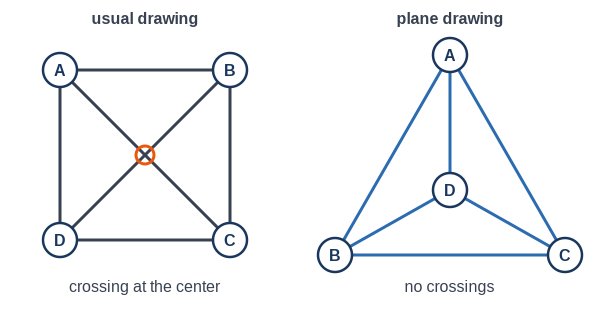
Answer: K_4 is planar, and its plane drawing has 4 faces.
Example 3: Counting faces from degrees
A connected planar graph has 10 vertices, and every vertex has degree 3. How many faces does any plane drawing of it have?
2e = 10 \cdot 3
By the handshaking lemma, the degrees add to twice the number of edges.
2e = 30
Multiply.
e = 15
Divide both sides by 2.
f = 2 - v + e
Solve Euler’s formula for f.
f = 2 - 10 + 15 = 7
Substitute v = 10 and e = 15.
Answer: every plane drawing has 7 faces.
Example 4: Why K₅ is not planar
Use the edge limit to prove that K_5 is not planar.
v = 5
K_5 has 5 vertices.
e = \frac{5 \cdot 4}{2} = 10Every pair is joined: 5 choose 2 edges.
3v - 6 = 3 \cdot 5 - 6 = 9
Find the largest number of edges a simple planar graph with 5 vertices can have.
10 \gt 9
K_5 has more edges than the limit allows.
Answer: K_5 breaks the limit e ≤ 3v − 6, so it is not planar.
Example 5: The three utilities puzzle (word problem)
Three houses each need a pipe or cable from each of three utilities: water, gas and electricity. Can all nine lines be laid on flat ground without any two crossing?
K_{3,3}Houses on one side, utilities on the other, every house joined to every utility.
v = 6,\ e = 9
There are 3 + 3 vertices and 3 · 3 edges.
\text{no triangles}The graph is bipartite, so every cycle has even length and every face has degree at least 4.
2v - 4 = 2 \cdot 6 - 4 = 8
Find the edge limit for graphs with no triangles.
9 \gt 8
K_{3,3} has more edges than the limit allows.
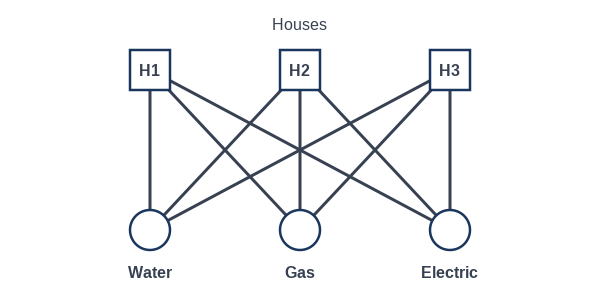
Answer: no. K_{3,3} is not planar, so at least two lines must cross.
Common mistakes
| Mistake | Example of the error | Fix |
|---|---|---|
| Forgetting the outer face | Counting 3 faces for the plane drawing of K_4 | The unbounded region counts: K_4 has 4 faces. |
| Calling a graph nonplanar because one drawing crosses | “The square with diagonals crosses, so K_4 is not planar.” | Planar means some drawing has no crossings. Try moving vertices first. |
| Using an edge limit to prove planarity | “6 vertices and 12 edges meets e ≤ 3v − 6, so it is planar.” | The limits only rule graphs out. A graph containing K_{3,3} can meet e ≤ 3v − 6 and still be nonplanar. |
| Using 3v − 6 for a bipartite graph | “K_{3,3} has 9 ≤ 12 edges, so it passes.” | With no triangles, use the sharper limit e ≤ 2v − 4 = 8. |
| Applying Euler’s formula to a disconnected graph | “Two separate triangles have 6 − 6 + f = 2, so f = 2.” | They have 3 faces (two insides and the outer face). With c connected pieces, v − e + f = 1 + c, and 6 − 6 + 3 = 1 + 2. |
| Counting a crossing point as a vertex | Adding the middle of the crossed square as a fifth vertex | A crossing is not a vertex. Redraw the graph instead. |
Related ideas
Kuratowski’s theorem
A subdivision of a graph replaces edges with paths through new degree-2 vertices. Kuratowski’s theorem says a graph is planar if and only if it contains no subdivision of K_5 or K_{3,3}. So these two graphs are the only basic obstacles to planarity.
Polyhedra
The corners, edges and faces of any convex polyhedron form a connected planar graph: imagine looking through one face and flattening the rest. So V − E + F = 2 for every convex polyhedron, which is how Euler first stated the formula. A cube has 8 − 12 + 6 = 2.
Maps and the four color theorem
A map gives a planar graph: make each region a vertex and join regions that share a border. The four color theorem from graph coloring says that every planar graph has χ(G) ≤ 4. The fact that every planar graph has a vertex of degree at most 5 is the key step in the easier proof that 5 colors are always enough.
Practice problems
- A connected planar graph has 7 vertices and 12 edges. How many faces does a plane drawing have?
- A connected planar graph has 10 edges and a plane drawing with 6 faces. How many vertices does it have?
- What is the largest number of edges a simple planar graph with 12 vertices can have?
- Is a simple graph with 8 vertices and 20 edges planar?
- A simple graph has 6 vertices and 12 edges and contains K_{3,3}. Since 12 ≤ 3(6) − 6, is it planar?
- How many faces does a plane drawing of a tree with 9 vertices have?
- Is K_{2,4} planar? Check Euler’s formula for your drawing.
- A connected plane graph has 8 vertices, and every face (including the outer face) is a triangle. How many edges and faces does it have?
- What is the largest number of edges a simple planar bipartite graph with 10 vertices can have?
- A soccer ball is a polyhedron with 12 pentagons and 20 hexagons. Each edge is shared by two faces. How many edges and corners does it have?
Show answers
1.
f = 2 - v + e
Solve Euler’s formula for f.
f = 2 - 7 + 12 = 7
Substitute v = 7 and e = 12.
Answer: 7 faces
2.
v = 2 + e - f
Solve Euler’s formula for v.
v = 2 + 10 - 6 = 6
Substitute e = 10 and f = 6.
Answer: 6 vertices
3.
3v - 6 = 3 \cdot 12 - 6
Use the edge limit for simple planar graphs.
36 - 6 = 30
Multiply, then subtract.
Answer: 30 edges
4.
3 \cdot 8 - 6 = 18
Find the edge limit for 8 vertices.
20 \gt 18
The graph has too many edges.
Answer: no, it is not planar
5.
K_{3,3} \subseteq GThe graph contains a nonplanar graph, so it cannot be drawn without crossings.
Answer: no; meeting e ≤ 3v − 6 does not prove a graph is planar
6.
e = 9 - 1 = 8
A tree with n vertices has n − 1 edges.
f = 2 - 9 + 8 = 1
Use Euler’s formula; a tree has only the outer face.
Answer: 1 face
7.
u_1, u_2 \text{ above and below}Put one vertex of the 2-side above and one below a row of the 4 other vertices; every edge goes up or down with no crossings.
v = 6,\ e = 2 \cdot 4 = 8
Count vertices and edges.
f = 2 - 6 + 8 = 4
Euler’s formula predicts 4 faces: 3 between neighboring middle vertices, plus the outer face.
Answer: yes, K_{2,4} is planar, with v − e + f = 6 − 8 + 4 = 2
8.
e = 3v - 6 = 3 \cdot 8 - 6 = 18
Every face is a triangle, so 2e = 3f exactly and the limit is reached.
f = 2 - 8 + 18 = 12
Use Euler’s formula.
2 \cdot 18 = 3 \cdot 12 = 36
Check: face degrees add to 2e.
Answer: 18 edges and 12 faces
9.
2v - 4 = 2 \cdot 10 - 4
A bipartite graph has no triangles, so use the sharper limit.
20 - 4 = 16
Multiply, then subtract.
Answer: 16 edges
10.
f = 12 + 20 = 32
Count the faces.
2e = 12 \cdot 5 + 20 \cdot 6
Add the face degrees; each edge is counted twice.
2e = 60 + 120 = 180
Multiply and add.
e = 90
Divide by 2.
v = 2 + 90 - 32 = 60
Solve Euler’s formula for v.
Answer: 90 edges and 60 corners
Planar graphs FAQ
What makes a graph planar?
A graph is planar if it can be drawn in the plane with no edges crossing. It only has to be possible for one drawing; other drawings of the same graph may cross.
What is Euler’s formula for planar graphs?
For a connected planar graph drawn without crossings, v − e + f = 2, where v is the number of vertices, e the number of edges and f the number of faces, including the outer face.
How do you prove a graph is not planar?
Show that it breaks an edge limit (e ≤ 3v − 6, or e ≤ 2v − 4 when there are no triangles), or find a subdivision of K_5 or K_{3,3} inside it.
Is K₄ planar?
Yes. Draw a triangle with three of the vertices and put the fourth vertex inside it; the three edges to the inside vertex do not cross.
Summary
- A planar graph can be drawn without crossings; a plane drawing splits the plane into faces, including the outer face.
- Euler’s formula: v − e + f = 2 for every connected planar graph.
- A simple planar graph with v ≥ 3 has e ≤ 3v − 6, and e ≤ 2v − 4 if it has no triangles.
- K_5 and K_{3,3} are not planar, and by Kuratowski’s theorem they are the only basic obstacles.
- Edge limits can rule planarity out but never prove it; a drawing with no crossings proves it.
Previous lesson: Graph Coloring
Next lesson: Dijkstra’s Algorithm
Back to the Discrete Math Index