
Prime Factorization
Prime factorization means writing a number as a product of prime numbers. A prime number has exactly two factors, 1 and itself, like 2, 3, 5 and 7. To find the prime factorization, split the number into factors until every factor is prime. For example, 60 = 2 \times 2 \times 3 \times 5.
Before this lesson: You should know your multiplication facts and how to divide whole numbers. You’ll also use exponents to write repeated factors in a short way.
Extra practice: The Pre-Algebra Unit 2 Practice Pack has printable problems, answer keys and a cheat sheet for this unit.
What Is a Prime Number?
A factor is a number that divides another number with no remainder. The factors of 12 are 1, 2, 3, 4, 6 and 12.
- A prime number has exactly two factors: 1 and itself. Examples: 2, 3, 5, 7, 11 and 13.
- A composite number has more than two factors. Examples: 4, 6, 9, 10 and 12.
- The number 1 is neither prime nor composite, because it has only one factor.
Here are the prime numbers less than 50. Notice that 2 is the only even prime.
2,\ 3,\ 5,\ 7,\ 11,\ 13,\ 17,\ 19,\ 23,\ 29,\ 31,\ 37,\ 41,\ 43,\ 47
Divisibility rules
These quick tests tell you if a prime divides a number. They save time when you look for factors.
| A number is divisible by | If | Example |
|---|---|---|
| 2 | The last digit is even (0, 2, 4, 6 or 8). | 738 ends in 8 |
| 3 | The sum of the digits is divisible by 3. | 738: 7 + 8 + 3 = 18 |
| 5 | The last digit is 0 or 5. | 435 ends in 5 |
| 9 | The sum of the digits is divisible by 9. | 738: the digit sum 18 is divisible by 9 |
How to Find the Prime Factorization
The most common method is a factor tree. Here is how it works:
- Write the number at the top.
- Split it into any two factors that multiply to give it.
- Keep splitting each factor that is not prime.
- Stop when every branch ends in a prime. Circle the primes.
- Write the primes as a product, from smallest to largest.
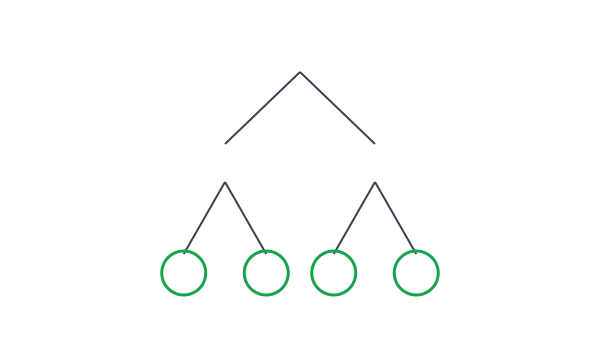
You can start with any pair of factors. If you split 60 into 4 and 15 instead, you still end with 2, 2, 3 and 5. Every whole number greater than 1 has only one prime factorization.
To write it in a short way, use exponents for repeated primes. Since 2 appears twice, 2 \times 2 = 2^2.
60 = 2 \times 2 \times 3 \times 5 = 2^2 \times 3 \times 5
Worked Examples
Example 1: A factor tree for 36
Find the prime factorization of 36.
36 = 4 \times 9
Step 1. Split 36 into two factors.
Step 2. Neither 4 nor 9 is prime, so split them both: 4 = 2 \times 2 and 9 = 3 \times 3.
36 = 2 \times 2 \times 3 \times 3 = 2^2 \times 3^2
Step 3. Every branch now ends in a prime.
Answer: 36 = 2^2 \times 3^2.
Example 2: Divide by small primes
Find the prime factorization of 84.
Step 1. 84 is even, so divide by 2: 84 ÷ 2 = 42.
Step 2. 42 is even, so divide by 2 again: 42 ÷ 2 = 21.
Step 3. 21 is odd. Its digits add to 3, so divide by 3: 21 ÷ 3 = 7. The number 7 is prime, so stop.
Answer: 84 = 2 \times 2 \times 3 \times 7 = 2^2 \times 3 \times 7.
Example 3: A larger number
Find the prime factorization of 150.
Step 1. 150 ends in 0, so split it as 10 \times 15.
150 = 2 \times 3 \times 5 \times 5 = 2 \times 3 \times 5^2
Step 2. Split each factor: 10 = 2 \times 5 and 15 = 3 \times 5.
Answer: 150 = 2 \times 3 \times 5^2. Check: 2 \times 3 \times 25 = 150.
Example 4: Is the number prime?
Is 91 a prime number?
Step 1. Try small primes. 91 is odd, so 2 doesn’t work. Its digits add to 10, so 3 doesn’t work. It doesn’t end in 0 or 5, so 5 doesn’t work.
Step 2. Try 7: 91 ÷ 7 = 13. It divides evenly.
Answer: No. 91 = 7 \times 13, so it is composite. You only need to test primes up to about the square root of the number. Since 10 \times 10 = 100, testing primes up to 7 is enough for 91.
Example 5: Word problem
A locker code is three different prime numbers. When you multiply them, you get 286. What are the three numbers?
286 \div 2 = 143
Step 1. 286 is even, so divide by 2.
Step 2. 143 is not divisible by 3, 5 or 7. Try 11.
143 \div 11 = 13
Step 3. Divide by 11.
286 = 2 \times 11 \times 13
Step 4. 13 is prime, so write the prime factorization.
Answer: The code uses 2, 11 and 13.
Common Mistakes
| Mistake | What it looks like | How to fix it |
|---|---|---|
| Stopping too soon | 60 = 2 \times 30 | 30 is not prime. Keep splitting until every factor is prime. |
| Calling 1 a prime | 12 = 1 \times 2 \times 2 \times 3 | 1 is not prime, so leave it out: 12 = 2^2 \times 3. |
| Thinking all odd numbers are prime | “9 is prime” | 9 = 3 \times 3, so 9 is composite. |
| Dropping a factor | 84 = 2 \times 3 \times 7 | Multiply your answer to check. 2 \times 3 \times 7 = 42, not 84. |
| Mixing up exponents and multiplying | 2^3 = 6 | 2^3 = 2 \times 2 \times 2 = 8. |
Another Method: The Division Ladder
Some students like the division ladder better than a tree. Divide by the smallest prime that works, write the answer below, and repeat until you reach a prime.
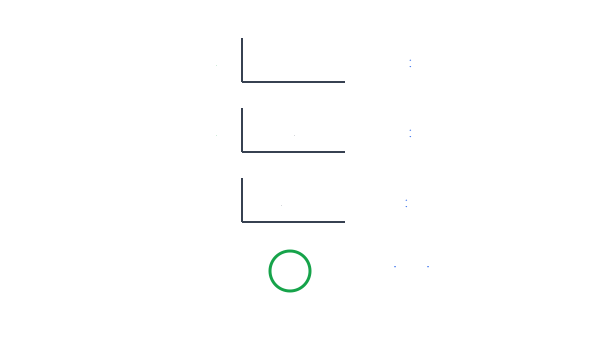
Both methods give the same answer. Prime factorization helps you find the greatest common factor and least common multiple, which come next. It also helps you simplify fractions.
Practice Problems
For problems 1–7, write the prime factorization. Use exponents for repeated primes.
- 18
- 50
- 64
- 90
- 126
- 231
- 200
- Is 57 a prime number? Explain.
- Write 2 \times 2 \times 3 \times 3 \times 3 with exponents. What number is it?
- A garden has 91 tulips planted in equal rows. There is more than one row, and more than one tulip in each row. How many rows could there be?
Show answers
1.
18 = 2 \times 9
Divide by 2.
2 \times 9 = 2 \times 3^2
Write 9 as 3 squared.
2.
50 = 2 \times 25
Divide by 2.
2 \times 25 = 2 \times 5^2
Write 25 as 5 squared.
3.
64 = 2 \times 2 \times 2 \times 2 \times 2 \times 2
Keep dividing by 2.
2 \times 2 \times 2 \times 2 \times 2 \times 2 = 2^6
Write the six 2s with an exponent.
4.
90 = 9 \times 10
Split 90 into 9 and 10.
9 \times 10 = 2 \times 3^2 \times 5
Write each factor with primes.
5.
126 = 2 \times 63
Divide by 2.
2 \times 63 = 2 \times 3^2 \times 7
63 is 9 times 7, and 9 is 3 squared.
6.
231 \div 3 = 77
231 is odd, and its digits add to 6, so divide by 3.
77 = 7 \times 11
Factor 77.
231 = 3 \times 7 \times 11
Write the prime factorization.
7.
200 = 2 \times 100
Divide by 2.
2 \times 100 = 2^3 \times 5^2
100 is 2 squared times 5 squared, so combine the 2s.
8.
No. Its digits add to 12, so 3 divides it.
57 = 3 \times 19
Divide by 3.
9.
2^2 \times 3^3
There are two 2s and three 3s. Write them with exponents.
4 \times 27 = 108
Evaluate the powers and multiply.
10.
91 = 7 \times 13
Factor 91.
There could be 7 rows of 13 tulips or 13 rows of 7 tulips.
Want more practice? The Pre-Algebra Unit 2 Practice Pack has 58 pages of problems on this and the other lessons in the unit, with step-by-step answers and a cheat sheet.
Prime Factorization FAQ
Is 1 a prime number?
No. A prime number has exactly two factors, but 1 has only one factor. So 1 is neither prime nor composite.
Is 2 the only even prime number?
Yes. Every other even number can be divided by 2, so it has at least three factors.
What is the prime factorization of 100?
100 = 2 \times 2 \times 5 \times 5 = 2^2 \times 5^2.
Does it matter which factors you start with?
No. Any factor tree for a number ends with the same primes. Only the order of the steps changes.
Summary
- A prime number has exactly two factors: 1 and itself.
- Prime factorization writes a number as a product of primes.
- Use a factor tree or a division ladder, and stop when every factor is prime.
- Use exponents for repeated primes, like 2^2 \times 3 \times 5.
- Multiply your answer to check it.
Previous lesson: Coordinate Plane
Next lesson: Greatest Common Factor
Back to the Pre-Algebra Index