
Standard Matrix of a Linear Transformation
The standard matrix of a linear transformation T: ℝⁿ → ℝᵐ is the m × n matrix A = [T(e₁) ⋯ T(eₙ)], whose columns are the images of the standard basis vectors e₁, …, eₙ. It is the one matrix with T(x) = Ax for every x, so you find it by applying T to each eᵢ.
Before this lesson: Linear Transformations and Matrix Equation Ax = b
Why every linear transformation is a matrix
The standard basis vectors of ℝⁿ are e₁ = (1, 0, …, 0), e₂ = (0, 1, 0, …, 0), through eₙ = (0, …, 0, 1). Every vector x = (x₁, …, xₙ) is a linear combination of them: x = x₁e₁ + ⋯ + xₙeₙ.
A linear transformation keeps linear combinations, so T(x) = x₁T(e₁) + ⋯ + xₙT(eₙ). That combination of columns is exactly the matrix-vector product Ax with A = [T(e₁) ⋯ T(eₙ)]. Knowing where T sends the n standard basis vectors tells you where it sends every vector.
A = \begin{bmatrix} T(\mathbf{e}_1) & T(\mathbf{e}_2) & \cdots & T(\mathbf{e}_n) \end{bmatrix}, \qquad T(\mathbf{x}) = A\mathbf{x}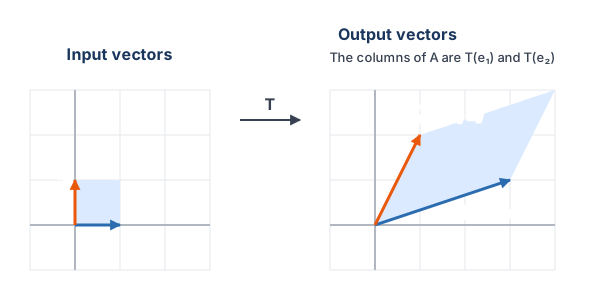
How to find the standard matrix
- Check the sizes. T: ℝⁿ → ℝᵐ has an m × n standard matrix: one column for each input variable, one row for each output entry.
- Compute T(e₁), T(e₂), …, T(eₙ). With a formula, substitute each eᵢ; with a geometric description, find where each eᵢ lands.
- Write those vectors as the columns of A, in order.
- Check with one test vector: Ax should equal T(x).
If you only know T on other vectors, first write each eᵢ as a combination of those vectors, then use linearity, as in Example 4.
Standard matrix examples
Example 1: From a formula
Find the standard matrix of T(x₁, x₂) = (2x₁ − 3x₂, x₁ + 4x₂, −x₂).
T: \mathbb{R}^2 \to \mathbb{R}^3Two inputs and three outputs, so A is 3 × 2.
T(\mathbf{e}_1) = T(1, 0) = (2, 1, 0)Substitute x₁ = 1, x₂ = 0: 2 − 0 = 2, 1 + 0 = 1 and −0 = 0.
T(\mathbf{e}_2) = T(0, 1) = (-3, 4, -1)Substitute x₁ = 0, x₂ = 1: 0 − 3 = −3, 0 + 4 = 4 and −1.
A = \begin{bmatrix} 2 & -3 \\ 1 & 4 \\ 0 & -1 \end{bmatrix}Use T(e₁) and T(e₂) as the columns.
A\begin{bmatrix} 1 \\ 1 \end{bmatrix} = \begin{bmatrix} 2 - 3 \\ 1 + 4 \\ 0 - 1 \end{bmatrix} = \begin{bmatrix} -1 \\ 5 \\ -1 \end{bmatrix}Check with x = (1, 1) (see the matrix equation Ax = b for the product).
T(1, 1) = (2 - 3,\; 1 + 4,\; -1) = (-1, 5, -1)
The formula gives the same vector.
Answer: A has rows [2 −3], [1 4] and [0 −1]. Each row holds the coefficients of one output entry.
Example 2: From the images of e₁ and e₂
T: ℝ² → ℝ² is linear with T(e₁) = (4, −1) and T(e₂) = (2, 3). Find the standard matrix and T(5, −2).
A = \begin{bmatrix} 4 & 2 \\ -1 & 3 \end{bmatrix}The given images are the columns.
T(5, -2) = 5\begin{bmatrix} 4 \\ -1 \end{bmatrix} - 2\begin{bmatrix} 2 \\ 3 \end{bmatrix}Ax is a combination of the columns with weights 5 and −2.
= \begin{bmatrix} 20 \\ -5 \end{bmatrix} - \begin{bmatrix} 4 \\ 6 \end{bmatrix}Multiply each column by its weight.
= \begin{bmatrix} 16 \\ -11 \end{bmatrix}Subtract: 20 − 4 = 16 and −5 − 6 = −11.
Answer: A has rows [4 2] and [−1 3], and T(5, −2) = (16, −11).
Example 3: A shear described in words
A horizontal shear T: ℝ² → ℝ² leaves e₁ fixed and moves e₂ = (0, 1) to (3, 1). Find its standard matrix and the image of (2, 1).
T(\mathbf{e}_1) = (1, 0)e₁ stays where it is.
T(\mathbf{e}_2) = (3, 1)Given.
A = \begin{bmatrix} 1 & 3 \\ 0 & 1 \end{bmatrix}Use the images as columns.
A\begin{bmatrix} 2 \\ 1 \end{bmatrix} = \begin{bmatrix} 1 \cdot 2 + 3 \cdot 1 \\ 0 \cdot 2 + 1 \cdot 1 \end{bmatrix} = \begin{bmatrix} 5 \\ 1 \end{bmatrix}Multiply A by (2, 1).
Answer: A has rows [1 3] and [0 1]. The point (2, 1) moves to (5, 1): it slides right by 3 times its height.
Example 4: From the images of other vectors
T: ℝ² → ℝ² is linear with T(1, 1) = (3, 5) and T(1, −1) = (1, −1). Find the standard matrix.
\mathbf{e}_1 = \tfrac{1}{2}(1, 1) + \tfrac{1}{2}(1, -1)Write e₁ as a combination: ½ + ½ = 1 and ½ − ½ = 0.
\mathbf{e}_2 = \tfrac{1}{2}(1, 1) - \tfrac{1}{2}(1, -1)Write e₂ the same way: ½ − ½ = 0 and ½ + ½ = 1.
T(\mathbf{e}_1) = \tfrac{1}{2}(3, 5) + \tfrac{1}{2}(1, -1)Apply T and use linearity.
T(\mathbf{e}_1) = \tfrac{1}{2}(4, 4) = (2, 2)Add the vectors, then halve.
T(\mathbf{e}_2) = \tfrac{1}{2}(3, 5) - \tfrac{1}{2}(1, -1)Apply T and use linearity.
T(\mathbf{e}_2) = \tfrac{1}{2}(2, 6) = (1, 3)Subtract the vectors, then halve.
A = \begin{bmatrix} 2 & 1 \\ 2 & 3 \end{bmatrix}Use T(e₁) and T(e₂) as the columns.
A\begin{bmatrix} 1 \\ 1 \end{bmatrix} = \begin{bmatrix} 3 \\ 5 \end{bmatrix},\; A\begin{bmatrix} 1 \\ -1 \end{bmatrix} = \begin{bmatrix} 1 \\ -1 \end{bmatrix}Check: 2 + 1 = 3, 2 + 3 = 5, 2 − 1 = 1 and 2 − 3 = −1.
Answer: A has rows [2 1] and [2 3]. Writing (3, 5) and (1, −1) as the columns would be wrong, because (1, 1) and (1, −1) are not e₁ and e₂.
Example 5: Cost and weight of an order
An online shop sells shirts ($8, 200 g), hoodies ($20, 600 g) and hats ($6, 100 g). For an order of x₁ shirts, x₂ hoodies and x₃ hats, T(x₁, x₂, x₃) = (total cost, total weight in grams). Find the standard matrix and the cost and weight of an order of 10 shirts, 4 hoodies and 5 hats.
T(\mathbf{e}_1) = (8, 200),\; T(\mathbf{e}_2) = (20, 600),\; T(\mathbf{e}_3) = (6, 100)e₁ is an order of one shirt, e₂ one hoodie and e₃ one hat.
A = \begin{bmatrix} 8 & 20 & 6 \\ 200 & 600 & 100 \end{bmatrix}Use the three images as columns; A is 2 × 3.
A\begin{bmatrix} 10 \\ 4 \\ 5 \end{bmatrix} = \begin{bmatrix} 8 \cdot 10 + 20 \cdot 4 + 6 \cdot 5 \\ 200 \cdot 10 + 600 \cdot 4 + 100 \cdot 5 \end{bmatrix}Multiply A by the order vector.
= \begin{bmatrix} 80 + 80 + 30 \\ 2000 + 2400 + 500 \end{bmatrix}Multiply each pair.
= \begin{bmatrix} 190 \\ 4900 \end{bmatrix}Add.
Answer: the order costs $190 and weighs 4900 g (4.9 kg). Each column of A is the price and weight of one item.
Common mistakes
| Mistake | Example of the error | Fix |
|---|---|---|
| Putting T(eᵢ) in rows | Writing rows (2, 1, 0) and (−3, 4, −1) in Example 1 | T(eᵢ) is column i. Rows hold the coefficients of each output entry. |
| Getting the size backward | Calling the matrix of T: ℝ² → ℝ³ a 2 × 3 matrix | T: ℝⁿ → ℝᵐ gives an m × n matrix: m outputs, n inputs. |
| Using images of other vectors as columns | In Example 4, writing A with columns (3, 5) and (1, −1) | Columns must be T(e₁), …, T(eₙ). Rewrite each eᵢ in terms of the given vectors first. |
| Dropping a missing variable | For T(x₁, x₂, x₃) = (x₁ − 2x₃, 4x₂), writing row 1 as [1 −2] | Every row has n entries; x₂ is missing from row 1, so its entry is 0: [1 0 −2]. |
| Finding a matrix for a nonlinear map | Writing a 2 × 2 matrix for T(x₁, x₂) = (x₁ + 4, x₂) | Only linear maps have a standard matrix; check T(0) = 0 first. |
Related ideas
Rotations and reflections. The rotation and reflection matrices in matrix transformations are standard matrices: each column is the image of e₁ or e₂. The same column rule works for any linear map from ℝⁿ to ℝᵐ, not only maps of the plane.
What the matrix tells you. The columns of A show the range of T: every output T(x) = Ax is a combination of the columns. The next lesson, One-to-One and Onto Transformations, uses the pivots of A to decide whether T reaches every vector in ℝᵐ and whether different inputs can share an output.
Practice problems
- Find the standard matrix of T(x₁, x₂) = (x₁ + x₂, 3x₁ − x₂).
- Find the standard matrix of T(x₁, x₂, x₃) = (x₁ − 2x₃, 4x₂).
- Find the standard matrix of the dilation T(x) = 5x on ℝ².
- T: ℝ² → ℝ² is linear with T(e₁) = (1, −2) and T(e₂) = (3, 0). Find A and T(2, 1).
- Find the standard matrix of the reflection of ℝ² across the x₁-axis.
- Find the standard matrix of the projection T(x₁, x₂, x₃) = (x₁, x₂, 0) of ℝ³ onto the x₁x₂-plane, then find T(4, −1, 7).
- T is linear with T(e₁) = (2, 0, 1) and T(e₂) = (−1, 3, 5). Give the domain and codomain, then find T(−1, 2).
- T: ℝ² → ℝ² is linear with T(1, 0) = (3, 1) and T(1, 1) = (5, 4). Find the standard matrix.
- Find the standard matrix of T(x₁, x₂) = (x₂, x₁) and the image of (−3, 8). What does T do geometrically?
- A cup of strawberries has 50 calories and 7 g of sugar; a cup of yogurt has 150 calories and 17 g of sugar. T(x₁, x₂) = (calories, sugar) for x₁ cups of strawberries and x₂ cups of yogurt. Find the standard matrix and the totals for a smoothie with 2 cups of strawberries and 1 cup of yogurt.
Show answers
1.
T(\mathbf{e}_1) = (1 + 0,\; 3 - 0) = (1, 3)Substitute e₁ = (1, 0).
T(\mathbf{e}_2) = (0 + 1,\; 0 - 1) = (1, -1)Substitute e₂ = (0, 1).
Answer: A has rows [1 1] and [3 −1] (columns (1, 3) and (1, −1)).
2.
T(\mathbf{e}_1) = (1, 0),\; T(\mathbf{e}_2) = (0, 4),\; T(\mathbf{e}_3) = (-2, 0)Substitute each standard basis vector of ℝ³.
A = \begin{bmatrix} 1 & 0 & -2 \\ 0 & 4 & 0 \end{bmatrix}Use the images as columns; A is 2 × 3.
Answer: A has rows [1 0 −2] and [0 4 0].
3.
T(\mathbf{e}_1) = 5(1, 0) = (5, 0),\; T(\mathbf{e}_2) = 5(0, 1) = (0, 5)Scale each basis vector by 5.
Answer: A has rows [5 0] and [0 5], which is 5I.
4.
A = \begin{bmatrix} 1 & 3 \\ -2 & 0 \end{bmatrix}The given images are the columns.
A\begin{bmatrix} 2 \\ 1 \end{bmatrix} = \begin{bmatrix} 2 + 3 \\ -4 + 0 \end{bmatrix} = \begin{bmatrix} 5 \\ -4 \end{bmatrix}Multiply: 2(1) + 1(3) = 5 and 2(−2) + 1(0) = −4.
Answer: A has rows [1 3] and [−2 0], and T(2, 1) = (5, −4).
5.
T(\mathbf{e}_1) = (1, 0),\; T(\mathbf{e}_2) = (0, -1)Reflecting across the x₁-axis leaves e₁ alone and flips e₂.
Answer: A has rows [1 0] and [0 −1].
6.
T(\mathbf{e}_1) = (1, 0, 0),\; T(\mathbf{e}_2) = (0, 1, 0),\; T(\mathbf{e}_3) = (0, 0, 0)Substitute each basis vector.
T(4, -1, 7) = (4, -1, 0)
Apply the formula, or multiply A by (4, −1, 7).
Answer: A has rows [1 0 0], [0 1 0] and [0 0 0], and T(4, −1, 7) = (4, −1, 0).
7.
A = \begin{bmatrix} 2 & -1 \\ 0 & 3 \\ 1 & 5 \end{bmatrix}Two columns with three entries each, so T: ℝ² → ℝ³.
T(-1, 2) = -1\begin{bmatrix} 2 \\ 0 \\ 1 \end{bmatrix} + 2\begin{bmatrix} -1 \\ 3 \\ 5 \end{bmatrix} = \begin{bmatrix} -2 - 2 \\ 0 + 6 \\ -1 + 10 \end{bmatrix}Combine the columns with weights −1 and 2.
T(-1, 2) = (-4, 6, 9)
Simplify each entry.
Answer: domain ℝ², codomain ℝ³, and T(−1, 2) = (−4, 6, 9).
8.
\mathbf{e}_2 = (1, 1) - (1, 0)Write e₂ in terms of the given vectors.
T(\mathbf{e}_2) = (5, 4) - (3, 1) = (2, 3)Apply T and use linearity.
Answer: T(e₁) = (3, 1), so A has columns (3, 1) and (2, 3): rows [3 2] and [1 3].
9.
T(\mathbf{e}_1) = (0, 1),\; T(\mathbf{e}_2) = (1, 0)Substitute e₁ and e₂.
T(-3, 8) = (8, -3)
Swap the entries.
Answer: A has rows [0 1] and [1 0]; T(−3, 8) = (8, −3). T reflects the plane across the line x₂ = x₁.
10.
A = \begin{bmatrix} 50 & 150 \\ 7 & 17 \end{bmatrix}Column 1 is one cup of strawberries; column 2 is one cup of yogurt.
A\begin{bmatrix} 2 \\ 1 \end{bmatrix} = \begin{bmatrix} 100 + 150 \\ 14 + 17 \end{bmatrix} = \begin{bmatrix} 250 \\ 31 \end{bmatrix}Multiply: 50(2) + 150(1) and 7(2) + 17(1).
Answer: the smoothie has 250 calories and 31 g of sugar.
Standard matrix FAQ
What is the standard matrix of a linear transformation?
It is the matrix A with T(x) = Ax for every x. Its columns are T(e₁), T(e₂), …, T(eₙ).
How do you find the standard matrix?
Apply T to each standard basis vector e₁, …, eₙ and write the results as the columns of A, in order. Check the result with one test vector.
What size is the standard matrix?
For T: ℝⁿ → ℝᵐ, the standard matrix is m × n: n columns, one for each input entry, and m rows, one for each output entry.
Is the standard matrix unique?
Yes. If Ax = Bx for every x, then Aeᵢ = Beᵢ, so every column of A equals the matching column of B.
Summary
- The standard matrix of T: ℝⁿ → ℝᵐ is A = [T(e₁) ⋯ T(eₙ)], an m × n matrix.
- T(x) = Ax for every x, because x = x₁e₁ + ⋯ + xₙeₙ and T keeps linear combinations.
- From a formula, each row of A holds the coefficients of one output entry; missing variables get 0.
- From a geometric description, find where each eᵢ lands.
- If T is known only on other vectors, write each eᵢ in terms of them first.
Previous lesson: Linear Transformations
Next lesson: One-to-One and Onto Transformations
Back to the Linear Algebra Index