
Area of Trapezoids
The area of a trapezoid is half the sum of its two parallel sides times its height: A = \frac{1}{2}(b_1 + b_2)h. The parallel sides, b_1 and b_2, are called the bases. The height is the straight distance between them. For example, bases of 6 and 10 with a height of 4 give an area of 32.
Before this lesson: You should know the area of a triangle and the area of a parallelogram. You will also use the order of operations.
What a Trapezoid Is
A trapezoid is a four-sided shape with exactly one pair of parallel sides. The two parallel sides are the bases. They usually have different lengths. The other two sides are called legs.
The height is the distance straight across from one base to the other. It makes a right angle with both bases. A slanted leg is not the height.
Why the Trapezoid Formula Works
Make a copy of the trapezoid and turn it upside down. Fit the two copies together. They make a parallelogram.
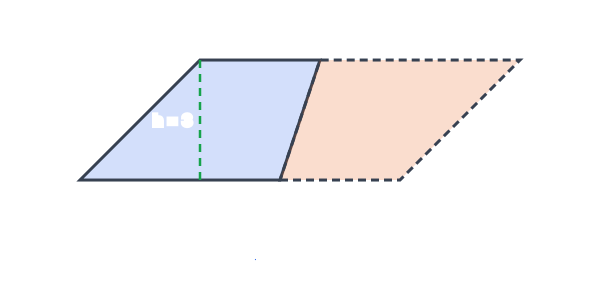
The parallelogram’s base is b_1 + b_2, and its height is h. So its area is (b_1 + b_2)h. One trapezoid is half of it.
The Area of a Trapezoid Formula
A = \frac{1}{2}(b_1 + b_2)h- Add the two bases.
- Multiply by the height.
- Take half.
You can also think of it as the average of the two bases times the height. The average of 6 and 10 is 8, and 8 \times 4 = 32.
Worked Examples
Example 1: Use the formula
A trapezoid has bases of 6 cm and 10 cm and a height of 4 cm. Find its area.
Step 1. Add the bases: 6 + 10 = 16.
Step 2. Multiply by the height: 16 \times 4 = 64.
Step 3. Take half: 64 \div 2 = 32.
Answer: The area is 32 cm².
Example 2: Decimal bases
A trapezoid has bases of 3.5 m and 6.5 m and a height of 5 m. Find its area.
Step 1. Add the bases: 3.5 + 6.5 = 10.
Step 2. Multiply and halve: \frac{1}{2} \times 10 \times 5 = 25.
Answer: The area is 25 m².
Example 3: Ignore the slanted side
A trapezoid has bases of 8 in and 12 in, a height of 5 in and a slanted leg of 6.4 in. Find its area.
Step 1. Only the bases and the height go in the formula. The 6.4 in leg is not used.
Step 2. A = \frac{1}{2}(8 + 12) \times 5 = \frac{1}{2} \times 20 \times 5 = 50.
Answer: The area is 50 in².
Example 4: Find a missing height
A trapezoid has an area of 63 ft² and bases of 5 ft and 9 ft. Find its height.
Step 1. Write the formula with what you know: 63 = \frac{1}{2}(5 + 9)h.
Step 2. Add the bases: 63 = \frac{1}{2} \times 14 \times h = 7h.
Step 3. Divide by 7: h = 9.
Answer: The height is 9 ft.
Example 5: Word problem with a deck
A deck is shaped like a trapezoid. Its parallel sides are 14 ft and 20 ft long, and they are 9 ft apart. One gallon of stain covers 50 ft². How many gallons do you need?
Step 1. Find the area: \frac{1}{2}(14 + 20) \times 9 = \frac{1}{2} \times 34 \times 9 = 153 ft².
Step 2. Divide by the coverage: 153 \div 50 = 3.06.
Step 3. 3 gallons isn’t quite enough, so round up.
Answer: You need 4 gallons of stain.
Common Mistakes with the Area of a Trapezoid
| Mistake | Example of the error | Fix |
|---|---|---|
| Forgetting the one-half | (6 + 10) \times 4 = 64 | That is two trapezoids. Take half: 64 \div 2 = 32. |
| Using a slanted leg as the height | \frac{1}{2}(8 + 12) \times 6.4 = 64 | Use the height, which makes a right angle with the bases: \frac{1}{2}(20) \times 5 = 50. |
| Multiplying only one base | \frac{1}{2} \times 10 \times 4 = 20 | Add both bases first: \frac{1}{2}(6 + 10) \times 4 = 32. |
| Skipping the parentheses | \frac{1}{2} \times 6 + 10 \times 4 = 43 | Add the bases before you multiply: \frac{1}{2}(6 + 10) \times 4. |
| Leaving off square units | Writing the area as 32 cm | Area uses square units: 32 cm². |
Trapezoids and Other Shapes
The trapezoid formula works for other shapes too. If both bases are the same length, the shape is a parallelogram. Then \frac{1}{2}(b + b)h = bh, the parallelogram formula.
If one base shrinks to 0, the shape becomes a triangle. Then \frac{1}{2}(b + 0)h = \frac{1}{2}bh, the triangle formula.
Practice Problems
- Find the area of a trapezoid with bases 4 m and 8 m and height 3 m.
- Find the area of a trapezoid with bases 7 in and 11 in and height 6 in.
- Find the area of a trapezoid with bases 2.5 cm and 4.5 cm and height 4 cm.
- Find the area of a trapezoid with bases 10 ft and 16 ft and height 7 ft.
- A trapezoid has bases of \frac{1}{2} ft and \frac{3}{2} ft and a height of 1 ft. Find its area.
- A trapezoid has an area of 40 m² and bases of 6 m and 10 m. Find its height.
- A trapezoid has an area of 45 in², a height of 5 in and one base of 7 in. Find the other base.
- A trapezoid has bases of 9 cm and 15 cm, a height of 8 cm and slanted legs of 10 cm. Find its area.
- Use the trapezoid formula when both bases are 6 and the height is 4. What shape is it, and does the answer match?
- A lot has parallel sides of 30 m and 50 m that are 20 m apart. Sod costs $4 per square meter. How much will it cost to cover the lot?
Show answers
- \frac{1}{2}(4 + 8) \times 3 = \frac{1}{2} \times 12 \times 3 = 18 m²
- \frac{1}{2}(7 + 11) \times 6 = \frac{1}{2} \times 18 \times 6 = 54 in²
- \frac{1}{2}(2.5 + 4.5) \times 4 = \frac{1}{2} \times 7 \times 4 = 14 cm²
- \frac{1}{2}(10 + 16) \times 7 = 13 \times 7 = 91 ft²
- \frac{1}{2}\left(\frac{1}{2} + \frac{3}{2}\right) \times 1 = \frac{1}{2} \times 2 \times 1 = 1 ft²
- 40 = \frac{1}{2} \times 16 \times h = 8h, so h = 5 m.
- 45 = \frac{1}{2}(7 + b) \times 5. Double: 90 = 5(7 + b), so 7 + b = 18 and b = 11 in.
- Ignore the legs: \frac{1}{2}(9 + 15) \times 8 = 12 \times 8 = 96 cm²
- \frac{1}{2}(6 + 6) \times 4 = 24. It is a parallelogram, and 6 \times 4 = 24 matches.
- \frac{1}{2}(30 + 50) \times 20 = 800 m², and 800 \times 4 = 3{,}200. It costs $3,200.
Area of a Trapezoid FAQ
What is the formula for the area of a trapezoid?
The formula is A = \frac{1}{2}(b_1 + b_2)h. Add the two parallel sides, multiply by the height, and take half.
What are the bases of a trapezoid?
The bases are the two parallel sides. They can be on the top and bottom or on the left and right, depending on how the trapezoid is turned.
Do you use the slanted sides to find the area?
No. The slanted sides, called legs, are only used for perimeter. For area, use the two bases and the height.
Summary
- A trapezoid has exactly one pair of parallel sides, called the bases.
- Area: A = \frac{1}{2}(b_1 + b_2)h.
- Add the bases first, then multiply by the height, then take half.
- The height makes a right angle with the bases. Don’t use the slanted legs.
- Two copies of a trapezoid make a parallelogram, which is why the formula works.
Previous lesson: Area of Triangles
Next lesson: Circumference and Area of Circles
Back to the Pre-Algebra (Math Basics) Index