
Area of Rectangles and Parallelograms
The area of a rectangle is its length times its width, A = l \times w. The area of a parallelogram is its base times its height, A = b \times h. Area measures the space inside a flat shape. It is counted in square units, like square feet (ft²) or square meters (m²).
Before this lesson: You should know perimeter and how to multiply decimals and fractions.
Extra practice: The Pre-Algebra Unit 6 Practice Pack has printable problems, answer keys and a cheat sheet for this unit.
What Area Means
Picture covering a floor with square tiles that are 1 foot on each side. The number of tiles you need is the area of the floor in square feet.
A rectangle 5 tiles long and 3 tiles wide holds 3 rows of 5 tiles. That is 3 \times 5 = 15 tiles. So you can multiply instead of counting.
Area Formulas for Rectangles, Squares and Parallelograms
| Shape | Formula | What the letters mean |
|---|---|---|
| Rectangle | A = l \times w | length times width |
| Square | A = s^2 | side times side |
| Parallelogram | A = b \times h | base times height |
A parallelogram is a four-sided shape whose opposite sides are parallel, like a slanted rectangle. Its height is the straight-up distance from the base to the top. The height makes a right angle with the base. It is not the slanted side.
Why the Parallelogram Formula Works
Cut a triangle off one end of the parallelogram and slide it to the other end. Now you have a rectangle. Its width is the same base, and its height is the same height.
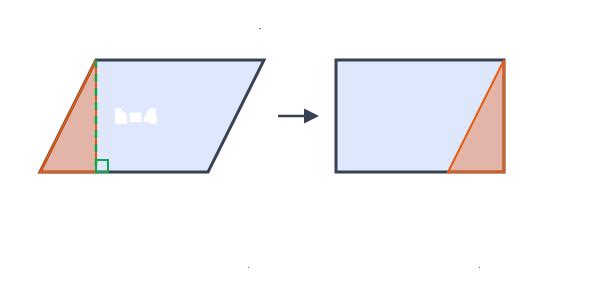
Nothing was added or lost, so the area didn’t change. That is why a parallelogram uses A = b \times h, just like a rectangle.
Worked Examples
Example 1: Area of a rectangle
A rug is 9 feet long and 6 feet wide. Find its area.
A = l \times w
Step 1. Write the formula.
A = 9 \times 6 = 54
Step 2. Substitute and multiply.
Answer: The area is 54 ft².
Example 2: Area of a square
A square tile has sides of 7 cm. Find its area.
A = 7^2 = 7 \times 7 = 49
Step 1. Use A = s^2.
Answer: The area is 49 cm².
Example 3: Area of a parallelogram
A parallelogram has a base of 12 m, a height of 5 m and a slanted side of 6.5 m. Find its area.
Step 1. Pick the base and the height. The slanted side, 6.5 m, is not the height, so you don’t use it.
A = b \times h = 12 \times 5 = 60
Step 2. Multiply.
Answer: The area is 60 m².
Example 4: Find a missing side
A rectangle has an area of 84 in² and a length of 12 in. Find its width.
84 = 12 \times w
Step 1. Write the formula with what you know.
w = 84 \div 12 = 7
Step 2. Divide both sides by 12.
Answer: The width is 7 in.
Example 5: Word problem with painting a wall
A wall is 12 feet wide and 8 feet tall. It has a window that is 3 feet wide and 4 feet tall. One can of paint covers 40 ft². How many cans do you need?
12 \times 8 = 96
Step 1. Find the wall’s area (ft²).
96 - 3 \times 4 = 96 - 12 = 84
Step 2. Subtract the window. The area is in square feet.
84 \div 40 = 2.1
Step 3. Divide by the coverage (cans).
Step 4. You can’t buy part of a can, and 2 cans aren’t enough. Round up.
Answer: You need 3 cans of paint.
Common Mistakes with Area
| Mistake | Example of the error | Fix |
|---|---|---|
| Using the slanted side as the height | Parallelogram area 12 \times 6.5 = 78 m² | Use the height, which makes a right angle with the base: 12 \times 5 = 60 m². |
| Adding instead of multiplying | A 9 by 6 rug has area 9 + 6 = 15 | Adding is for perimeter. Area multiplies: 9 \times 6 = 54 ft². |
| Squaring as doubling | A square with side 7 has area 7 \times 2 = 14 | 7^2 = 7 \times 7 = 49. |
| Mixing units | A 2 ft by 9 in rectangle: 2 \times 9 = 18 | Use one unit: 2 ft = 24 in, so 24 \times 9 = 216 in². |
| Leaving off square units | Writing the area as 54 ft | Area uses square units: 54 ft². |
Square Units and Converting Them
One square foot is 12 inches by 12 inches, so 1 \text{ ft}^2 = 12 \times 12 = 144 \text{ in}^2. In the same way, 1 \text{ yd}^2 = 3 \times 3 = 9 \text{ ft}^2.
This is why you can’t just multiply by 12 to turn square feet into square inches. You multiply by 12 twice, once for each direction.
Practice Problems
- Find the area of a rectangle that is 8 m by 5 m.
- Find the area of a rectangle that is 10.5 in by 4 in.
- Find the area of a square with sides of 12 ft.
- A parallelogram has a base of 9 cm and a height of 4 cm. Find its area.
- A parallelogram has a base of 15 cm, a height of 7 cm and slanted sides of 8 cm. Find its area.
- A rectangle has an area of 72 m² and a width of 6 m. Find its length.
- A parallelogram has an area of 56 in² and a base of 8 in. Find its height.
- A rectangle is 2 feet long and 9 inches wide. Find its area in square inches.
- A square has an area of 81 cm². How long is each side?
- A floor is 14 ft by 11 ft. Tile costs $3 per square foot. How much will the tile cost?
Show answers
1.
8 \times 5 = 40
Multiply. The area is in square meters.
2.
10.5 \times 4 = 42
Multiply. The area is in square inches.
3.
12^2 = 144
Square the side. The area is in square feet.
4.
9 \times 4 = 36
Multiply. The area is in square centimeters.
5.
15 \times 7 = 105
Use the height, not the slanted side (cm²).
6.
72 \div 6 = 12
Divide the area by the base. The height is in meters.
7.
56 \div 8 = 7
Divide the area by the base. The height is in inches.
8.
2 ft = 24 in, so 24 \times 9 = 216 in²
9.
9 \times 9 = 81, so each side is 9 cm. (This is the square root of 81.)
10.
14 \times 11 = 154 ft², and 154 \times 3 = 462. The tile costs $462.
Want more practice? The Pre-Algebra Unit 6 Practice Pack has 43 pages of problems on this and the other lessons in the unit, with step-by-step answers and a cheat sheet.
Area of Rectangles and Parallelograms FAQ
What is the formula for the area of a rectangle?
The area of a rectangle is A = l \times w, length times width. The answer is in square units.
How do you find the area of a parallelogram?
Multiply the base by the height: A = b \times h. The height is the straight-up distance between the base and the opposite side, not the slanted side.
Is a square a rectangle?
Yes. A square is a rectangle with four equal sides, so its area is side times side, s^2.
What is the difference between area and perimeter?
Area is the space inside a shape, measured in square units. Perimeter is the distance around it, measured in regular length units.
Summary
- Area is the number of unit squares that cover a shape.
- Rectangle: A = l \times w. Square: A = s^2.
- Parallelogram: A = b \times h, using the height, not the slanted side.
- Use the same unit for both lengths, and give the answer in square units.
- 1 \text{ ft}^2 = 144 \text{ in}^2 and 1 \text{ yd}^2 = 9 \text{ ft}^2.
Previous lesson: Perimeter
Next lesson: Area of Triangles
Back to the Pre-Algebra Index