
Multiplying and Dividing Fractions
Multiplying and dividing fractions is often easier than adding them. To multiply, multiply the numerators and multiply the denominators. To divide, flip the second fraction and multiply. For example, \frac{2}{3} \times \frac{3}{4} = \frac{6}{12} = \frac{1}{2} and \frac{1}{2} \div \frac{1}{4} = \frac{1}{2} \times \frac{4}{1} = 2. When you are done, simplify the answer if the top and bottom share a factor.
Before this lesson: You should know how to simplify fractions and how to multiply and divide integers.
Extra practice: The Pre-Algebra Unit 2 Practice Pack has printable problems, answer keys and a cheat sheet for this unit.
What Multiplying Fractions Means
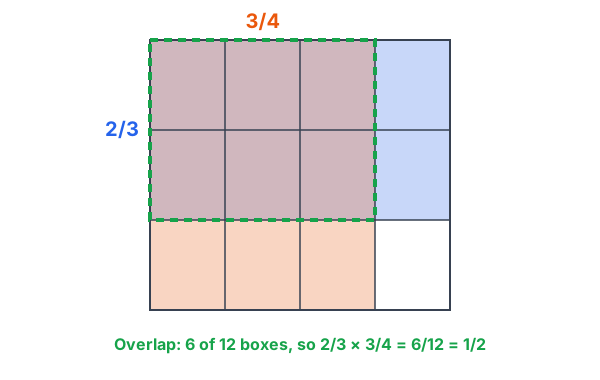
Multiplying by a fraction means taking part of something. So \frac{2}{3} \times \frac{3}{4} means “two thirds of three fourths.”
In the picture, the orange columns show \frac{3}{4} of the square. The blue rows show \frac{2}{3}. The overlap is 6 of the 12 boxes, which is \frac{1}{2} of the square.
What Dividing Fractions Means
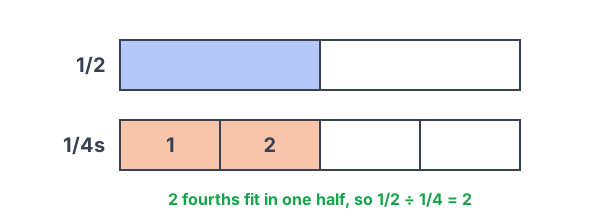
Dividing asks, “How many of these fit into that?” So \frac{1}{2} \div \frac{1}{4} asks how many fourths fit into one half. The answer is 2.
Rules for Multiplying and Dividing Fractions
Multiplying
Multiply straight across: tops times tops, and bottoms times bottoms. You don’t need a common denominator.
\frac{a}{b} \times \frac{c}{d} = \frac{a \times c}{b \times d}Dividing
The reciprocal of a fraction is the fraction flipped upside down. The reciprocal of \frac{2}{5} is \frac{5}{2}. To divide, multiply by the reciprocal of the second fraction.
\frac{a}{b} \div \frac{c}{d} = \frac{a}{b} \times \frac{d}{c}Many students remember this as keep, change, flip: keep the first fraction, change ÷ to ×, and flip the second fraction. Here a, b, c and d are whole numbers, and none of the bottom numbers is 0.
Simplify before you multiply
If a top number and a bottom number share a factor, you can divide them both by it before you multiply. This keeps the numbers small. It works even when the two numbers are in different fractions.
Worked Examples
Example 1: Multiply two fractions
Find \frac{2}{5} \times \frac{3}{7}.
Step 1. Multiply the numerators: 2 × 3 = 6.
Step 2. Multiply the denominators: 5 × 7 = 35.
Answer: \frac{2}{5} \times \frac{3}{7} = \frac{6}{35}. It is already in simplest form.
Example 2: Simplify first
Find \frac{4}{9} \times \frac{3}{8}.
Step 1. The 4 on top and the 8 on the bottom share 4. Divide both by 4 to get 1 and 2.
\frac{4}{9} \times \frac{3}{8} = \frac{1}{3} \times \frac{1}{2} = \frac{1}{6}Step 2. The 3 on top and the 9 on the bottom share 3. Divide both by 3 to get 1 and 3.
Answer: \frac{1}{6}. If you multiply first, you get \frac{12}{72}, which also simplifies to \frac{1}{6}.
Example 3: A whole number times a fraction
Find 6 \times \frac{2}{3}.
6 = \frac{6}{1}Step 1. Write the whole number as a fraction.
\frac{6}{1} \times \frac{2}{3} = \frac{12}{3}Step 2. Multiply.
Answer: \frac{12}{3} = 4.
Example 4: Divide two fractions
Find \frac{3}{4} \div \frac{2}{5}.
\frac{3}{4} \div \frac{2}{5} = \frac{3}{4} \times \frac{5}{2} = \frac{15}{8}Step 1. Keep \frac{3}{4}. Change ÷ to ×. Flip \frac{2}{5} to \frac{5}{2}.
Answer: \frac{15}{8}, which is the same as 1\frac{7}{8}.
Example 5: Word problem
A ribbon is \frac{3}{4} of a yard long. You cut it into pieces that are each \frac{1}{8} of a yard long. How many pieces do you get?
\frac{3}{4} \div \frac{1}{8}Step 1. “How many pieces fit” means divide.
\frac{3}{4} \div \frac{1}{8} = \frac{3}{4} \times \frac{8}{1} = \frac{24}{4} = 6Step 2. Keep, change, flip.
Answer: You get 6 pieces.
Common Mistakes
| Mistake | What it looks like | How to fix it |
|---|---|---|
| Finding a common denominator to multiply | Rewriting \frac{2}{5} \times \frac{3}{7} with 35 on the bottom | You only need a common denominator to add or subtract. To multiply, go straight across. |
| Flipping the wrong fraction | \frac{3}{4} \div \frac{2}{5} = \frac{4}{3} \times \frac{2}{5} | Keep the first fraction. Flip only the second one. |
| Forgetting to flip | \frac{3}{4} \div \frac{2}{5} = \frac{6}{20} | Dividing means multiplying by the reciprocal: \frac{3}{4} \times \frac{5}{2}. |
| Multiplying a whole number by the top and bottom | 6 \times \frac{2}{3} = \frac{12}{18} | Write 6 as \frac{6}{1}. Only the top gets multiplied by 6. |
| Simplifying two tops together | Dividing the 4 and the 3 in \frac{4}{9} \times \frac{3}{8} | Simplify a top with a bottom, never a top with a top. |
Fractions of a Number and Negative Fractions
The word of usually means multiply. To find \frac{1}{2} of 10, multiply: \frac{1}{2} \times 10 = 5.
Negative fractions use the same sign rules as multiplying integers. Different signs give a negative answer, and the same signs give a positive answer.
-\frac{3}{4} \times \frac{2}{3} = -\frac{6}{12} = -\frac{1}{2}To multiply or divide mixed numbers, change them to improper fractions first. The next lesson shows how.
Practice Problems
Write each answer in simplest form.
- \frac{1}{3} \times \frac{3}{5}
- \frac{5}{6} \times \frac{2}{3}
- \frac{7}{8} \times \frac{4}{7}
- 10 \times \frac{3}{5}
- \frac{1}{2} \div \frac{1}{3}
- \frac{4}{5} \div 2
- \frac{2}{3} \div \frac{4}{9}
- \frac{5}{8} \div \frac{5}{6}
- -\frac{3}{4} \times \frac{2}{3}
- A class has 24 students. Two thirds of them play a sport. How many students play a sport?
Show answers
1.
\frac{1 \times 3}{3 \times 5} = \frac{3}{15} = \frac{1}{5}Multiply the tops and the bottoms, then simplify.
2.
\frac{5 \times 2}{6 \times 3} = \frac{10}{18} = \frac{5}{9}Multiply the tops and the bottoms, then simplify.
3.
\frac{1}{2} \times \frac{1}{1} = \frac{1}{2}The 7s and the 4 and 8 simplify.
4.
\frac{10}{1} \times \frac{3}{5} = \frac{30}{5} = 6Multiply and simplify.
5.
\frac{1}{2} \times \frac{3}{1} = \frac{3}{2}Multiply and simplify.
6.
\frac{4}{5} \times \frac{1}{2} = \frac{4}{10} = \frac{2}{5}Write 2 as \frac{2}{1} and flip it.
7.
\frac{2}{3} \times \frac{9}{4} = \frac{18}{12} = \frac{3}{2}Multiply and simplify.
8.
\frac{5}{8} \times \frac{6}{5} = \frac{30}{40} = \frac{3}{4}Multiply and simplify.
9.
-\frac{6}{12} = -\frac{1}{2}The signs are different, so the answer is negative.
10.
\frac{2}{3} \times 24 = \frac{48}{3} = 16. So 16 students play a sport.
Want more practice? The Pre-Algebra Unit 2 Practice Pack has 58 pages of problems on this and the other lessons in the unit, with step-by-step answers and a cheat sheet.
Multiplying and Dividing Fractions FAQ
Why do you flip the second fraction when dividing?
Dividing by a number is the same as multiplying by its reciprocal. For example, dividing by 2 is the same as multiplying by \frac{1}{2}. Flipping gives you the reciprocal.
Do you need a common denominator to multiply fractions?
No. Just multiply the tops and multiply the bottoms. Common denominators are only needed to add or subtract.
What is the reciprocal of a whole number?
Write the whole number over 1, then flip it. The reciprocal of 5 is \frac{1}{5}.
Does multiplying by a fraction always make a number smaller?
It does when the fraction is less than 1. Multiplying by \frac{1}{2} cuts a number in half. Multiplying by a fraction greater than 1, like \frac{3}{2}, makes it bigger.
Summary
- To multiply fractions, multiply the numerators and multiply the denominators.
- To divide fractions, keep the first fraction, change ÷ to ×, and flip the second.
- You don’t need a common denominator to multiply or divide.
- Simplify a top with a bottom before you multiply to keep numbers small.
- Write whole numbers over 1 before you multiply or divide.
Previous lesson: Adding and Subtracting Fractions
Next lesson: Mixed Numbers and Improper Fractions
Back to the Pre-Algebra Index