
Mixed Numbers and Improper Fractions
Mixed numbers and improper fractions are two ways to write an amount bigger than 1. A mixed number has a whole number and a fraction, like 2\frac{3}{4}. An improper fraction has a top number that is at least as big as the bottom, like \frac{11}{4}. To change 2\frac{3}{4}, multiply 2 by 4 and add 3 to get \frac{11}{4}.
Before this lesson: You should know how to add and subtract fractions and how to multiply and divide fractions.
What Mixed Numbers and Improper Fractions Mean
Picture 2 whole pizzas and \frac{3}{4} of a third pizza, all cut into fourths. You have 2\frac{3}{4} pizzas. You could also count the slices: 4 + 4 + 3 = 11 fourths, or \frac{11}{4}.
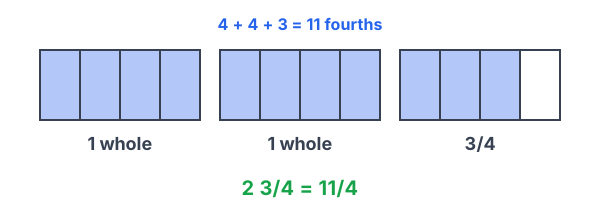
Both forms name the same amount. A mixed number is easier to picture. An improper fraction is easier to use when you multiply or divide.
How to Convert Between the Two Forms
Mixed number to improper fraction
- Multiply the whole number by the denominator.
- Add the numerator.
- Write the result over the same denominator.
2\frac{3}{4} = \frac{2 \times 4 + 3}{4} = \frac{11}{4}Improper fraction to mixed number
- Divide the numerator by the denominator.
- The quotient is the whole number.
- The remainder is the new numerator. Keep the same denominator.
\frac{11}{4}: \quad 11 \div 4 = 2 \text{ remainder } 3, \quad \text{so } \frac{11}{4} = 2\frac{3}{4}Worked Examples
Example 1: Mixed number to improper fraction
Write 3\frac{2}{5} as an improper fraction.
Step 1. Multiply the whole number by the denominator: 3 × 5 = 15.
Step 2. Add the numerator: 15 + 2 = 17.
Answer: 3\frac{2}{5} = \frac{17}{5}.
Example 2: Improper fraction to mixed number
Write \frac{23}{6} as a mixed number.
Step 1. Divide: 23 ÷ 6 = 3 with a remainder of 5, because 6 × 3 = 18 and 23 − 18 = 5.
Step 2. The whole number is 3. The remainder 5 goes over the denominator 6.
Answer: \frac{23}{6} = 3\frac{5}{6}.
Example 3: Add mixed numbers
Find 2\frac{1}{3} + 1\frac{1}{2}.
Step 1. Change both to improper fractions: 2\frac{1}{3} = \frac{7}{3} and 1\frac{1}{2} = \frac{3}{2}.
Step 2. Use the common denominator 6, then add.
\frac{7}{3} + \frac{3}{2} = \frac{14}{6} + \frac{9}{6} = \frac{23}{6}Answer: \frac{23}{6} = 3\frac{5}{6}.
Example 4: Multiply mixed numbers
Find 1\frac{1}{2} \times 2\frac{2}{3}.
Step 1. Change both to improper fractions: \frac{3}{2} and \frac{8}{3}.
Step 2. Multiply straight across.
\frac{3}{2} \times \frac{8}{3} = \frac{24}{6} = 4Answer: 4.
Example 5: Word problem
A board is 5\frac{1}{4} feet long. You cut off a piece that is 2\frac{3}{4} feet long. How long is the board now?
Step 1. “How long is it now” means subtract: 5\frac{1}{4} - 2\frac{3}{4}.
Step 2. Change to improper fractions: \frac{21}{4} - \frac{11}{4} = \frac{10}{4}.
Step 3. Simplify and write as a mixed number: \frac{10}{4} = \frac{5}{2} = 2\frac{1}{2}.
Answer: The board is 2\frac{1}{2} feet long.
Common Mistakes
| Mistake | What it looks like | How to fix it |
|---|---|---|
| Adding the whole number to the numerator | 2\frac{3}{4} = \frac{5}{4} | Multiply the whole number by the denominator first: 2 \times 4 + 3 = 11. |
| Multiplying the parts separately | 1\frac{1}{2} \times 2\frac{2}{3} = 2\frac{2}{6} | Change to improper fractions first. The answer is 4. |
| Putting the remainder on the bottom | \frac{23}{6} = 3\frac{6}{5} | The remainder is the numerator, and the denominator stays 6: 3\frac{5}{6}. |
| Losing the sign on a negative mixed number | -2\frac{1}{3} = \frac{-6 + 1}{3} | The minus sign covers the whole amount: -2\frac{1}{3} = -\frac{7}{3}. |
Subtracting Mixed Numbers by Regrouping
You can also subtract mixed numbers without changing them to improper fractions. If the top fraction is too small, borrow 1 from the whole number.
For 5\frac{1}{4} - 2\frac{3}{4}, you can’t take \frac{3}{4} from \frac{1}{4}. Borrow 1, which is \frac{4}{4}, so 5\frac{1}{4} = 4\frac{5}{4}.
4\frac{5}{4} - 2\frac{3}{4} = 2\frac{2}{4} = 2\frac{1}{2}Both methods give the same answer. Later, you’ll see mixed numbers in measurement problems and recipes.
Practice Problems
For problems 1–2, write an improper fraction. For problems 3–5, write a mixed number or a whole number.
- 4\frac{1}{2}
- 2\frac{5}{8}
- \frac{17}{3}
- \frac{29}{4}
- \frac{30}{6}
- 1\frac{2}{3} + 2\frac{1}{4}
- 4\frac{1}{5} - 1\frac{3}{5}
- 2\frac{1}{2} \times 1\frac{1}{5}
- 3\frac{3}{4} \div 1\frac{1}{4}
- A recipe uses 1\frac{3}{4} cups of flour. How much flour do you need to make 3 batches?
Show answers
- \frac{4 \times 2 + 1}{2} = \frac{9}{2}
- \frac{2 \times 8 + 5}{8} = \frac{21}{8}
- 17 ÷ 3 = 5 remainder 2, so \frac{17}{3} = 5\frac{2}{3}
- 29 ÷ 4 = 7 remainder 1, so \frac{29}{4} = 7\frac{1}{4}
- 30 ÷ 6 = 5 with no remainder, so \frac{30}{6} = 5
- \frac{5}{3} + \frac{9}{4} = \frac{20}{12} + \frac{27}{12} = \frac{47}{12} = 3\frac{11}{12}
- \frac{21}{5} - \frac{8}{5} = \frac{13}{5} = 2\frac{3}{5}
- \frac{5}{2} \times \frac{6}{5} = \frac{30}{10} = 3
- \frac{15}{4} \div \frac{5}{4} = \frac{15}{4} \times \frac{4}{5} = 3
- 3 \times \frac{7}{4} = \frac{21}{4} = 5\frac{1}{4} cups of flour
Mixed Numbers and Improper Fractions FAQ
Is an improper fraction wrong?
No. An improper fraction is a correct way to write a number. Algebra teachers often prefer improper fractions, while measurement problems often use mixed numbers.
Is 4/4 an improper fraction?
Yes. A fraction is improper when the top is equal to or bigger than the bottom. \frac{4}{4} equals 1.
How do you change a mixed number to a decimal?
Keep the whole number and change the fraction to a decimal. Since \frac{3}{4} = 0.75, the mixed number 2\frac{3}{4} = 2.75.
Do you have to convert mixed numbers before you add them?
No. You can add the whole numbers and the fractions separately, then regroup if the fractions add up to more than 1. Converting first is often simpler.
Summary
- A mixed number is a whole number plus a fraction. An improper fraction has a top at least as big as its bottom.
- Mixed to improper: multiply the whole number by the denominator, then add the numerator.
- Improper to mixed: divide. The quotient is the whole number, and the remainder is the new numerator.
- Change mixed numbers to improper fractions before you multiply or divide.
- When subtracting, borrow 1 from the whole number if you need to.
Previous lesson: Multiplying and Dividing Fractions
Next lesson: Operations with Decimals
Back to the Pre-Algebra (Math Basics) Index