
Adding and Subtracting Fractions
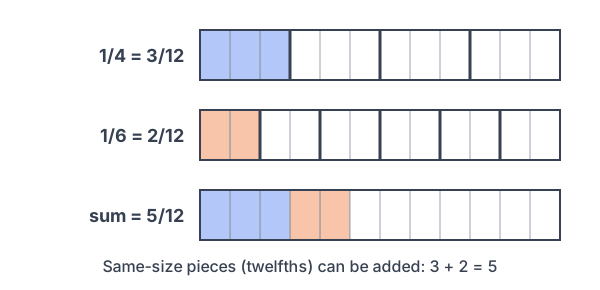
Adding and subtracting fractions is easy when the denominators match: add or subtract the numerators and keep the denominator. If the denominators are different, first rewrite the fractions with a common denominator. For example, \frac{1}{4} + \frac{1}{6} = \frac{3}{12} + \frac{2}{12} = \frac{5}{12}. Then simplify the answer if you can.
Before this lesson: You should know how to write equivalent fractions and how to find the least common multiple of two numbers.
Why You Need a Common Denominator
The denominator tells you the size of each piece. You can only add pieces that are the same size. Two quarters plus one quarter is three quarters, just like 2 apples plus 1 apple is 3 apples.
But quarters and sixths are different sizes, so you can’t add them as they are. First cut them into pieces that are the same size. Twelfths work for both, because 12 is a multiple of 4 and of 6.
How to Add and Subtract Fractions
Same denominators
Add or subtract the numerators. Keep the denominator the same.
\frac{a}{c} + \frac{b}{c} = \frac{a + b}{c} \qquad \frac{a}{c} - \frac{b}{c} = \frac{a - b}{c}Here a, b and c stand for whole numbers, and c is not 0.
Different denominators
- Find the least common denominator (LCD). It is the LCM of the denominators.
- Rewrite each fraction with the LCD. Multiply its top and bottom by the same number.
- Add or subtract the numerators. Keep the LCD as the denominator.
- Simplify the answer.
Worked Examples
Example 1: Add with the same denominator
Find \frac{2}{9} + \frac{5}{9}.
Step 1. The denominators are both 9, so add the numerators: 2 + 5 = 7.
Step 2. Keep the denominator.
Answer: \frac{2}{9} + \frac{5}{9} = \frac{7}{9}.
Example 2: Subtract and simplify
Find \frac{7}{10} - \frac{3}{10}.
Step 1. Subtract the numerators: 7 − 3 = 4. This gives \frac{4}{10}.
Step 2. Simplify. The GCF of 4 and 10 is 2.
\frac{7}{10} - \frac{3}{10} = \frac{4}{10} = \frac{2}{5}Answer: \frac{2}{5}.
Example 3: Add with different denominators
Find \frac{2}{3} + \frac{1}{4}.
Step 1. The LCM of 3 and 4 is 12, so the LCD is 12.
Step 2. Rewrite each fraction with 12 on the bottom.
\frac{2}{3} = \frac{2 \times 4}{3 \times 4} = \frac{8}{12} \qquad \frac{1}{4} = \frac{1 \times 3}{4 \times 3} = \frac{3}{12}Step 3. Add the numerators: \frac{8}{12} + \frac{3}{12} = \frac{11}{12}.
Answer: \frac{11}{12}. It is already in simplest form.
Example 4: Subtract with different denominators
Find \frac{5}{6} - \frac{3}{8}.
Step 1. The LCM of 6 and 8 is 24.
Step 2. Rewrite: \frac{5}{6} = \frac{20}{24} and \frac{3}{8} = \frac{9}{24}.
Step 3. Subtract the numerators.
\frac{20}{24} - \frac{9}{24} = \frac{11}{24}Answer: \frac{11}{24}.
Example 5: Word problem
Jamal ran \frac{3}{4} of a mile on Monday and \frac{5}{6} of a mile on Tuesday. How much farther did he run on Tuesday?
Step 1. “How much farther” means subtract: \frac{5}{6} - \frac{3}{4}.
Step 2. The LCD of 6 and 4 is 12. Rewrite: \frac{5}{6} = \frac{10}{12} and \frac{3}{4} = \frac{9}{12}.
Step 3. Subtract: \frac{10}{12} - \frac{9}{12} = \frac{1}{12}.
Answer: He ran \frac{1}{12} of a mile farther on Tuesday.
Common Mistakes
| Mistake | What it looks like | How to fix it |
|---|---|---|
| Adding the denominators | \frac{1}{4} + \frac{1}{6} = \frac{2}{10} | Never add the bottoms. Find a common denominator, then add only the tops. |
| Changing the bottom but not the top | \frac{2}{3} = \frac{2}{12} | Multiply the top by the same number as the bottom: \frac{2}{3} = \frac{8}{12}. |
| Forgetting to simplify | \frac{4}{10} as a final answer | Divide the top and bottom by the GCF: \frac{4}{10} = \frac{2}{5}. |
| Subtracting in the wrong order | \frac{3}{10} - \frac{7}{10} = \frac{4}{10} | Keep the order. 3 - 7 = -4, so the answer is -\frac{2}{5}. |
Adding Fractions with Negative Signs and Whole Numbers
Fractions follow the same sign rules as adding and subtracting integers. Work with the numerators, then keep the common denominator.
-\frac{1}{2} + \frac{1}{3} = -\frac{3}{6} + \frac{2}{6} = \frac{-3 + 2}{6} = -\frac{1}{6}To add a whole number and a fraction, write the whole number as a fraction first. For example, 2 = \frac{6}{3}, so 2 + \frac{1}{3} = \frac{7}{3}.
Adding and subtracting mixed numbers, like 2\frac{1}{3} + 1\frac{1}{2}, is covered in the lesson on mixed numbers later in this unit.
Practice Problems
Find each sum or difference. Write answers in simplest form.
- \frac{3}{8} + \frac{2}{8}
- \frac{5}{7} - \frac{2}{7}
- \frac{1}{6} + \frac{1}{6}
- \frac{9}{10} - \frac{3}{10}
- \frac{1}{2} + \frac{1}{3}
- \frac{3}{4} - \frac{1}{6}
- \frac{2}{5} + \frac{3}{10}
- \frac{3}{4} + \frac{2}{3}
- -\frac{1}{2} + \frac{1}{3}
- A pizza is cut into equal slices. Ana eats \frac{1}{3} of it, and Ben eats \frac{1}{4} of it. What fraction of the pizza is left?
Show answers
- \frac{3 + 2}{8} = \frac{5}{8}
- \frac{5 - 2}{7} = \frac{3}{7}
- \frac{2}{6} = \frac{1}{3}
- \frac{6}{10} = \frac{3}{5}
- The LCD is 6: \frac{3}{6} + \frac{2}{6} = \frac{5}{6}
- The LCD is 12: \frac{9}{12} - \frac{2}{12} = \frac{7}{12}
- The LCD is 10: \frac{4}{10} + \frac{3}{10} = \frac{7}{10}
- The LCD is 12: \frac{9}{12} + \frac{8}{12} = \frac{17}{12}, which is the same as 1\frac{5}{12}.
- The LCD is 6: -\frac{3}{6} + \frac{2}{6} = -\frac{1}{6}
- Together they eat \frac{4}{12} + \frac{3}{12} = \frac{7}{12}. The whole pizza is \frac{12}{12}, so \frac{12}{12} - \frac{7}{12} = \frac{5}{12} is left.
Adding and Subtracting Fractions FAQ
Do you add the denominators when adding fractions?
No. The denominator tells the size of the pieces, and that size doesn’t change when you add. Add only the numerators once the denominators match.
Do you have to use the least common denominator?
No. Any common denominator works, such as the product of the two denominators. The LCD just keeps the numbers smaller, so there is less to simplify.
How do you add a fraction and a whole number?
Write the whole number as a fraction with the same denominator. For example, 3 + \frac{2}{5} = \frac{15}{5} + \frac{2}{5} = \frac{17}{5}.
What if the answer is bigger than 1?
That is fine. You can leave it as an improper fraction, like \frac{17}{12}, or write it as a mixed number, 1\frac{5}{12}.
Summary
- You can only add or subtract fractions with the same denominator.
- With the same denominator, add or subtract the numerators and keep the denominator.
- With different denominators, rewrite both fractions using the least common denominator first.
- Never add or subtract the denominators.
- Simplify your answer at the end.
Previous lesson: Fractions
Next lesson: Multiplying and Dividing Fractions
Back to the Pre-Algebra (Math Basics) Index