
Least Common Multiple
The least common multiple (LCM) of two numbers is the smallest number that both of them divide into with no remainder. To find it, list the multiples of each number until you find one they share, or use prime factorization. For example, the LCM of 4 and 6 is 12.
Before this lesson: You should know how to write a prime factorization and how to find the greatest common factor.
What Is the Least Common Multiple?
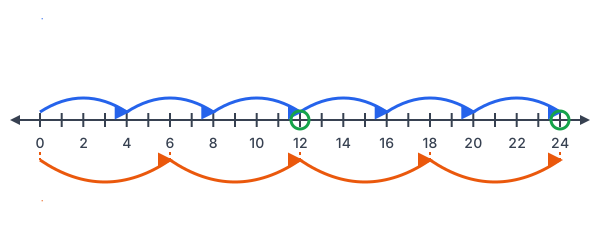
A multiple of a number is what you get when you multiply it by 1, 2, 3 and so on. You can think of the multiples as skip counting.
- Multiples of 4: 4, 8, 12, 16, 20, 24, …
- Multiples of 6: 6, 12, 18, 24, 30, …
The numbers in both lists, like 12 and 24, are common multiples. The smallest one is 12, so the LCM of 4 and 6 is 12.
How to Find the Least Common Multiple
Method 1: List the multiples
- List multiples of the larger number.
- Check each one. Stop at the first one the smaller number divides into.
- That number is the LCM.
Method 2: Use prime factorization
- Write the prime factorization of each number.
- List every prime that appears in any of them.
- For each prime, use the larger exponent.
- Multiply those primes. The product is the LCM.
Method 3: Use the GCF
For two numbers, multiply them and divide by their GCF.
\text{LCM} = \frac{\text{first number} \times \text{second number}}{\text{GCF}}Worked Examples
Example 1: List the multiples
Find the LCM of 6 and 8.
Step 1. List multiples of the larger number, 8: 8, 16, 24, 32, …
Step 2. Check each one. 6 doesn’t divide 8 or 16, but 24 ÷ 6 = 4.
Answer: The LCM of 6 and 8 is 24.
Example 2: Use prime factorization
Find the LCM of 12 and 18.
Step 1. Write each prime factorization.
\begin{aligned}
12 &= 2^2 \times 3 \\
18 &= 2 \times 3^2
\end{aligned}
Step 2. The primes are 2 and 3. Use the larger exponent of each: 2^2 and 3^2.
2^2 \times 3^2 = 4 \times 9 = 36
Answer: The LCM of 12 and 18 is 36.
Example 3: Use the GCF
Find the LCM of 20 and 30.
Step 1. The GCF of 20 and 30 is 10.
Step 2. Multiply the numbers and divide by the GCF.
\text{LCM} = \frac{20 \times 30}{10} = \frac{600}{10} = 60Answer: The LCM of 20 and 30 is 60.
Example 4: Three numbers
Find the LCM of 4, 6 and 10.
Step 1. Write each prime factorization: 4 = 2^2, 6 = 2 \times 3 and 10 = 2 \times 5.
Step 2. Every prime that appears is 2, 3 or 5. The largest power of 2 is 2^2.
2^2 \times 3 \times 5 = 60
Answer: The LCM of 4, 6 and 10 is 60.
Example 5: Word problem
Hot dogs come in packs of 10, and buns come in packs of 8. You want the same number of hot dogs and buns. What is the smallest number of each you can buy? How many packs of each is that?
Step 1. The number of hot dogs must be a multiple of 10, and the number of buns must be a multiple of 8. You need the smallest number that is both, which is the LCM.
Step 2. Multiples of 10: 10, 20, 30, 40. Since 40 ÷ 8 = 5, the LCM is 40.
Step 3. Find the packs: 40 ÷ 10 = 4 packs of hot dogs and 40 ÷ 8 = 5 packs of buns.
Answer: Buy 40 of each: 4 packs of hot dogs and 5 packs of buns.
Common Mistakes
| Mistake | What it looks like | How to fix it |
|---|---|---|
| Always multiplying the two numbers | LCM of 4 and 6 is 24 | 24 is a common multiple, but 12 is smaller. Check smaller multiples first. |
| Finding the GCF instead | LCM of 12 and 18 is 6 | The LCM can’t be smaller than the larger number. The LCM is 36. |
| Using the smaller exponent | 2 \times 3 = 6 for 12 and 18 | Use the larger exponent of each prime: 2^2 \times 3^2 = 36. |
| Leaving out a prime | 2^2 \times 3 = 12 for 4, 6 and 10 | Include every prime that appears, including the 5 from 10. |
| Listing factors instead of multiples | Factors of 8: 1, 2, 4, 8 | Multiples get bigger: 8, 16, 24, 32 and so on. |
Using the LCM
Finding a common denominator
To add \frac{1}{4} + \frac{1}{6}, you need fractions with the same bottom number. The LCM of 4 and 6 is 12, so 12 is the least common denominator (LCD).
\frac{1}{4} + \frac{1}{6} = \frac{3}{12} + \frac{2}{12} = \frac{5}{12}You’ll learn this step by step when you add and subtract fractions.
How the GCF and LCM are related
For two numbers, the GCF times the LCM equals the two numbers multiplied together. For 4 and 6, the GCF is 2 and the LCM is 12, and 2 \times 12 = 4 \times 6 = 24.
Practice Problems
For problems 1–8, find the LCM.
- 3 and 5
- 4 and 10
- 6 and 9
- 8 and 12
- 7 and 14
- 9 and 12
- 15 and 25
- 2, 3 and 4
- The GCF of 16 and 24 is 8. Use it to find the LCM of 16 and 24.
- One bus leaves the station every 12 minutes. Another leaves every 15 minutes. Both leave at 8:00 a.m. When will they next leave at the same time?
Show answers
- Multiples of 5: 5, 10, 15. 3 divides 15, so the LCM is 15.
- Multiples of 10: 10, 20. 4 divides 20, so the LCM is 20.
- Multiples of 9: 9, 18. 6 divides 18, so the LCM is 18.
- Multiples of 12: 12, 24. 8 divides 24, so the LCM is 24.
- 7 divides 14, so the LCM is 14.
- 9 = 3^2 and 12 = 2^2 \times 3. The LCM is 2^2 \times 3^2 = 36.
- 15 = 3 \times 5 and 25 = 5^2. The LCM is 3 \times 5^2 = 75.
- Multiples of 4: 4, 8, 12. Both 2 and 3 divide 12, so the LCM is 12.
- \frac{16 \times 24}{8} = \frac{384}{8} = 48. The LCM is 48.
- The LCM of 12 and 15 is 60, so they leave together again 60 minutes later, at 9:00 a.m.
Least Common Multiple FAQ
Is the LCM always bigger than the numbers?
The LCM is never smaller than the larger number. It can be equal to it. The LCM of 7 and 14 is 14.
What is the LCM of two prime numbers?
If the two primes are different, their LCM is their product. The LCM of 5 and 7 is 35.
What is the difference between LCM and LCD?
The least common denominator (LCD) is the LCM of the denominators of two or more fractions. It is the smallest bottom number they can all share.
How do you find the LCM quickly?
List multiples of the larger number and stop at the first one the smaller number divides. For big numbers, use prime factorization or divide the product by the GCF.
Summary
- The LCM is the smallest multiple that two or more numbers share.
- For small numbers, list multiples of the larger number until the smaller one divides it.
- With prime factorization, use every prime that appears, with the larger exponent.
- For two numbers, the LCM equals their product divided by their GCF.
- The LCM of the denominators is the least common denominator.
Previous lesson: Greatest Common Factor
Next lesson: Fractions
Back to the Pre-Algebra (Math Basics) Index