
Perimeter
Perimeter is the distance all the way around the outside of a flat shape. To find the perimeter, add the lengths of all the sides. For a rectangle, you can use the formula P = 2l + 2w. Perimeter is a length, so it uses units like inches, feet or meters.
Before this lesson: You should know how to add decimals and fractions, and how to change units with unit conversions.
What Perimeter Means
Imagine walking along the edge of a park until you get back to where you started. The total distance you walked is the perimeter of the park.
Perimeter only measures the outside edge. It does not measure the space inside. That is called area, which you will learn next.
Perimeter Formulas
For any polygon, the perimeter is the sum of the side lengths. A polygon is a flat shape with straight sides. Some shapes have shortcuts.
| Shape | Formula | Why it works |
|---|---|---|
| Any polygon | P = \text{sum of all sides} | Add every side once. |
| Rectangle | P = 2l + 2w | There are two lengths and two widths. |
| Square | P = 4s | All four sides are the same length. |
| Regular polygon | P = n \times s | All n sides are the same length s. |
A regular polygon has all sides the same length, like an equilateral triangle or a stop-sign octagon. The perimeter of a circle has a special name, circumference. It has its own formula in a later lesson.
How to Find a Missing Side
Some shapes don’t label every side. In a shape with only right angles, opposite edges add up to the same total. Use that to find each missing side.
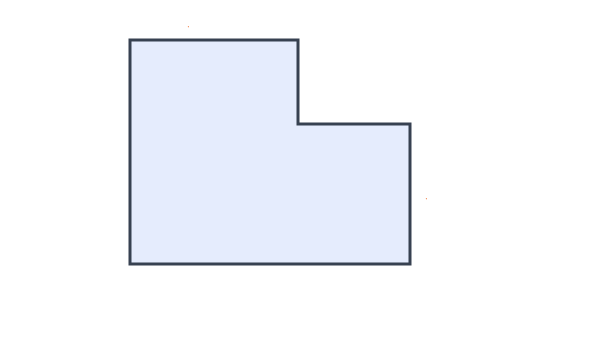
The top edge plus the 4 m step must equal the 10 m bottom, so the top is 10 - 4 = 6 m. The two right edges must equal the 8 m left side, so the lower right edge is 8 - 3 = 5 m.
Worked Examples
Example 1: Perimeter of a triangle
A triangle has sides of 7 cm, 9 cm and 12 cm. Find its perimeter.
Step 1. Add all three sides: 7 + 9 + 12 = 28.
Answer: The perimeter is 28 cm.
Example 2: Perimeter of a rectangle
A rectangle is 15 m long and 8 m wide. Find its perimeter.
Step 1. Write the formula: P = 2l + 2w.
Step 2. Substitute: P = 2(15) + 2(8) = 30 + 16.
Step 3. Add: 30 + 16 = 46.
Answer: The perimeter is 46 m.
Example 3: Find the side of a square from its perimeter
A square has a perimeter of 36 inches. How long is each side?
Step 1. A square has 4 equal sides, so 4s = 36.
Step 2. Divide by 4: s = 36 \div 4 = 9.
Answer: Each side is 9 inches.
Example 4: Perimeter of an L-shaped figure
Find the perimeter of the L-shaped figure in the diagram above.
Step 1. Find the missing sides: the top is 10 - 4 = 6 m and the lower right side is 8 - 3 = 5 m.
Step 2. Go around the shape and add all six sides: 10 + 5 + 4 + 3 + 6 + 8 = 36.
Answer: The perimeter is 36 m. That matches a 10 m by 8 m rectangle, because the notch just moves two edges inward.
Example 5: Word problem with a garden fence
A garden is a rectangle 12 feet long and 7.5 feet wide. It needs a fence on all sides except a 3-foot gate. Fencing costs $4 per foot. How much will the fence cost?
Step 1. Find the perimeter: 2(12) + 2(7.5) = 24 + 15 = 39 feet.
Step 2. Subtract the gate: 39 - 3 = 36 feet of fence.
Step 3. Multiply by the price: 36 \times 4 = 144.
Answer: The fence will cost $144.
Common Mistakes with Perimeter
| Mistake | Example of the error | Fix |
|---|---|---|
| Adding only two sides of a rectangle | A 15 m by 8 m rectangle has P = 15 + 8 = 23 m | A rectangle has four sides: 2(15) + 2(8) = 46 m. |
| Multiplying instead of adding | P = 15 \times 8 = 120 | Multiplying gives area. Perimeter adds the sides. |
| Skipping unlabeled sides | Adding only the four labeled sides of an L-shape | Find every missing side first, then add all six. |
| Mixing units | A 3 ft by 18 in rectangle: 2(3) + 2(18) = 42 | Change to one unit first: 2(36) + 2(18) = 108 in. |
| Using square units | Writing the answer as 46 m² | Perimeter is a length, so the unit is m, not m². |
Perimeter vs. Area
| Question | Perimeter | Area |
|---|---|---|
| What it measures | The distance around the outside | The space inside |
| How to find it for a rectangle | 2l + 2w | l \times w |
| Units | ft, m, in | ft², m², in² |
| Real-life uses | Fences, frames, trim, borders | Carpet, paint, tiles, grass |
Practice Problems
- A triangle has sides 5 in, 5 in and 8 in. Find the perimeter.
- Find the perimeter of a rectangle that is 9 cm by 4 cm.
- Find the perimeter of a square with sides of 6.5 ft.
- A regular hexagon has sides of 7 m. Find its perimeter.
- A rectangle has a perimeter of 50 m and a length of 15 m. Find its width.
- A square has a perimeter of 48 cm. How long is each side?
- A triangle has a perimeter of 30 in. Two sides are 8 in and 11 in. Find the third side.
- A rectangle is 3 feet long and 18 inches wide. Find its perimeter in inches.
- An L-shaped room has only right angles. Its longest sides are 12 m and 9 m. Find its perimeter.
- A photo is 8 in by 10 in. Ribbon costs $0.25 per inch. How much does it cost to put ribbon around the edge?
Show answers
- 5 + 5 + 8 = 18 in
- 2(9) + 2(4) = 18 + 8 = 26 cm
- 4 \times 6.5 = 26 ft
- 6 \times 7 = 42 m
- 50 - 2(15) = 20, and 20 \div 2 = 10. The width is 10 m.
- 48 \div 4 = 12 cm
- 30 - 8 - 11 = 11 in
- 3 feet is 36 inches. 2(36) + 2(18) = 72 + 36 = 108 in
- Like Example 4, the notch doesn’t change the total: 2(12) + 2(9) = 42 m.
- 2(8) + 2(10) = 36 in, and 36 \times 0.25 = 9. It costs $9.
Perimeter FAQ
What is the formula for the perimeter of a rectangle?
The formula is P = 2l + 2w, where l is the length and w is the width. You can also write it as P = 2(l + w).
Is perimeter the same as area?
No. Perimeter is the distance around a shape, and area is the space inside it. A 4 by 3 rectangle has a perimeter of 14 units but an area of 12 square units.
What units does perimeter use?
Perimeter uses length units, like inches, feet, centimeters or meters. It never uses square units.
Summary
- Perimeter is the distance around a shape.
- Add all the side lengths to find it.
- Rectangle: P = 2l + 2w. Square: P = 4s.
- Find missing sides before you add.
- Use the same unit for every side, and give the answer in length units.
Previous lesson: Properties of Numbers
Next lesson: Area of Rectangles and Parallelograms
Back to the Pre-Algebra (Math Basics) Index