
Properties of Numbers
The properties of numbers are rules that are always true for adding and multiplying. They tell you when you can change the order or the grouping of numbers without changing the answer. The main ones are the commutative, associative, identity, inverse and zero properties. They make mental math faster. You also use them in every algebra step.
Before this lesson: You should know the order of operations and how to add and subtract integers. It also helps to know multiplying fractions for the inverse property.
What the Properties of Numbers Mean
Try 3 \times 4 and 4 \times 3. Both give 12. Picture 3 rows of 4 dots. Turn the picture sideways and you get 4 rows of 3 dots. The number of dots stays the same.
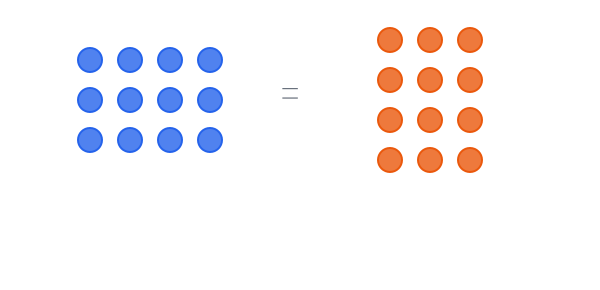
Facts like this hold for every number, not just 3 and 4. We give them names so we can use them. In the rules below, the letters a, b and c stand for any numbers.
The Properties of Numbers Rules
| Property | Addition | Multiplication | What it means |
|---|---|---|---|
| Commutative | a + b = b + a | a \times b = b \times a | You can change the order. |
| Associative | (a + b) + c = a + (b + c) | (a \times b) \times c = a \times (b \times c) | You can change the grouping. |
| Identity | a + 0 = a | a \times 1 = a | Adding 0 or multiplying by 1 changes nothing. |
| Inverse | a + (-a) = 0 | a \times \frac{1}{a} = 1 (when a is not 0) | Opposites add to 0. Reciprocals multiply to 1. |
| Zero property | (none) | a \times 0 = 0 | Anything times 0 is 0. |
- Commutative comes from “commute,” which means to move around. The numbers swap places.
- Associative comes from “associate,” which means to group with. The parentheses move, but the numbers stay in order.
- The additive inverse of a number is its opposite, like 5 and −5. The multiplicative inverse is its reciprocal, like \frac{2}{3} and \frac{3}{2}.
One more rule links adding and multiplying: a(b + c) = ab + ac. It has its own lesson, the distributive property, in Algebra 1.
Worked Examples
Example 1: Name the property
Name the property shown in each statement.
- 7 + 9 = 9 + 7
- (2 \times 5) \times 3 = 2 \times (5 \times 3)
- 15 \times 1 = 15
Step 1. In the first one, the numbers swap places. That is the commutative property for adding.
Step 2. In the second one, the numbers stay in order, but the parentheses move. That is the associative property for multiplying.
Step 3. In the third one, multiplying by 1 leaves 15 unchanged. That is the identity property for multiplying.
Answer: commutative (adding), associative (multiplying), identity (multiplying)
Example 2: Use the properties for mental math
Find 25 + 38 + 75 without a calculator.
Step 1. 25 and 75 make 100. Use the commutative property to swap 38 and 75: 25 + 75 + 38.
Step 2. Use the associative property to group the easy pair: (25 + 75) + 38 = 100 + 38.
Answer: 138
Example 3: Regroup to multiply
Find 4 \times 17 \times 25.
Step 1. 4 and 25 make 100. Swap the order: 4 \times 25 \times 17.
Step 2. Group them: (4 \times 25) \times 17 = 100 \times 17.
Answer: 1,700
Example 4: Subtraction and division don’t follow these rules
Show that order matters when you subtract, and grouping matters when you divide.
Step 1. Swap the order in a subtraction: 10 - 4 = 6, but 4 - 10 = -6. The answers are different.
Step 2. Move the parentheses in a division: (12 \div 3) \div 2 = 4 \div 2 = 2, but 12 \div (3 \div 2) = 12 \div 1.5 = 8.
Answer: One example where a rule fails is enough to show it is not a rule. The commutative and associative properties do not work for subtracting or dividing.
Example 5: Word problem with a shopping total
Lena buys a notebook for $3.75, a binder for $8.40 and pens for $6.25. Find the total in your head.
Step 1. $3.75 and $6.25 add up to exactly $10. Swap the order to put them next to each other.
Step 2. Group them: (3.75 + 6.25) + 8.40 = 10 + 8.40.
Answer: The total is $18.40.
Common Mistakes with Properties of Numbers
| Mistake | Example of the error | Fix |
|---|---|---|
| Using the commutative property on subtraction | 8 - 3 = 3 - 8 | Order matters in subtraction: 8 - 3 = 5 but 3 - 8 = -5. |
| Mixing up commutative and associative | Calling (2 + 3) + 4 = 2 + (3 + 4) commutative | The order didn’t change, only the grouping. That is associative. |
| Moving parentheses in subtraction | (8 - 3) - 2 = 8 - (3 - 2) | (8 - 3) - 2 = 3 but 8 - (3 - 2) = 7. |
| Thinking the identity for multiplication is 0 | 9 \times 0 = 9 | Multiplying by 1 keeps a number the same. Multiplying by 0 gives 0. |
| Confusing the two inverses | Saying the inverse of 7 for multiplying is −7 | The opposite, −7, is for adding. For multiplying, use the reciprocal: 7 \times \frac{1}{7} = 1. |
Rewriting Subtraction and Division
You can still use the properties when you subtract or divide. Rewrite the problem first. Subtracting is the same as adding the opposite: 10 - 4 = 10 + (-4). Dividing is the same as multiplying by the reciprocal: 12 \div 3 = 12 \times \frac{1}{3}.
Once you rewrite them, you can swap and regroup. For example, 10 - 4 + 6 = 10 + (-4) + 6 = 10 + 6 + (-4) = 12.
Practice Problems
- Name the property: 6 \times 8 = 8 \times 6
- Name the property: (4 + 9) + 1 = 4 + (9 + 1)
- Name the property: 0 + 23 = 23
- Name the property: -5 + 5 = 0
- Name the property: \frac{2}{3} \times \frac{3}{2} = 1
- Name the property: 999 \times 0 = 0
- Use the properties to find 18 + 47 + 2 in your head.
- Use the properties to find 5 \times 13 \times 2 in your head.
- Is 20 \div 5 equal to 5 \div 20? What does that tell you?
- Ty buys snacks for $1.60, $4.85 and $2.40. Use the properties to find the total in your head.
Show answers
- Commutative property for multiplying. The order changed.
- Associative property for adding. The grouping changed.
- Identity property for adding. Adding 0 changes nothing.
- Inverse property for adding. A number plus its opposite is 0.
- Inverse property for multiplying. A number times its reciprocal is 1.
- Zero property. Any number times 0 is 0.
- (18 + 2) + 47 = 20 + 47 = 67
- (5 \times 2) \times 13 = 10 \times 13 = 130
- No. 20 \div 5 = 4 but 5 \div 20 = 0.25. Order matters when you divide.
- (1.60 + 2.40) + 4.85 = 4 + 4.85 = 8.85. The total is $8.85.
Properties of Numbers FAQ
What are the 4 main properties of math?
The four most common are the commutative, associative, identity and distributive properties. Many books also list the inverse and zero properties.
What is the difference between commutative and associative?
The commutative property changes the order of the numbers. The associative property keeps the order but changes the grouping with parentheses.
Is subtraction commutative?
No. 7 - 2 = 5 but 2 - 7 = -5. Order matters when you divide, too.
What is the identity property?
The identity property says that adding 0 or multiplying by 1 leaves a number the same. So 0 is the identity for adding, and 1 is the identity for multiplying.
Summary
- Commutative: you can change the order when you add or multiply.
- Associative: you can change the grouping when you add or multiply.
- Identity: a + 0 = a and a \times 1 = a.
- Inverse: opposites add to 0, and reciprocals multiply to 1.
- Zero property: any number times 0 is 0.
- Order and grouping matter when you subtract or divide.
Previous lesson: Order of Operations
Next lesson: Perimeter
Back to the Pre-Algebra (Math Basics) Index