
Unit Conversions
Unit conversions change a measurement from one unit to another, like feet to inches or minutes to hours. Multiply by a conversion factor, which is a fraction equal to 1, such as \frac{12 \text{ in}}{1 \text{ ft}}. Put the unit you want on top, so the old unit cancels. For example, 5 \text{ ft} \times \frac{12 \text{ in}}{1 \text{ ft}} = 60 \text{ in}.
Before this lesson: You should know how to find a unit rate and how to multiply fractions.
Big Units and Small Units
The same length can be measured with big units or small units. One yard is the same length as 3 feet or 36 inches. When you change to a smaller unit, you need more of them, so the number gets bigger.
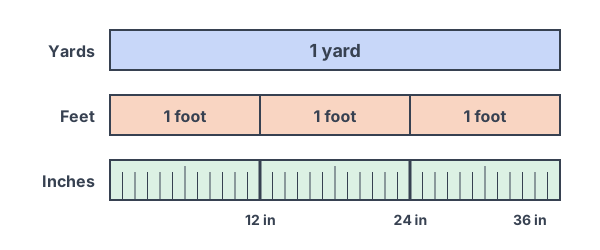
- Big unit to small unit: multiply. For example, 2 feet is 2 × 12 = 24 inches.
- Small unit to big unit: divide. For example, 36 inches is 36 ÷ 12 = 3 feet.
Common Conversion Factors
| Type | U.S. units | Metric units |
|---|---|---|
| Length | 1 ft = 12 in, 1 yd = 3 ft, 1 mi = 5,280 ft | 1 m = 100 cm, 1 km = 1,000 m |
| Weight or mass | 1 lb = 16 oz, 1 ton = 2,000 lb | 1 kg = 1,000 g |
| Volume | 1 cup = 8 fl oz, 1 qt = 4 cups, 1 gal = 4 qt | 1 L = 1,000 mL |
| Time | 1 min = 60 s, 1 h = 60 min, 1 day = 24 h | (same) |
How to Convert Units with a Conversion Factor
- Write the measurement you have.
- Multiply by a conversion factor. Put the unit you want on top and the unit you have on the bottom.
- Cancel the units that appear on both the top and the bottom.
- Multiply or divide the numbers. Your answer is in the new unit.
A conversion factor equals 1, because the top and bottom are the same amount. Multiplying by 1 doesn’t change the measurement, only how it is written.
Worked Examples
Example 1: Feet to inches
Convert 5 feet to inches.
Step 1. You want inches, so put inches on top: \frac{12 \text{ in}}{1 \text{ ft}}.
5 \text{ ft} \times \frac{12 \text{ in}}{1 \text{ ft}} = 60 \text{ in}Answer: 5 feet = 60 inches.
Example 2: Minutes to hours
Convert 150 minutes to hours.
Step 1. You want hours, so put hours on top: \frac{1 \text{ h}}{60 \text{ min}}.
150 \text{ min} \times \frac{1 \text{ h}}{60 \text{ min}} = \frac{150}{60} \text{ h} = 2.5 \text{ h}Answer: 150 minutes = 2.5 hours, or 2 hours and 30 minutes.
Example 3: Metric units
Convert 3.2 kilometers to meters.
Step 1. There are 1,000 meters in 1 kilometer. Meters are smaller, so multiply.
Step 2. 3.2 × 1,000 = 3,200. Multiplying by 1,000 moves the decimal point 3 places right.
Answer: 3.2 km = 3,200 m.
Example 4: Two steps
How many minutes are in 2 days?
Step 1. Change days to hours, then hours to minutes.
2 \text{ days} \times \frac{24 \text{ h}}{1 \text{ day}} \times \frac{60 \text{ min}}{1 \text{ h}} = 2 \times 24 \times 60 \text{ min}Step 2. 2 × 24 = 48, and 48 × 60 = 2,880.
Answer: There are 2,880 minutes in 2 days.
Example 5: Word problem
A leaky faucet drips 2 cups of water per hour. How many quarts does it drip in one day?
Step 1. Find the cups in one day: 2 cups per hour × 24 hours = 48 cups.
Step 2. Change cups to quarts. There are 4 cups in a quart, and quarts are bigger, so divide: 48 ÷ 4 = 12.
Answer: The faucet drips 12 quarts of water in one day.
Common Mistakes
| Mistake | What it looks like | How to fix it |
|---|---|---|
| Dividing when you should multiply | 5 ft = 5 ÷ 12 inches | Inches are smaller, so you need more of them. Multiply: 5 × 12 = 60. |
| Flipping the conversion factor | 150 \text{ min} \times \frac{60 \text{ min}}{1 \text{ h}} | Put the unit you want on top. The old unit must cancel. |
| Skipping a step | Changing days straight to minutes by multiplying by 60 | Go one unit at a time: days to hours, then hours to minutes. |
| Moving the decimal the wrong way | 3.2 km = 0.0032 m | Meters are smaller than kilometers, so the number must get bigger: 3,200 m. |
Converting Rates and Metric Units
You can convert a rate the same way, one unit at a time. For example, 2 cups per hour is 48 cups per day. This builds on unit rates and proportions.
In the metric system, every unit is 10, 100 or 1,000 times the next. Converting just moves the decimal point, as in multiplying decimals by 10, 100 and 1,000. To change between U.S. and metric units, use an exact factor such as 1 inch = 2.54 centimeters.
Practice Problems
- Convert 4 yards to feet.
- Convert 96 inches to feet.
- Convert 3.5 hours to minutes.
- Convert 5 pounds to ounces.
- Convert 2.5 liters to milliliters.
- Convert 750 grams to kilograms.
- Convert 6 quarts to gallons.
- Convert 3 miles to feet.
- How many minutes are in one week?
- You have 1.5 gallons of lemonade. How many 1-cup servings can you pour?
Show answers
- 4 × 3 = 12 feet
- 96 ÷ 12 = 8 feet
- 3.5 × 60 = 210 minutes
- 5 × 16 = 80 ounces
- 2.5 × 1,000 = 2,500 milliliters
- 750 ÷ 1,000 = 0.75 kilograms
- 6 ÷ 4 = 1.5 gallons
- 3 × 5,280 = 15,840 feet
- 7 days × 24 hours × 60 minutes = 10,080 minutes
- 1.5 gallons × 4 quarts × 4 cups = 24 cups, so you can pour 24 servings.
Unit Conversions FAQ
How many inches are in a foot and in a yard?
There are 12 inches in a foot and 36 inches in a yard, because a yard is 3 feet and 3 × 12 = 36.
How do you convert metric units?
Multiply or divide by 10, 100 or 1,000. Moving to a smaller unit, like kilometers to meters, makes the number bigger.
What is dimensional analysis?
Dimensional analysis is the method in this lesson: multiply by conversion factors so the units you don’t want cancel out. Science classes use it a lot.
How do you convert between U.S. and metric units?
Use a conversion factor that links them. For example, 1 inch is exactly 2.54 centimeters, so 12 inches is 12 × 2.54 = 30.48 centimeters.
Summary
- To change to a smaller unit, multiply. To change to a bigger unit, divide.
- A conversion factor is a fraction equal to 1, like \frac{12 \text{ in}}{1 \text{ ft}}.
- Put the unit you want on top, so the old unit cancels.
- For big changes, convert one unit at a time.
- Metric conversions move the decimal point.
Previous lesson: Proportions
Next lesson: Percentages
Back to the Pre-Algebra (Math Basics) Index