
Unit Rates
A unit rate tells how much of one thing there is for exactly 1 unit of another, like 60 miles per hour or $3 per pound. To find a unit rate, divide the first amount by the second amount. For example, $12 for 4 pounds of apples is 12 ÷ 4 = $3 per pound.
Before this lesson: You should know how to write ratios and how to divide in operations with decimals.
What Is a Unit Rate?
A rate is a ratio that compares two different kinds of units, like miles and hours, or dollars and pounds. A unit rate is a rate where the second amount is 1. The word “per” means “for each” or “for every one.”
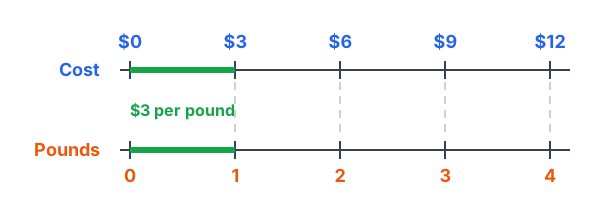
A double number line shows how the two amounts grow together. If 4 pounds cost $12, each pound adds $3.
How to Find a Unit Rate
- Write the rate as a fraction, with the amount you want “per” on the bottom.
- Divide the top by the bottom.
- Write the answer with both units, such as “miles per hour.”
\text{unit rate} = \frac{\text{first amount}}{\text{second amount}}A unit price is a unit rate for cost, such as dollars per ounce. Comparing unit prices shows which item is the better buy.
Worked Examples
Example 1: Speed
A car travels 150 miles in 3 hours. What is its speed in miles per hour?
Step 1. Write the rate with hours on the bottom: \frac{150 \text{ miles}}{3 \text{ hours}}.
Step 2. Divide: 150 ÷ 3 = 50.
Answer: 50 miles per hour.
Example 2: Unit price
A pack of 6 bagels costs $4.50. What is the price per bagel?
Step 1. Divide the cost by the number of bagels: 4.50 ÷ 6.
Step 2. 4.50 ÷ 6 = 0.75.
Answer: $0.75 per bagel.
Example 3: Compare unit prices
A 12-ounce box of cereal costs $3.60. A 20-ounce box costs $5.40. Which is the better buy?
Step 1. Find each unit price. Small box: 3.60 ÷ 12 = 0.30, so $0.30 per ounce.
Step 2. Large box: 5.40 ÷ 20 = 0.27, so $0.27 per ounce.
Answer: The 20-ounce box is the better buy, because each ounce costs less.
Example 4: A rate with fractions
Maria walks \frac{1}{2} mile in \frac{1}{4} hour. What is her speed in miles per hour?
Step 1. Divide the miles by the hours.
\frac{1}{2} \div \frac{1}{4} = \frac{1}{2} \times \frac{4}{1} = 2Answer: 2 miles per hour.
Example 5: Word problem
Leo types 210 words in 5 minutes. At that rate, how many words can he type in 12 minutes?
Step 1. Find the unit rate: 210 ÷ 5 = 42 words per minute.
Step 2. Multiply the unit rate by the time: 42 × 12 = 504.
Answer: He can type 504 words in 12 minutes.
Common Mistakes
| Mistake | What it looks like | How to fix it |
|---|---|---|
| Dividing in the wrong order | $12 for 4 pounds: 4 ÷ 12 | Put the “per” unit on the bottom. Dollars per pound is 12 ÷ 4 = $3. |
| Comparing total prices | “The $3.60 box is cheaper, so it’s the better buy.” | Compare the price per ounce, not the total price. |
| Leaving off the units | The speed is 50 | Write both units: 50 miles per hour. |
| Rounding money too early | Rounding 0.27 to 0.3 before you compare | Keep the cents until you compare, then round to the nearest cent if needed. |
Unit Rates and Proportions
Once you know a unit rate, you can find any amount by multiplying. If apples cost $3 per pound, 7 pounds cost 3 × 7 = $21. This idea leads to proportions, where two rates are equal.
Unit rates also show up when you change units, such as feet per second to miles per hour. When both numbers are fractions, divide them the same way you divide fractions.
Practice Problems
- A train goes 240 miles in 4 hours. Find its speed.
- Three pizzas cost $18. Find the price per pizza.
- Ava reads 45 pages in 3 days. How many pages is that per day?
- An 8-pound bag of rice costs $10. Find the price per pound.
- A heart beats 21 times in 15 seconds. How many times does it beat per minute?
- Which is the better buy: 6 cans for $3.30, or 10 cans for $5.20?
- Three fourths of a pound of cheese costs $6. Find the price per pound.
- A recipe uses \frac{2}{3} cup of oats for half a batch. How many cups of oats does a full batch use?
- A car gets 28 miles per gallon. How far can it go on 9 gallons?
- Jen earns $93 for 6 hours of work. What is her pay per hour?
Show answers
- 240 ÷ 4 = 60 miles per hour
- 18 ÷ 3 = $6 per pizza
- 45 ÷ 3 = 15 pages per day
- 10 ÷ 8 = $1.25 per pound
- 15 seconds is one fourth of a minute, so 21 × 4 = 84 beats per minute
- 3.30 ÷ 6 = $0.55 per can and 5.20 ÷ 10 = $0.52 per can. The 10-can pack is the better buy.
- 6 \div \frac{3}{4} = 6 \times \frac{4}{3} = 8, so $8 per pound
- \frac{2}{3} \div \frac{1}{2} = \frac{2}{3} \times 2 = \frac{4}{3}, or 1\frac{1}{3} cups per batch
- 28 × 9 = 252 miles
- 93 ÷ 6 = 15.5, so $15.50 per hour
Unit Rates FAQ
What does “per” mean in a rate?
“Per” means “for each one.” So 30 miles per gallon means 30 miles for each gallon of gas.
What is the difference between a rate and a unit rate?
A rate compares any two amounts with different units, like 150 miles in 3 hours. A unit rate gives the amount for just 1 unit, like 50 miles in 1 hour.
How do you find the unit price?
Divide the total price by the number of units. A $5.40 box with 20 ounces costs 5.40 ÷ 20 = $0.27 per ounce.
Can a unit rate be a decimal or a fraction?
Yes. Unit rates are often decimals, like $0.75 per bagel, or fractions, like 1\frac{1}{3} cups per batch.
Summary
- A rate compares two amounts with different units.
- A unit rate gives the amount for 1 unit. “Per” means “for each one.”
- To find a unit rate, divide the first amount by the second.
- Compare unit prices to find the better buy.
- Multiply a unit rate by any amount to predict a total.
Previous lesson: Ratios
Next lesson: Proportions
Back to the Pre-Algebra (Math Basics) Index