
Ratios
A ratio compares two amounts. If a shelter has 3 cats and 5 dogs, the ratio of cats to dogs is 3 to 5. You can write it as 3 to 5, 3:5 or \frac{3}{5}. Equivalent ratios make the same comparison, like 3:5 and 6:10. To find equivalent ratios, multiply or divide both numbers by the same number.
Before this lesson: You should know how to write equivalent fractions and how to find the greatest common factor.
What Is a Ratio?
A ratio tells how much of one thing there is compared to another. The order matters. “Cats to dogs” is 3:5, but “dogs to cats” is 5:3.
Part-to-part and part-to-whole ratios
Suppose a bag has 4 red marbles and 7 blue marbles, for 11 in all.
| Type | What it compares | Example |
|---|---|---|
| Part to part | One part to another part | Red to blue is 4:7 |
| Part to whole | One part to the total | Red to all marbles is 4:11 |
A part-to-whole ratio is the same as a fraction of the total. Here, \frac{4}{11} of the marbles are red.
How to Simplify and Scale Ratios
Ratios work like fractions. You can multiply or divide both numbers by the same nonzero number, and the comparison stays the same.
- To simplify: divide both numbers by their GCF. For example, 18:24 becomes 3:4.
- To scale up: multiply both numbers by the same number. For example, 3:4 becomes 9:12.
- Use the same units: before comparing, change both amounts to the same unit.
Worked Examples
Example 1: Write a ratio three ways
A bag has 4 red marbles and 7 blue marbles. Write the ratio of blue marbles to all marbles.
Step 1. Find the total: 4 + 7 = 11 marbles.
Step 2. Blue comes first, then the total.
Answer: 7 to 11, 7:11 or \frac{7}{11}.
Example 2: Simplify a ratio
Simplify the ratio 18:24.
Step 1. The GCF of 18 and 24 is 6.
Step 2. Divide both numbers by 6: 18 ÷ 6 = 3 and 24 ÷ 6 = 4.
Answer: 18:24 simplifies to 3:4.
Example 3: Find a missing number
Find the missing number: 2:5 = ?:35.
Step 1. The second number went from 5 to 35. Since 35 ÷ 5 = 7, it was multiplied by 7.
Step 2. Multiply the first number by 7 too: 2 × 7 = 14.
Answer: 2:5 = 14:35.
Example 4: Use a ratio table
A recipe uses 3 cups of flour for every 2 cups of sugar. How much sugar do you need with 12 cups of flour?
Step 1. Make a table. Multiply both numbers by the same amount in each column.
| Flour (cups) | 3 | 6 | 9 | 12 |
|---|---|---|---|---|
| Sugar (cups) | 2 | 4 | 6 | 8 |
Step 2. The flour went from 3 to 12, which is 4 times as much. So the sugar is 2 × 4 = 8.
Answer: You need 8 cups of sugar.
Example 5: Word problem
The ratio of boys to girls in a club is 3:5. There are 40 students in the club. How many are girls?
Step 1. Draw a tape diagram. Boys get 3 equal boxes, and girls get 5 equal boxes. That is 8 boxes in all.
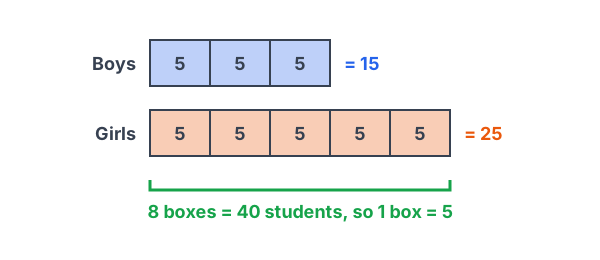
Step 2. The 8 boxes hold 40 students, so each box is 40 ÷ 8 = 5 students.
Step 3. Girls have 5 boxes: 5 × 5 = 25.
Answer: There are 25 girls (and 15 boys). Check: 15:25 simplifies to 3:5.
Common Mistakes
| Mistake | What it looks like | How to fix it |
|---|---|---|
| Writing the numbers in the wrong order | Dogs to cats written as 3:5 | Write the numbers in the order the words say: dogs to cats is 5:3. |
| Mixing up part-to-part and part-to-whole | Red to all marbles written as 4:7 | “To all” means use the total: 4:11. |
| Adding instead of multiplying | 3:5 = 4:6 | Multiply both numbers by the same number: 3:5 = 6:10. |
| Comparing different units | 2 feet to 18 inches written as 2:18 | Change to the same unit first: 24 inches to 18 inches is 4:3. |
| Thinking the total is one of the numbers | With boys:girls = 3:5 and 40 students, saying there are 5 girls | Each part of the ratio stands for a group. Find the value of one box first. |
Ratios, Fractions and Rates
A part-to-whole ratio is a fraction. A part-to-part ratio is not a fraction of the whole, but you can still write it with a fraction bar.
When a ratio compares two different kinds of units, like miles to hours, it is called a rate. The next lesson shows how to find a unit rate. Ratios also lead to proportions, where two ratios are set equal.
Practice Problems
- A fruit bowl has 5 apples and 3 oranges. Write the ratio of apples to all fruit.
- Simplify 12:16.
- Simplify 45:30.
- Are 9:12 and 15:20 equivalent ratios? Explain.
- Find the missing number: 4:9 = 20:?
- Find the missing number: 7:3 = ?:12
- A rice recipe uses 2 cups of rice for every 3 cups of water. How much water do you need for 8 cups of rice?
- Write the ratio of 1 hour to 45 minutes in simplest form.
- The ratio of red to blue marbles is 2:7. There are 54 marbles in all. How many are red?
- A team won 6 games and lost 4. Write the ratio of wins to games played in simplest form.
Show answers
- There are 5 + 3 = 8 pieces of fruit, so the ratio is 5:8.
- The GCF is 4: 12:16 = 3:4.
- The GCF is 15: 45:30 = 3:2.
- Yes. Both simplify to 3:4.
- 4 × 5 = 20, so multiply 9 by 5: the missing number is 45.
- 3 × 4 = 12, so multiply 7 by 4: the missing number is 28.
- The rice went from 2 to 8, which is 4 times as much. Water: 3 × 4 = 12 cups.
- 1 hour is 60 minutes. The ratio 60:45 simplifies to 4:3.
- There are 2 + 7 = 9 boxes, so each box is 54 ÷ 9 = 6 marbles. Red: 2 × 6 = 12.
- They played 6 + 4 = 10 games. Wins to games is 6:10, which simplifies to 3:5.
Ratios FAQ
What is the difference between a ratio and a fraction?
A fraction compares a part to a whole. A ratio can compare a part to a whole or a part to another part. So every fraction is a ratio, but not every ratio is a fraction of the whole.
Does the order of a ratio matter?
Yes. The ratio of cats to dogs, 3:5, is not the same as dogs to cats, 5:3. Always follow the order of the words.
Can a ratio have three numbers?
Yes. For example, a trail mix might have peanuts, raisins and almonds in the ratio 3:2:1. You can simplify or scale it the same way.
How do you simplify a ratio?
Divide both numbers by their greatest common factor. The ratio 18:24 has a GCF of 6, so it simplifies to 3:4.
Summary
- A ratio compares two amounts. Write it as a to b, a:b or as a fraction.
- The order of the numbers matches the order of the words.
- Part-to-part ratios compare two groups. Part-to-whole ratios compare a group to the total.
- Multiply or divide both numbers by the same number to find equivalent ratios.
- Use a ratio table or a tape diagram to solve ratio word problems.
Previous lesson: Nested Fractions
Next lesson: Unit Rates
Back to the Pre-Algebra (Math Basics) Index