
Nested Fractions
Nested fractions, also called complex fractions, have a fraction in the top, the bottom or both. To simplify one, remember that the main fraction bar means divide. Simplify the top and the bottom, then divide the top by the bottom. For example, \dfrac{1/2}{3/4} = \frac{1}{2} \div \frac{3}{4} = \frac{1}{2} \times \frac{4}{3} = \frac{2}{3}.
Before this lesson: You should know how to add and subtract fractions and how to multiply and divide fractions.
What Is a Nested Fraction?
A nested fraction is a fraction stacked on top of another fraction. The longest bar is the main fraction bar. Everything above it is the top, and everything below it is the bottom.
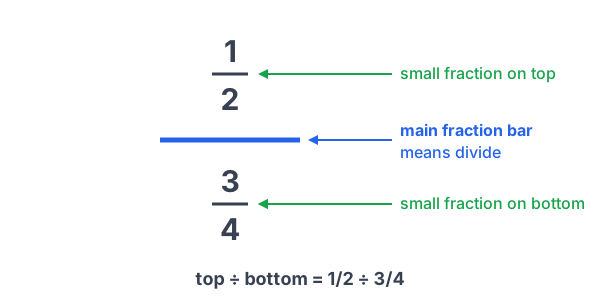
\dfrac{\;\dfrac{1}{2}\;}{\dfrac{3}{4}} = \frac{1}{2} \div \frac{3}{4}A nested fraction can look scary, but it is just a division problem written in a stack.
How to Simplify Nested Fractions
Method 1: Divide the top by the bottom
- Simplify the top into one fraction.
- Simplify the bottom into one fraction.
- Divide the top by the bottom: keep, change, flip.
- Simplify the answer.
Method 2: Multiply by the LCD
- Find the least common denominator (LCD) of every small fraction inside.
- Multiply the whole top and the whole bottom by the LCD. This clears the small fractions.
- Simplify what is left.
Method 1 is usually easiest when the top and bottom are single fractions. Method 2 saves time when the top or bottom has a sum or difference.
Worked Examples
Example 1: One fraction over another
Simplify \dfrac{2/3}{5/6}.
Step 1. Rewrite the main fraction bar as division: \frac{2}{3} \div \frac{5}{6}.
Step 2. Keep, change, flip.
\frac{2}{3} \times \frac{6}{5} = \frac{12}{15} = \frac{4}{5}Answer: \frac{4}{5}.
Example 2: A whole number on the bottom
Simplify \dfrac{3/4}{6}.
Step 1. Write 6 as \frac{6}{1}, so the problem is \frac{3}{4} \div \frac{6}{1}.
Step 2. Flip and multiply.
\frac{3}{4} \times \frac{1}{6} = \frac{3}{24} = \frac{1}{8}Answer: \frac{1}{8}.
Example 3: Sums in the top and bottom
Simplify \dfrac{1 + \frac{1}{2}}{3 - \frac{1}{4}}.
Step 1. Simplify the top: 1 + \frac{1}{2} = \frac{3}{2}.
Step 2. Simplify the bottom: 3 - \frac{1}{4} = \frac{12}{4} - \frac{1}{4} = \frac{11}{4}.
Step 3. Divide the top by the bottom.
\frac{3}{2} \div \frac{11}{4} = \frac{3}{2} \times \frac{4}{11} = \frac{12}{22} = \frac{6}{11}Answer: \frac{6}{11}.
Example 4: Use the LCD method
Simplify \dfrac{\frac{2}{3} - \frac{1}{6}}{\frac{1}{2} + \frac{1}{4}}.
Step 1. The small denominators are 3, 6, 2 and 4. Their LCD is 12.
Step 2. Multiply every term on top and bottom by 12.
\dfrac{12 \times \frac{2}{3} - 12 \times \frac{1}{6}}{12 \times \frac{1}{2} + 12 \times \frac{1}{4}} = \frac{8 - 2}{6 + 3} = \frac{6}{9}Answer: \frac{6}{9} = \frac{2}{3}.
Example 5: Word problem
You use \frac{3}{4} cup of sugar to make 1\frac{1}{2} batches of cookies. How much sugar is in one batch?
Step 1. Sugar per batch is the sugar divided by the batches: \dfrac{3/4}{1\frac{1}{2}}.
Step 2. Write 1\frac{1}{2} as \frac{3}{2}, then divide.
\frac{3}{4} \div \frac{3}{2} = \frac{3}{4} \times \frac{2}{3} = \frac{6}{12} = \frac{1}{2}Answer: One batch uses \frac{1}{2} cup of sugar.
Common Mistakes
| Mistake | What it looks like | How to fix it |
|---|---|---|
| Flipping the top instead of the bottom | \frac{3}{2} \times \frac{5}{6} for \dfrac{2/3}{5/6} | Keep the top fraction. Flip only the bottom one. |
| Misreading the main fraction bar | Reading \dfrac{4}{2/5} as \frac{4}{2} \div 5 | Find the longest bar first. Here it is 4 \div \frac{2}{5} = 10. |
| Multiplying only part of the top by the LCD | 12 \times \frac{2}{3} - \frac{1}{6} | Multiply every term on the top and the bottom. |
| Adding small fractions without a common denominator | 1 + \frac{1}{2} = \frac{2}{2} | Write 1 as \frac{2}{2} first: \frac{2}{2} + \frac{1}{2} = \frac{3}{2}. |
Nested Fractions and Order of Operations
The main fraction bar works like a grouping symbol. Finish everything on the top and everything on the bottom first. Then divide. This follows the order of operations.
In algebra, you’ll see nested fractions with variables, like \dfrac{1/x}{2/x}. Those use the same two methods, and they are taught in Algebra 2 (coming soon).
Practice Problems
Simplify each nested fraction.
- \dfrac{1/2}{1/4}
- \dfrac{3/5}{9/10}
- \dfrac{5/8}{5/12}
- \dfrac{6}{3/4}
- \dfrac{2/7}{4}
- \dfrac{1 + \frac{1}{3}}{2/3}
- \dfrac{\frac{1}{2} + \frac{1}{4}}{1/8}
- \dfrac{3 - \frac{1}{2}}{1 + \frac{1}{4}}
- \dfrac{\frac{2}{3} + \frac{1}{2}}{5/6}
- Jordan walks 2\frac{1}{2} miles in \frac{3}{4} of an hour. How many miles does he walk per hour?
Show answers
- \frac{1}{2} \times \frac{4}{1} = 2
- \frac{3}{5} \times \frac{10}{9} = \frac{30}{45} = \frac{2}{3}
- \frac{5}{8} \times \frac{12}{5} = \frac{60}{40} = \frac{3}{2}
- \frac{6}{1} \times \frac{4}{3} = \frac{24}{3} = 8
- \frac{2}{7} \times \frac{1}{4} = \frac{2}{28} = \frac{1}{14}
- The top is \frac{4}{3}. Then \frac{4}{3} \times \frac{3}{2} = 2.
- The top is \frac{3}{4}. Then \frac{3}{4} \times \frac{8}{1} = 6.
- The top is \frac{5}{2} and the bottom is \frac{5}{4}. Then \frac{5}{2} \times \frac{4}{5} = 2.
- The top is \frac{4}{6} + \frac{3}{6} = \frac{7}{6}. Then \frac{7}{6} \times \frac{6}{5} = \frac{7}{5}.
- \frac{5}{2} \div \frac{3}{4} = \frac{5}{2} \times \frac{4}{3} = \frac{20}{6} = \frac{10}{3}, or 3\frac{1}{3} miles per hour.
Nested Fractions FAQ
Is a nested fraction the same as a complex fraction?
Yes. Nested fractions, complex fractions, compound fractions and stacked fractions all mean a fraction with another fraction inside it.
Can a fraction be inside a fraction?
Yes. The top, the bottom or both can be fractions. The main fraction bar still means divide.
Which method is easiest for nested fractions?
If the top and bottom are each one fraction, divide them. If either one is a sum or difference of fractions, multiplying by the LCD is usually faster.
Summary
- A nested fraction has a fraction in its top, bottom or both.
- The main fraction bar means divide the top by the bottom.
- Method 1: simplify the top and bottom, then keep, change, flip.
- Method 2: multiply every term on top and bottom by the LCD of the small fractions.
- Always simplify the final answer.
Previous lesson: Converting Fractions and Decimals
Next lesson: Ratios
Back to the Pre-Algebra Index