
Compound Inequalities
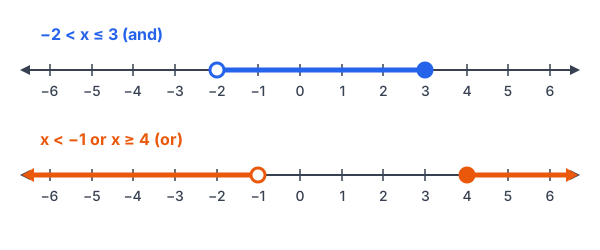
A compound inequality is two inequalities joined by “and” or “or.” An “and” inequality, like -2 \lt x \le 3, is true only where both parts are true, so its graph is the overlap. An “or” inequality, like x \lt -1 or x \ge 4, is true where at least one part is true.
Before this lesson: You should know how to solve multi-step inequalities and when to flip the sign, from one-step inequalities.
Extra practice: The Algebra 1 Unit 2 Practice Pack has printable problems, answer keys and a cheat sheet for this unit.
What Is a Compound Inequality?
Sometimes one inequality is not enough. A ride might need riders who are at least 48 inches tall and under 76 inches tall. That is two inequalities at once: h \ge 48 and h \lt 76.
You can write an “and” inequality as one three-part statement: 48 \le h \lt 76. Read it from the middle: h is between 48 and 76.
An “or” inequality is different. It is true when either part is true. Its graph is usually two pieces that point away from each other.
| Type | Means | Graph | Example |
|---|---|---|---|
| And | Both parts must be true | One piece between two points | -2 \lt x \le 3 |
| Or | At least one part must be true | Two pieces pointing apart | x \lt -1 or x \ge 4 |
How to Solve Compound Inequalities
“And” inequalities (three parts)
- Do the same operation to all three parts.
- Get the variable alone in the middle.
- If you multiply or divide by a negative number, flip both inequality signs.
- Graph the numbers between the two ends.
\begin{aligned}
1 &\lt 2x - 3 \le 9 \\
4 &\lt 2x \le 12 & &\text{add 3 to all three parts} \\
2 &\lt x \le 6 & &\text{divide all three parts by 2}
\end{aligned}
“Or” inequalities
- Solve each inequality on its own.
- Keep the word “or” between the answers.
- Graph both answers on the same number line.
Worked Examples
Example 1: A three-part inequality
Solve -3 \le x + 2 \lt 5 and graph it.
-3 - 2 \le x + 2 - 2 \lt 5 - 2
Step 1. Subtract 2 from all three parts.
-5 \le x \lt 3
Step 2. Simplify each part.
Step 3. Graph it. Use a closed circle at -5, because it is included. Use an open circle at 3, because it is not. Shade between them.
Answer: -5 \le x \lt 3
Check: Try x = 0, which is inside. 0 + 2 = 2, and -3 \le 2 \lt 5 is true.
Example 2: Two steps in the middle
Solve 1 \lt 2x - 3 \le 9.
1 + 3 \lt 2x - 3 + 3 \le 9 + 3
Step 1. Add 3 to all three parts.
4 \lt 2x \le 12
Step 2. Simplify each part.
\frac{4}{2} \lt \frac{2x}{2} \le \frac{12}{2}Step 3. Divide all three parts by 2.
2 \lt x \le 6
Step 4. Simplify each part.
Answer: 2 \lt x \le 6
Check: Try x = 4. Then 2(4) - 3 = 5, and 1 \lt 5 \le 9 is true.
Example 3: Dividing by a negative
Solve -7 \le 5 - 3x \lt 11.
-7 - 5 \le 5 - 3x - 5 \lt 11 - 5
Step 1. Subtract 5 from all three parts.
-12 \le -3x \lt 6
Step 2. Simplify each part.
\frac{-12}{-3} \ge \frac{-3x}{-3} \gt \frac{6}{-3}Step 3. Divide all three parts by -3. Dividing by a negative flips both signs (see one-step inequalities).
4 \ge x \gt -2
Step 4. Simplify each part.
-2 \lt x \le 4
Step 5. Rewrite it so the smaller number is on the left.
Answer: -2 \lt x \le 4
Check: Try x = 0. Then 5 - 3(0) = 5, and -7 \le 5 \lt 11 is true.
Example 4: An “or” inequality
Solve 2x + 1 \lt -5 or 3x - 4 \ge 8.
2x \lt -6 \text{ or } 3x - 4 \ge 8Step 1. Solve the first part. Subtract 1 from both sides.
x \lt -3 \text{ or } 3x - 4 \ge 8Step 2. Divide both sides by 2.
x \lt -3 \text{ or } 3x \ge 12Step 3. Solve the second part. Add 4 to both sides.
x \lt -3 \text{ or } x \ge 4Step 4. Divide both sides by 3.
Step 5. Graph both. Put an open circle at -3 and shade left. Put a closed circle at 4 and shade right.
Answer: x \lt -3 or x \ge 4
Check: Try x = 5. Then 3(5) - 4 = 11, and 11 \ge 8, so it works. Try x = 0. Neither part is true, and 0 is not shaded.
Example 5: Word problem
Sam’s phone plan costs $20 a month plus $5 for each gigabyte (GB) of data. He wants his bill to be at least $35 and at most $50. How many GB can he use?
35 \le 20 + 5g \le 50
Step 1. Let g = the number of GB. The bill is 20 + 5g. “At least 35 and at most 50” gives an “and” inequality.
15 \le 5g \le 30
Step 2. Subtract 20 from all three parts.
3 \le g \le 6
Step 3. Divide all three parts by 5.
Answer: 3 \le g \le 6. Sam can use from 3 to 6 GB.
Check: At 3 GB the bill is 20 + 5(3) = 35. At 6 GB it is 20 + 5(6) = 50. Both ends fit.
Common Mistakes
| Mistake | What it looks like | How to fix it |
|---|---|---|
| Changing only two parts | 1 \lt 2x - 3 \le 9 becomes 1 \lt 2x \le 12 | Add 3 to all three parts: 4 \lt 2x \le 12. |
| Flipping only one sign | -12 \le -3x \lt 6 becomes 4 \ge x \lt -2 | Flip both: 4 \ge x \gt -2, so -2 \lt x \le 4. |
| Writing an “or” as three parts | 4 \lt x \lt -1 | No number is both above 4 and below −1. Write two parts with “or”. |
| Graphing “and” as two rays | Shading outward from both points | “And” means the overlap. Shade between the two points. |
| Mixing up open and closed circles | A closed circle at 3 for x \lt 3 | Closed for \le and \ge. Open for \lt and \gt. |
Special Cases: No Solution and All Real Numbers
Sometimes the two parts don’t fit together the usual way.
| Inequality | What happens | Answer |
|---|---|---|
| x \lt 1 and x \gt 5 | No number is both less than 1 and greater than 5. There is no overlap. | No solution |
| x \lt 5 or x \gt 1 | Every number is less than 5, greater than 1, or both. | All real numbers |
You will use compound inequalities again to solve absolute value inequalities. For example, |x| \lt 3 becomes -3 \lt x \lt 3. To review what |x| means, see absolute value.
Practice Problems
Solve each compound inequality. Then sketch its graph on a number line.
- -4 \lt x - 3 \lt 2
- 6 \le 2x \le 14
- -5 \lt 3x + 1 \le 10
- 2 \le \frac{x}{4} + 1 \lt 3
- -1 \lt 7 - 2x \lt 9
- x + 5 \lt 2 or x - 1 \gt 4
- 4x \le -8 or 2x + 3 \ge 11
- -3x \gt 9 or \frac{x}{2} \ge 1
- x \gt 6 and x \lt 2
- A party hall costs $150 plus $12 per guest. A family wants to spend from $390 to $630, including both amounts. How many guests can they invite?
Answers
Show answers
1.
-1 \lt x \lt 5
Add 3 to all three parts.
Graph: open circles at −1 and 5, shaded between
2.
3 \le x \le 7
Divide all three parts by 2.
Graph: closed circles at 3 and 7, shaded between
3.
-6 \lt 3x \le 9
Subtract 1 from all three parts.
-2 \lt x \le 3
Divide all three parts by 3.
Graph: open circle at −2, closed circle at 3, shaded between
4.
1 \le \frac{x}{4} \lt 2Subtract 1 from all three parts.
4 \le x \lt 8
Multiply all three parts by 4.
Graph: closed circle at 4, open circle at 8, shaded between
5.
-8 \lt -2x \lt 2
Subtract 7 from all three parts.
4 \gt x \gt -1
Divide all three parts by −2 and flip both signs.
-1 \lt x \lt 4
Rewrite with the smaller number on the left.
Graph: open circles at −1 and 4, shaded between
6.
x \lt -3 \text{ or } x - 1 \gt 4Subtract 5 in the first part.
x \lt -3 \text{ or } x \gt 5Add 1 in the second part.
Graph: open circle at −3 shaded left, open circle at 5 shaded right
7.
x \le -2 \text{ or } 2x + 3 \ge 11Divide the first part by 4.
x \le -2 \text{ or } 2x \ge 8Subtract 3 in the second part.
x \le -2 \text{ or } x \ge 4Divide the second part by 2.
Graph: closed circle at −2 shaded left, closed circle at 4 shaded right
8.
x \lt -3 \text{ or } \frac{x}{2} \ge 1Divide the first part by −3 and flip the sign.
x \lt -3 \text{ or } x \ge 2Multiply the second part by 2.
Graph: open circle at −3 shaded left, closed circle at 2 shaded right
9.
x \gt 6
Find the numbers greater than 6.
x \lt 2
Find the numbers less than 2.
“And” needs both to be true. No number is both greater than 6 and less than 2
No solution.
10.
390 \le 150 + 12g \le 630
Let g = the number of guests. The cost is 150 + 12g, from 390 to 630.
240 \le 12g \le 480
Subtract 150 from all three parts.
20 \le g \le 40
Divide all three parts by 12.
They can invite 20 to 40 guests.
Want more practice? The Algebra 1 Unit 2 Practice Pack has 51 pages of problems on this and the other lessons in the unit, with step-by-step answers and a cheat sheet.
Compound Inequalities FAQ
What is a compound inequality?
It is two inequalities joined by the word “and” or “or.” You solve both parts and show the answer on one number line.
What is the difference between “and” and “or” inequalities?
An “and” inequality needs both parts to be true, so its graph is the overlap. An “or” inequality needs only one part to be true, so its graph includes both pieces.
How do you solve a three-part inequality?
Do the same thing to all three parts until the variable is alone in the middle. If you multiply or divide by a negative, flip both signs.
When does a compound inequality have no solution?
An “and” inequality has no solution when the two parts don’t overlap. For example, no number fits x \gt 6 and x \lt 2 at the same time.
Summary
- A compound inequality joins two inequalities with “and” or “or.”
- “And” means both parts are true. Its graph is the overlap between two points.
- “Or” means at least one part is true. Its graph is usually two pieces pointing apart.
- For a three-part inequality, do the same thing to all three parts.
- Dividing or multiplying by a negative flips both signs.
Previous lesson: Multi-Step Inequalities
Next lesson: Absolute Value Equations
Back to the Algebra 1 Index