
Absolute Value Equations
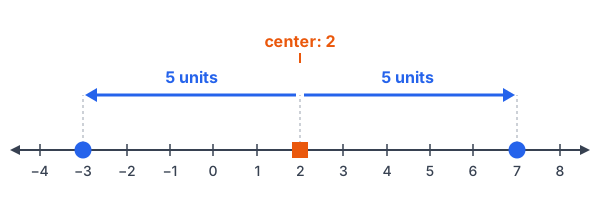
To solve an absolute value equation, first get the absolute value alone. Then split it into two equations, because a number and its opposite have the same absolute value. For example, |x - 2| = 5 means x - 2 = 5 or x - 2 = -5, so x = 7 or x = -3.
Before this lesson: You should know what absolute value means and how to solve two-step equations.
Extra practice: The Algebra 1 Unit 2 Practice Pack has printable problems, answer keys and a cheat sheet for this unit.
What Is an Absolute Value Equation?
An absolute value equation has a variable inside absolute value bars, like |x| = 4. Absolute value is distance from 0. So |x| = 4 asks: which numbers are 4 units from 0?
There are two: 4 and -4. That is why most absolute value equations have two solutions.
The same idea works with more inside the bars. |x - 2| = 5 asks which numbers are 5 units from 2. Count 5 to the right to get 7. Count 5 to the left to get -3.
How to Solve Absolute Value Equations
- Get the absolute value alone on one side.
- Look at the other side. If it is negative, there is no solution. If it is 0, there is one solution.
- If it is positive, write two equations: the inside equals the number, and the inside equals its opposite.
- Solve both equations.
- Check both answers in the original equation.
\begin{aligned}
|x - 2| &= 5 \\
x - 2 = 5 \quad &\text{or} \quad x - 2 = -5 \\
x = 7 \quad &\text{or} \quad x = -3
\end{aligned}
Check: |7 - 2| = |5| = 5 and |-3 - 2| = |-5| = 5. Both work.
Worked Examples
Example 1: Basic equation
Solve |x + 3| = 8.
Step 1. Check the setup. The absolute value is already alone, and 8 is positive.
x + 3 = 8 \text{ or } x + 3 = -8Step 2. Split it into two equations. The inside is 8 or it is −8.
x = 5 \text{ or } x = -11Step 3. Subtract 3 from both sides of each equation.
Answer: x = 5 or x = -11
Check: |5 + 3| = |8| = 8 and |-11 + 3| = |-8| = 8. Both work.
Example 2: Get the absolute value alone first
Solve 2|x - 1| + 3 = 13.
2|x - 1| = 10
Step 1. Subtract 3 from both sides.
|x - 1| = 5
Step 2. Divide both sides by 2. Now the absolute value is alone.
x - 1 = 5 \text{ or } x - 1 = -5Step 3. Split it into two equations.
x = 6 \text{ or } x = -4Step 4. Add 1 to both sides of each equation.
Answer: x = 6 or x = -4
Check: 2|6 - 1| + 3 = 2(5) + 3 = 13 and 2|-4 - 1| + 3 = 2(5) + 3 = 13. Both work.
Example 3: A coefficient inside the bars
Solve |3x - 4| = 11.
3x - 4 = 11 \text{ or } 3x - 4 = -11Step 1. Split it into two equations.
3x = 15 \text{ or } 3x = -7Step 2. Add 4 to both sides of each equation.
x = 5 \text{ or } x = -\frac{7}{3}Step 3. Divide both sides of each equation by 3. The second answer is a fraction (see fractions).
Answer: x = 5 or x = -\frac{7}{3}
Check: |3(5) - 4| = |11| = 11 and |3(-\frac{7}{3}) - 4| = |-7 - 4| = |-11| = 11. Both work.
Example 4: No solution
Solve |x + 7| + 10 = 4.
|x + 7| = -6
Step 1. Subtract 10 from both sides.
Step 2. An absolute value is a distance, so it can never be negative. No number makes this true. Stop here.
Answer: No solution.
Example 5: Word problem
A thermostat is set to 70°F. The heater switches on or off when the temperature is exactly 3°F away from the setting. At what temperatures does it switch?
|t - 70| = 3
Step 1. Let t = the temperature. “3 away from 70” means the distance between t and 70 is 3.
t - 70 = 3 \text{ or } t - 70 = -3Step 2. Split it into two equations.
t = 73 \text{ or } t = 67Step 3. Add 70 to both sides of each equation.
Answer: It switches at 67°F and at 73°F. Both are 3 degrees from 70.
Common Mistakes
| Mistake | What it looks like | How to fix it |
|---|---|---|
| Splitting before getting the absolute value alone | 2|x - 1| + 3 = 13 becomes 2(x - 1) + 3 = -13, so x = -7 | First get |x - 1| = 5. Then split. The answers are 6 and -4. |
| Writing only one equation | |x + 3| = 8 gives only x = 5 | Also solve x + 3 = -8, which gives x = -11. |
| Solving when the other side is negative | |x| = -5 gives “x = -5” | A distance can’t be negative. There is no solution. |
| Moving a number into the bars | |x| + 3 = 10 becomes |x + 3| = 10 | Subtract 3 outside the bars: |x| = 7, so x = \pm 7. |
| Making only part of the inside negative | |3x - 4| = 11 becomes 3x + 4 = -11 | Keep the inside the same. Only the other side changes sign: 3x - 4 = -11. |
Special Cases and Distance
| After you get the absolute value alone | Example | Number of solutions |
|---|---|---|
| It equals a positive number | |x - 2| = 5 | Two: x = 7 or x = -3 |
| It equals 0 | |x - 6| = 0 | One: x = 6 |
| It equals a negative number | |2x + 5| = -3 | None |
You can also go the other way and write an equation from a distance. |x - a| = d means “x is d units from a.” For example, the numbers 4 units from -1 solve |x + 1| = 4. They are 3 and -5.
Next, you will solve inequalities like |x| \lt 3. Those use the compound inequalities you just learned.
Practice Problems
Solve each equation. If there is no solution, say so.
- |x| = 12
- |x - 4| = 9
- |3x + 6| = 0
- |2x| + 5 = 17
- 3|x + 1| = 21
- |4x - 2| = 10
- \left|\frac{x}{2} + 1\right| = 3
- 5|x - 3| - 4 = 6
- |x - 8| + 9 = 2
- A bag of flour should weigh 5 pounds. A machine flags any bag that is exactly 0.2 pound off. Write and solve an equation to find the weights it flags.
Answers
Show answers
1.
x = 12 \text{ or } x = -12The numbers 12 units from 0 are 12 and −12.
2.
x - 4 = 9 \text{ or } x - 4 = -9Split it.
x = 13 \text{ or } x = -5Add 4 to both sides of each.
3.
3x + 6 = 0
Only 0 has an absolute value of 0, so the inside equals 0.
3x = -6
Subtract 6 from both sides.
x = -2
Divide both sides by 3.
There is one solution.
4.
|2x| = 12
Subtract 5 from both sides.
2x = 12 \text{ or } 2x = -12Split it.
x = 6 \text{ or } x = -6Divide both sides of each by 2.
5.
|x + 1| = 7
Divide both sides by 3.
x + 1 = 7 \text{ or } x + 1 = -7Split it.
x = 6 \text{ or } x = -8Subtract 1 from both sides of each.
6.
4x - 2 = 10 \text{ or } 4x - 2 = -10Split it.
4x = 12 \text{ or } 4x = -8Add 2 to both sides of each.
x = 3 \text{ or } x = -2Divide both sides of each by 4.
7.
\frac{x}{2} + 1 = 3 \text{ or } \frac{x}{2} + 1 = -3Split it.
\frac{x}{2} = 2 \text{ or } \frac{x}{2} = -4Subtract 1 from both sides of each.
x = 4 \text{ or } x = -8Multiply both sides of each by 2.
8.
5|x - 3| = 10
Add 4 to both sides.
|x - 3| = 2
Divide both sides by 5.
x - 3 = 2 \text{ or } x - 3 = -2Split it.
x = 5 \text{ or } x = 1Add 3 to both sides of each.
9.
|x - 8| = -7
Subtract 9 from both sides.
An absolute value can’t be negative
No solution.
10.
|w - 5| = 0.2
Let w = the weight. The distance from 5 is 0.2.
w - 5 = 0.2 \text{ or } w - 5 = -0.2Split it.
w = 5.2 \text{ or } w = 4.8Add 5 to both sides of each (see operations with decimals)
It flags bags of 5.2 pounds and 4.8 pounds.
Want more practice? The Algebra 1 Unit 2 Practice Pack has 51 pages of problems on this and the other lessons in the unit, with step-by-step answers and a cheat sheet.
Absolute Value Equations FAQ
How do you solve absolute value equations?
Get the absolute value alone on one side. Then write two equations, one with the positive number and one with its opposite, and solve both.
Why do absolute value equations have two solutions?
Absolute value measures distance from 0. Two numbers are the same distance from 0, one on each side, so there are usually two answers.
When does an absolute value equation have no solution?
It has no solution when the absolute value equals a negative number, like |x + 7| = -6. A distance can never be negative.
Can an absolute value equation have only one solution?
Yes. When the absolute value equals 0, the inside must equal 0. For example, |x - 6| = 0 has only one solution, x = 6.
Summary
- Absolute value is distance from 0, so it is never negative.
- Get the absolute value alone before you split the equation.
- Split |A| = c into A = c or A = -c when c is positive.
- If the absolute value equals 0, there is one solution. If it equals a negative number, there is none.
- Check both answers in the original equation.
Previous lesson: Compound Inequalities
Next lesson: Absolute Value Inequalities
Back to the Algebra 1 Index