
Absolute Value Inequalities
To solve an absolute value inequality, get the absolute value alone, then rewrite it without the bars. A “less than” inequality becomes an “and” inequality: |x| \lt 3 means -3 \lt x \lt 3. A “greater than” inequality becomes an “or” inequality: |x| \gt 3 means x \lt -3 or x \gt 3.
Before this lesson: You should know how to solve absolute value equations and compound inequalities.
Extra practice: The Algebra 1 Unit 2 Practice Pack has printable problems, answer keys and a cheat sheet for this unit.
What Does an Absolute Value Inequality Mean?
Absolute value is distance from 0. So |x| \lt 3 means “x is less than 3 units from 0.” Those numbers are all between -3 and 3.
|x| \gt 3 means “x is more than 3 units from 0.” Those numbers are outside: below -3 or above 3.
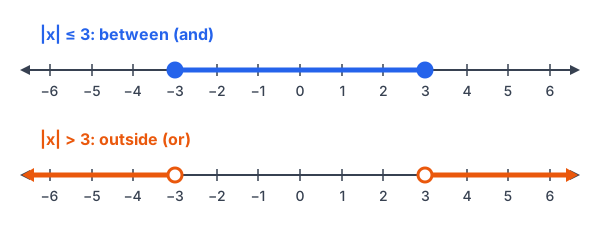
A memory trick: “less thand” and “greator.” Less than gives an “and” inequality. Greater than gives an “or” inequality.
How to Solve Absolute Value Inequalities
- Get the absolute value alone on one side.
- Check the number on the other side. If it is negative, see the special cases below.
- Rewrite the inequality using the table below.
- Solve the compound inequality.
- Graph the answer and check a number from the shaded part.
| If you have | Rewrite it as | Type | Graph |
|---|---|---|---|
| |A| \lt c | -c \lt A \lt c | And | Between two points |
| |A| \le c | -c \le A \le c | And | Between two points |
| |A| \gt c | A \lt -c or A \gt c | Or | Two outside pieces |
| |A| \ge c | A \le -c or A \ge c | Or | Two outside pieces |
Here A is whatever is inside the bars, and c is a positive number. Notice that the sign turns around on the -c side of an “or” inequality.
Worked Examples
Example 1: Less than
Solve |x - 1| \lt 4.
-4 \lt x - 1 \lt 4
Step 1. It is “less than,” so write an “and” inequality: the inside is between -4 and 4 (see compound inequalities).
-4 + 1 \lt x - 1 + 1 \lt 4 + 1
Step 2. Add 1 to all three parts.
-3 \lt x \lt 5
Step 3. Simplify each part.
Step 4. Graph it: open circles at -3 and 5, shaded between.
Answer: -3 \lt x \lt 5
Check: Try x = 0. |0 - 1| = 1, and 1 \lt 4. It works.
Example 2: Greater than or equal to
Solve |x + 2| \ge 5.
x + 2 \le -5 \text{ or } x + 2 \ge 5Step 1. It is “greater than,” so write an “or” inequality. Turn the sign around on the negative side.
x \le -7 \text{ or } x \ge 3Step 2. Subtract 2 from both sides of each part.
Step 3. Graph it: closed circle at -7 shaded left, closed circle at 3 shaded right.
Answer: x \le -7 or x \ge 3
Check: Try x = 4. |4 + 2| = 6, and 6 \ge 5. Try x = 0: |0 + 2| = 2, which is not at least 5, so 0 is not a solution.
Example 3: Get the absolute value alone first
Solve 3|2x - 1| + 4 \le 25.
3|2x - 1| \le 21
Step 1. Subtract 4 from both sides.
|2x - 1| \le 7
Step 2. Divide both sides by 3. Now the absolute value is alone.
-7 \le 2x - 1 \le 7
Step 3. It is “less than,” so write an “and” inequality.
-6 \le 2x \le 8
Step 4. Add 1 to all three parts.
-3 \le x \le 4
Step 5. Divide all three parts by 2.
Answer: -3 \le x \le 4
Check: Try x = 4. 3|2(4) - 1| + 4 = 3(7) + 4 = 25, and 25 \le 25. It works.
Example 4: A negative coefficient inside
Solve |5 - 2x| \gt 9.
5 - 2x \lt -9 \text{ or } 5 - 2x \gt 9Step 1. It is “greater than,” so write an “or” inequality.
-2x \lt -14 \text{ or } -2x \gt 4Step 2. Subtract 5 from both sides of each part.
x \gt 7 \text{ or } x \lt -2Step 3. Divide each part by -2 and flip each sign (see one-step inequalities).
x \lt -2 \text{ or } x \gt 7Step 4. Write the smaller part first.
Answer: x \lt -2 or x \gt 7
Check: Try x = 8. |5 - 16| = |-11| = 11, and 11 \gt 9. Try x = -3: |5 + 6| = 11, and 11 \gt 9. Both work.
Example 5: Word problem
A machine cuts boards that should be 48 inches long. A board passes if its length is within 0.25 inch of 48 inches. What lengths pass?
|L - 48| \le 0.25
Step 1. Let L = the length. “Within 0.25 of 48” means the distance from 48 is at most 0.25.
-0.25 \le L - 48 \le 0.25
Step 2. It is “less than or equal to,” so write an “and” inequality.
47.75 \le L \le 48.25
Step 3. Add 48 to all three parts (see operations with decimals).
Answer: Boards from 47.75 inches to 48.25 inches long pass.
Common Mistakes
| Mistake | What it looks like | How to fix it |
|---|---|---|
| Using “or” for a less-than inequality | |x - 1| \lt 4 becomes x - 1 \lt -4 or x - 1 \lt 4 | Less than means between: -4 \lt x - 1 \lt 4. |
| Not turning the sign on the negative side | |x + 2| \ge 5 becomes x + 2 \ge -5 or x + 2 \ge 5 | Use x + 2 \le -5 on the negative side. |
| Splitting before getting the absolute value alone | 3|2x - 1| + 4 \le 25 becomes -25 \le 3(2x - 1) + 4 \le 25 | First get |2x - 1| \le 7. Then split. |
| Forgetting to flip when dividing by a negative | -2x \lt -14 becomes x \lt 7 | Dividing by -2 flips the sign: x \gt 7. |
| Saying “no solution” for greater than a negative | |x| \gt -2 gives “no solution” | An absolute value is always at least 0, so it is always greater than −2. Every number works. |
Special Cases
When the number on the other side is negative or zero, think about distance instead of splitting.
| Inequality | Why | Answer |
|---|---|---|
| |x| \lt -2 | A distance can’t be less than a negative number. | No solution |
| |x| \gt -2 | Every distance is at least 0, which is more than −2. | All real numbers |
| |x| \le 0 | Only 0 is 0 units from 0. | x = 0 |
| |x| \gt 0 | Every number except 0 is more than 0 units from 0. | x \ne 0 |
Absolute value inequalities are useful for tolerances, like a part that must be within a set amount of its target size. To review the steps for “and” and “or” graphs, see compound inequalities. To review the sign-flip rule, see one-step inequalities.
Practice Problems
Solve each inequality. Then describe or sketch its graph.
- |x| \lt 6
- |x| \ge 2
- |x - 3| \le 5
- |x + 4| \gt 1
- |2x + 1| \lt 9
- |3x - 6| \ge 12
- 2|x - 5| + 1 \le 9
- |4 - x| \gt 3
- |x + 9| \lt -1
- A cereal box should hold 20 ounces. A box passes if its weight is within 0.5 ounce of 20 ounces. Write and solve an inequality for the weights that pass.
Answers
Show answers
1.
-6 \lt x \lt 6
“Less than” means between.
Graph: open circles at −6 and 6, shaded between
2.
x \le -2 \text{ or } x \ge 2“Greater than” means outside.
Graph: closed circles at −2 and 2, shaded outward
3.
-5 \le x - 3 \le 5
Write an “and” inequality.
-2 \le x \le 8
Add 3 to all three parts.
4.
x + 4 \lt -1 \text{ or } x + 4 \gt 1Write an “or” inequality.
x \lt -5 \text{ or } x \gt -3Subtract 4 from both sides of each.
5.
-9 \lt 2x + 1 \lt 9
Write an “and” inequality.
-10 \lt 2x \lt 8
Subtract 1 from all three parts.
-5 \lt x \lt 4
Divide all three parts by 2.
6.
3x - 6 \le -12 \text{ or } 3x - 6 \ge 12Write an “or” inequality.
3x \le -6 \text{ or } 3x \ge 18Add 6 to both sides of each.
x \le -2 \text{ or } x \ge 6Divide both sides of each by 3.
7.
2|x - 5| \le 8
Subtract 1 from both sides.
|x - 5| \le 4
Divide both sides by 2.
-4 \le x - 5 \le 4
Write an “and” inequality.
1 \le x \le 9
Add 5 to all three parts.
8.
4 - x \lt -3 \text{ or } 4 - x \gt 3Write an “or” inequality.
-x \lt -7 \text{ or } -x \gt -1Subtract 4 from both sides of each.
x \gt 7 \text{ or } x \lt 1Divide each part by −1 and flip each sign.
9.
An absolute value is never negative, so it can’t be less than a negative number
No solution.
10.
|w - 20| \le 0.5
Let w = the weight. The distance from 20 is at most 0.5.
-0.5 \le w - 20 \le 0.5
Write an “and” inequality.
19.5 \le w \le 20.5
Add 20 to all three parts.
Boxes from 19.5 to 20.5 ounces pass.
Want more practice? The Algebra 1 Unit 2 Practice Pack has 51 pages of problems on this and the other lessons in the unit, with step-by-step answers and a cheat sheet.
Absolute Value Inequalities FAQ
How do you solve absolute value inequalities?
Get the absolute value alone. If it is less than a number, write an “and” inequality. If it is greater than a number, write an “or” inequality. Then solve and graph.
When is an absolute value inequality “and” or “or”?
Less than (\lt or \le) gives “and,” because the answers are between two numbers. Greater than (\gt or \ge) gives “or,” because the answers are outside.
What if the absolute value is less than a negative number?
Then there is no solution, because an absolute value is never negative. If it is greater than a negative number, every number is a solution.
Do you flip the sign in absolute value inequalities?
For an “or” inequality, the part with -c uses the opposite sign. You also flip a sign any time you multiply or divide by a negative number.
Summary
- An absolute value inequality compares a distance to a number.
- Get the absolute value alone before you rewrite it.
- |A| \lt c means -c \lt A \lt c: an “and” inequality, shaded between.
- |A| \gt c means A \lt -c or A \gt c: an “or” inequality, shaded outside.
- If the number is negative, the answer is either no solution or all real numbers.
Previous lesson: Absolute Value Equations
Next lesson: Relations and Functions
Back to the Algebra 1 Index