
Two-Step Equations
A two-step equation needs two inverse operations to solve, like 3x + 5 = 20. To solve two-step equations, first undo the adding or subtracting, then undo the multiplying or dividing. Do each step to both sides: 3x + 5 = 20 becomes 3x = 15, so x = 5.
Before this lesson: You should know how to solve one-step equations and how to use the order of operations.
What Is a Two-Step Equation?
In a two-step equation, two things are done to the variable. In 3x + 5 = 20, the variable is multiplied by 3, and then 5 is added.
To solve it, undo those steps in reverse order. Think about getting dressed: you put on socks, then shoes. To undress, you take off the shoes first, then the socks.
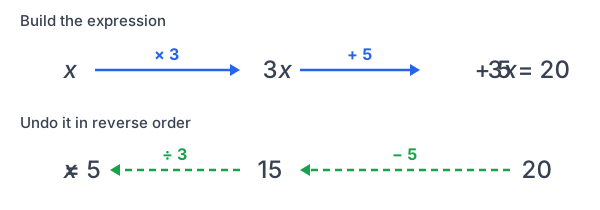
The last thing done to the variable was adding 5, so subtract 5 first. Then divide by 3.
How to Solve Two-Step Equations
- Undo the adding or subtracting. Do it to both sides.
- Undo the multiplying or dividing. Do it to both sides.
- Check your answer in the original equation.
\begin{aligned}
3x + 5 &= 20 \\
3x + 5 - 5 &= 20 - 5 \\
3x &= 15 \\
\frac{3x}{3} &= \frac{15}{3} \\
x &= 5
\end{aligned}
Check: 3(5) + 5 = 15 + 5 = 20. It works.
Worked Examples
Example 1: Negative numbers
Solve -2y - 7 = 9.
Step 1. 7 is subtracted, so add 7 to both sides.
Step 2. The variable is multiplied by -2, so divide both sides by -2.
\begin{aligned}
-2y - 7 &= 9 \\
-2y &= 16 \\
y &= -8
\end{aligned}
Check: -2(-8) - 7 = 16 - 7 = 9. It works.
Answer: y = -8
Example 2: Division
Solve \frac{x}{4} - 3 = 2.
Step 1. Add 3 to both sides.
Step 2. The variable is divided by 4, so multiply both sides by 4.
\begin{aligned}
\frac{x}{4} - 3 &= 2 \\
\frac{x}{4} &= 5 \\
x &= 20
\end{aligned}
Check: \frac{20}{4} - 3 = 5 - 3 = 2. It works.
Answer: x = 20
Example 3: Variable on the right side
Solve 11 = 5 - 3k.
Step 1. The variable can be on either side. Subtract 5 from both sides.
Step 2. Divide both sides by -3.
\begin{aligned}
11 &= 5 - 3k \\
6 &= -3k \\
-2 &= k
\end{aligned}
Check: 5 - 3(-2) = 5 + 6 = 11. It works.
Answer: k = -2
Example 4: A fraction coefficient
Solve \frac{2}{3}m + 4 = 10.
Step 1. Subtract 4 from both sides.
Step 2. Multiply both sides by the reciprocal of \frac{2}{3}, which is \frac{3}{2}.
\begin{aligned}
\tfrac{2}{3}m + 4 &= 10 \\
\tfrac{2}{3}m &= 6 \\
m &= \tfrac{3}{2}(6) = 9
\end{aligned}
Check: \frac{2}{3}(9) + 4 = 6 + 4 = 10. It works.
Answer: m = 9
Example 5: Word problem
A gym charges $35 to join, plus $15 each month. Jordan has paid $125 in total. How many months has Jordan been a member?
Step 1. Let m = the number of months. The cost is 15m + 35, so the equation is 15m + 35 = 125.
Step 2. Subtract 35, then divide by 15.
\begin{aligned}
15m + 35 &= 125 \\
15m &= 90 \\
m &= 6
\end{aligned}
Check: 15(6) + 35 = 90 + 35 = 125. It works.
Answer: Jordan has been a member for 6 months.
Common Mistakes
| Mistake | What it looks like | How to fix it |
|---|---|---|
| Dividing only one term | 3x + 5 = 20 becomes x + 5 = \frac{20}{3} | Undo the adding first: subtract 5, then divide by 3. |
| Subtracting when you should add | -2y - 7 = 9 becomes -2y = 2 | Undo subtracting 7 by adding 7: -2y = 16. |
| Dropping the negative sign | -2y = 16, so y = 8 | Divide by -2: y = -8. |
| Mixing up the fraction bar | \frac{x + 3}{4} = 5, so x + 3 = 5 - 4 | The 4 divides the whole top. Multiply by 4 first: x + 3 = 20. |
| Skipping the check | Writing an answer and moving on | Substitute your answer. If the two sides aren’t equal, look for a sign error. |
When a Fraction Bar Covers a Whole Side
The fraction bar acts like parentheses. It changes which step comes first. Compare these two equations:
\begin{aligned}
\frac{x}{3} + 4 &= 6 & &\Rightarrow & \frac{x}{3} &= 2 & &\Rightarrow & x &= 6 \\
\frac{x + 4}{3} &= 6 & &\Rightarrow & x + 4 &= 18 & &\Rightarrow & x &= 14
\end{aligned}
In the first one, only x is divided by 3, so subtract 4 first. In the second one, all of x + 4 is divided by 3, so multiply by 3 first. Equations with parentheses or more terms are covered in multi-step equations.
Practice Problems
Solve each equation. Check your answer.
- 2x + 3 = 11
- 5a - 4 = 21
- -3m + 8 = -7
- \frac{n}{6} + 2 = 9
- 7 - 4p = 27
- \frac{w}{-2} - 5 = 1
- 0.5x + 1.5 = 4
- \frac{3}{5}y - 4 = 8
- \frac{x + 3}{4} = 5
- A phone repair shop charges a $40 fee plus $25 for each hour of work. A repair costs $115. How many hours did it take?
Answers
Show answers
- 2x = 8, so x = 4
- 5a = 25, so a = 5
- -3m = -15, so m = 5
- \frac{n}{6} = 7, so n = 42
- -4p = 20, so p = -5
- \frac{w}{-2} = 6, so w = -12
- 0.5x = 2.5, so x = 5
- \frac{3}{5}y = 12, so y = \frac{5}{3}(12) = 20
- Multiply by 4 first: x + 3 = 20, so x = 17
- 25h + 40 = 115, so 25h = 75 and h = 3. The repair took 3 hours.
Two-Step Equations FAQ
What is a two-step equation?
It is an equation that takes two inverse operations to solve, such as 4x - 1 = 11.
How do you solve two-step equations?
First add or subtract to get the variable term alone. Then multiply or divide to get the variable alone. Do each step to both sides.
Which step do you do first?
Usually you undo the adding or subtracting first, because that was the last thing done to the variable. The exception is when a fraction bar or parentheses group the whole side.
What if the variable is on both sides?
Then it takes more than two steps. First move the variable terms to one side, then solve. Learn how in equations with variables on both sides.
Summary
- A two-step equation needs two inverse operations.
- Undo the operations in reverse order: adding or subtracting first, then multiplying or dividing.
- Do every step to both sides of the equation.
- Watch negative signs when you divide.
- Check your answer in the original equation.
Previous lesson: One-Step Equations
Next lesson: Multi-Step Equations
Back to the Algebra 1 Index