
Multi-Step Equations
Multi-step equations take more than two steps to solve. First simplify each side: use the distributive property to remove parentheses, then combine like terms. Then solve the two-step equation that is left. For example, 2(x + 3) + 4x = 30 simplifies to 6x + 6 = 30, so x = 4.
Before this lesson: You should know how to solve two-step equations, use the distributive property and combine like terms.
What Is a Multi-Step Equation?
A multi-step equation has extra parts that make it look harder, like parentheses or several terms with the same variable. For example, 2(x + 3) + 4x = 30 has parentheses and two x-terms.
The trick is to clean up first. Once each side is simplified, the equation turns into a two-step equation you already know how to solve.
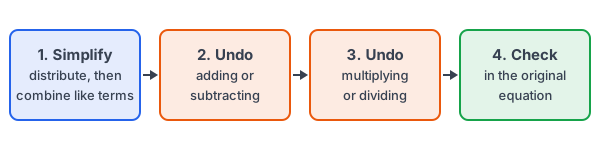
How to Solve Multi-Step Equations
- Use the distributive property to remove any parentheses.
- Combine like terms on each side.
- Undo adding or subtracting, on both sides.
- Undo multiplying or dividing, on both sides.
- Check your answer in the original equation.
\begin{aligned}
2(x + 3) + 4x &= 30 \\
2x + 6 + 4x &= 30 & &\text{distribute} \\
6x + 6 &= 30 & &\text{combine like terms} \\
6x &= 24 & &\text{subtract 6} \\
x &= 4 & &\text{divide by 6}
\end{aligned}
Check: 2(4 + 3) + 4(4) = 14 + 16 = 30. It works.
Worked Examples
Example 1: Combine like terms first
Solve 4x + 3x - 5 = 23.
Step 1. Combine 4x and 3x.
Step 2. Add 5, then divide by 7.
\begin{aligned}
4x + 3x - 5 &= 23 \\
7x - 5 &= 23 \\
7x &= 28 \\
x &= 4
\end{aligned}
Check: 4(4) + 3(4) - 5 = 16 + 12 - 5 = 23. It works.
Answer: x = 4
Example 2: Parentheses
Solve 3(x - 2) = 21.
Step 1. Distribute the 3.
Step 2. Add 6, then divide by 3.
\begin{aligned}
3(x - 2) &= 21 \\
3x - 6 &= 21 \\
3x &= 27 \\
x &= 9
\end{aligned}
Shortcut: Since 21 divides evenly by 3, you could divide both sides by 3 first: x - 2 = 7, so x = 9. Both ways work.
Answer: x = 9
Example 3: Distribute a negative, then combine
Solve -4(2y - 1) + 3y = 39.
Step 1. Distribute -4. Note that (-4)(-1) = +4.
Step 2. Combine -8y and 3y.
Step 3. Subtract 4, then divide by -5.
\begin{aligned}
-4(2y - 1) + 3y &= 39 \\
-8y + 4 + 3y &= 39 \\
-5y + 4 &= 39 \\
-5y &= 35 \\
y &= -7
\end{aligned}
Check: -4(2(-7) - 1) + 3(-7) = -4(-15) - 21 = 60 - 21 = 39. It works.
Answer: y = -7
Example 4: Clear the fractions
Solve \frac{x}{2} + \frac{x}{3} = 10.
Step 1. The denominators are 2 and 3. Their least common multiple is 6. Multiply every term on both sides by 6.
Step 2. The fractions disappear. Combine like terms and solve.
\begin{aligned}
6 \cdot \frac{x}{2} + 6 \cdot \frac{x}{3} &= 6 \cdot 10 \\
3x + 2x &= 60 \\
5x &= 60 \\
x &= 12
\end{aligned}
Check: \frac{12}{2} + \frac{12}{3} = 6 + 4 = 10. It works.
Answer: x = 12
Example 5: Word problem
The sum of three consecutive integers is 72. What are the integers?
Step 1. Consecutive integers come one after another, like 5, 6, 7. Let n = the first integer. The next two are n + 1 and n + 2.
Step 2. Write the equation and solve it.
\begin{aligned}
n + (n + 1) + (n + 2) &= 72 \\
3n + 3 &= 72 \\
3n &= 69 \\
n &= 23
\end{aligned}
Step 3. Answer the question that was asked. The integers are n = 23, then 24 and 25.
Answer: 23, 24 and 25. Check: 23 + 24 + 25 = 72.
Common Mistakes
| Mistake | What it looks like | How to fix it |
|---|---|---|
| Distributing to only the first term | 3(x - 2) = 21 becomes 3x - 2 = 21 | Multiply both terms: 3x - 6 = 21. |
| Dropping a sign when distributing a negative | -4(2y - 1) becomes -8y - 4 | (-4)(-1) = +4, so it is -8y + 4. |
| Combining unlike terms | 2x + 6 becomes 8x | 2x and 6 are not like terms. Leave them as 2x + 6. |
| Not multiplying every term | \frac{x}{2} + \frac{x}{3} = 10 becomes 3x + 2x = 10 | Multiply the 10 by 6 too: 3x + 2x = 60. |
| Stopping too early | Answering n = 23 when the question asks for three integers | Reread the question. Here the answer is 23, 24 and 25. |
Quick check: Substitute your answer into the original equation, not a simplified one. That way you also catch mistakes made while simplifying.
Practice Problems
Solve each equation. Check your answer.
- 5x - 2x + 4 = 19
- 4(a + 2) = 28
- 6 - 2(b - 1) = 14
- 3(2m - 5) + m = 20
- -2(3 - k) + 4k = 18
- 0.4(x + 10) = 6
- \frac{x}{4} + \frac{x}{2} = 9
- \frac{2(y + 1)}{3} = 6
- 5(p - 1) - 3(p + 2) = 7
- A rectangle’s length is 4 meters more than twice its width. Its perimeter is 50 meters. Find the width and the length.
Answers
Show answers
- 3x + 4 = 19, so 3x = 15 and x = 5
- 4a + 8 = 28, so 4a = 20 and a = 5
- 6 - 2b + 2 = 14, so 8 - 2b = 14, -2b = 6 and b = -3
- 6m - 15 + m = 20, so 7m = 35 and m = 5
- -6 + 2k + 4k = 18, so 6k = 24 and k = 4
- Divide by 0.4: x + 10 = 15, so x = 5
- Multiply by 4: x + 2x = 36, so 3x = 36 and x = 12
- Multiply by 3: 2(y + 1) = 18, so y + 1 = 9 and y = 8
- 5p - 5 - 3p - 6 = 7, so 2p - 11 = 7, 2p = 18 and p = 9
- Let w = the width, so the length is 2w + 4. Then 2w + 2(2w + 4) = 50, so 6w + 8 = 50 and w = 7. The width is 7 meters and the length is 2(7) + 4 = 18 meters.
Multi-Step Equations FAQ
What is a multi-step equation?
It is an equation that takes more than two steps to solve, usually because it has parentheses or like terms to combine first.
How do you solve multi-step equations?
Distribute to remove parentheses, combine like terms on each side, then undo adding or subtracting and multiplying or dividing. Check your answer at the end.
Do you always have to distribute first?
No. If the number outside the parentheses divides evenly into the other side, you can divide first. In 3(x - 2) = 21, dividing by 3 gives x - 2 = 7 right away.
How do you solve multi-step equations with fractions?
Multiply every term on both sides by the least common multiple of the denominators. This clears the fractions, so you can solve as usual.
Summary
- Simplify each side first: distribute, then combine like terms.
- After simplifying, solve the two-step equation that is left.
- Distribute negative numbers carefully and watch the signs.
- To clear fractions, multiply every term by the least common multiple of the denominators.
- Check your answer in the original equation.
Previous lesson: Two-Step Equations
Next lesson: Equations with Variables on Both Sides
Back to the Algebra 1 Index