
Cube Roots
A cube root of a number is the value you multiply by itself three times to get that number. The cube root of 27 is 3, because 3 \times 3 \times 3 = 27. We write it as \sqrt[3]{27} = 3. Unlike square roots, negative numbers have cube roots, so \sqrt[3]{-8} = -2.
Before this lesson: You should know cubes from Exponents and the ideas in Square Root. You will also use multiplying integers for negative numbers.
Extra practice: The Pre-Algebra Unit 4 Practice Pack has printable problems, answer keys and a cheat sheet for this unit.
What Is a Cube Root?
Cubing a number means using it as a factor three times: 3^3 = 3 \times 3 \times 3 = 27. A cube root goes the other way. It asks, “What number, used three times, gives 27?”
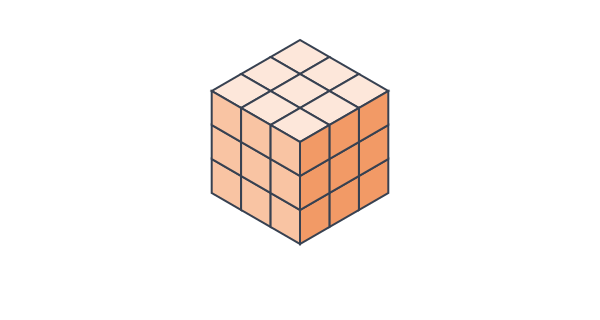
Picture a big cube built from small cubes. If it holds 27 small cubes, each edge is 3 cubes long. The volume is 27, and the cube root of the volume is the edge length.
The Cube Root Rule and Perfect Cubes
\sqrt[3]{a} = b \quad \text{means} \quad b \times b \times b = aThe small 3 in \sqrt[3]{\phantom{a}} is called the index. It tells you this is a cube root, not a square root. The number inside is the radicand, just like with square roots.
A perfect cube is a number made by cubing a whole number. These ten are worth knowing by heart.
| Cube | Cube root | Cube | Cube root |
|---|---|---|---|
| 1^3 = 1 | \sqrt[3]{1} = 1 | 6^3 = 216 | \sqrt[3]{216} = 6 |
| 2^3 = 8 | \sqrt[3]{8} = 2 | 7^3 = 343 | \sqrt[3]{343} = 7 |
| 3^3 = 27 | \sqrt[3]{27} = 3 | 8^3 = 512 | \sqrt[3]{512} = 8 |
| 4^3 = 64 | \sqrt[3]{64} = 4 | 9^3 = 729 | \sqrt[3]{729} = 9 |
| 5^3 = 125 | \sqrt[3]{125} = 5 | 10^3 = 1000 | \sqrt[3]{1000} = 10 |
Cube Roots of Negative Numbers
A negative number times itself three times stays negative. For example, (-2) \times (-2) \times (-2) = -8. So \sqrt[3]{-8} = -2.
This is a big difference from square roots. A negative number has no square root you know, but it always has a cube root. The cube root of a negative number is negative.
Cube Roots of Fractions and Decimals
For a fraction, take the cube root of the top and the bottom.
\sqrt[3]{\frac{8}{27}} = \frac{\sqrt[3]{8}}{\sqrt[3]{27}} = \frac{2}{3}For a decimal, find the decimal that cubes to the number. For example, \sqrt[3]{0.008} = 0.2 because 0.2 \times 0.2 \times 0.2 = 0.008. The answer has one third as many decimal places as the radicand.
How to Estimate a Cube Root
For a number that is not a perfect cube, find the perfect cubes just below and just above it. The cube root is between their cube roots.
For \sqrt[3]{40}, the nearby perfect cubes are 27 and 64. So \sqrt[3]{40} is between 3 and 4. Since 40 is closer to 27, the answer is closer to 3. A calculator gives \sqrt[3]{40} \approx 3.42.
Worked Examples
Example 1: Cube root of a perfect cube
Find \sqrt[3]{64}.
Step 1. Ask what number, used three times, gives 64.
4 \times 4 = 16
Step 2. Try 4. Multiply 4 by 4.
16 \times 4 = 64
Step 3. Multiply by 4 again. This gives 64.
Answer: \sqrt[3]{64} = 4
Example 2: Cube root of a negative number
Find \sqrt[3]{-125}.
Step 1. Ignore the sign first. Since 5^3 = 125, the number is 5 or −5.
(-5) \times (-5) \times (-5) = -125
Step 2. The radicand is negative, so the cube root is negative. Check.
Answer: \sqrt[3]{-125} = -5
Example 3: Cube root of a fraction and a decimal
Find \sqrt[3]{\frac{27}{64}} and \sqrt[3]{0.064}.
\sqrt[3]{27} = 3Step 1. For the fraction, find the cube root of the top.
\sqrt[3]{64} = 4Step 2. Find the cube root of the bottom. The answer is the top root over the bottom root.
Step 3. For the decimal, the digit is 4, since the cube root of 64 is 4. The radicand has 3 decimal places, so the answer has 1. Try 0.4.
0.4 \times 0.4 \times 0.4 = 0.064
Step 4. Check: use 0.4 as a factor three times.
Answer: \sqrt[3]{\frac{27}{64}} = \frac{3}{4} and \sqrt[3]{0.064} = 0.4
Example 4: Estimate a cube root
Estimate \sqrt[3]{100} to one decimal place.
Step 1. The perfect cubes around 100 are 64 and 125. So \sqrt[3]{100} is between 4 and 5.
Step 2. 100 is 36 away from 64 and 25 away from 125. It is a bit closer to 125, so the answer is a bit more than 4.5.
4.6^3 \approx 97.3
Step 3. Test 4.6. Test 4.7: 4.7^3 \approx 103.8. 97.3 is closer to 100.
Answer: \sqrt[3]{100} \approx 4.6
Example 5: Word problem with a cube-shaped box
A box shaped like a cube holds 216 cubic inches. How long is each edge? What is the area of one face?
Step 1. The volume of a cube is edge × edge × edge. So the edge is \sqrt[3]{216}.
6 \times 6 \times 6 = 216
Step 2. Find the number that, used three times, gives 216. Each edge is 6 inches.
6 \times 6 = 36
Step 3. Each face is a square. Multiply to find its area in square inches.
Answer: Each edge is 6 inches, and one face has an area of 36 square inches.
Common Mistakes with Cube Roots
| Mistake | Example of the error | Fix |
|---|---|---|
| Dividing by 3 | \sqrt[3]{27} = 9 | Ask what number, used three times, gives 27. 3 \times 3 \times 3 = 27, so the answer is 3. |
| Using only two factors | \sqrt[3]{9} = 3 | 3 \times 3 = 9 is squaring. For a cube root, check 3 \times 3 \times 3 = 27. |
| Saying a negative has no cube root | “\sqrt[3]{-27} has no answer” | Three negative factors give a negative. \sqrt[3]{-27} = -3. |
| Mixing up the index | Reading \sqrt[3]{8} as 3 \times \sqrt{8} | The small 3 is the index. It is part of the root sign, not a factor. |
Square Roots vs. Cube Roots
| Question | Square root | Cube root |
|---|---|---|
| Symbol | \sqrt{a} | \sqrt[3]{a} |
| It undoes | squaring | cubing |
| Number of equal factors | 2 | 3 |
| Shape | side of a square from its area | edge of a cube from its volume |
| Root of a negative number | none in the numbers you know | a negative number |
Square roots and cube roots both go with exponents. In Algebra 1, you will see that roots can also be written as exponents.
Practice Problems
- Find \sqrt[3]{343}.
- Find \sqrt[3]{729}.
- Find \sqrt[3]{1000}.
- Find \sqrt[3]{-1}.
- Find \sqrt[3]{-216}.
- Find \sqrt[3]{\frac{1}{125}}.
- Find \sqrt[3]{0.027}.
- Between which two whole numbers is \sqrt[3]{30}? Which one is it closer to?
- A cube-shaped tank holds 512 cubic feet of water. How long is each edge?
Show answers
1.
7 \times 7 \times 7 = 343
Use 7 as a factor three times.
Answer: 7.
2.
9 \times 9 \times 9 = 729
Use 9 as a factor three times.
Answer: 9.
3.
10 \times 10 \times 10 = 1000
Use 10 as a factor three times.
Answer: 10.
4.
(-1) \times (-1) \times (-1) = -1
Use −1 as a factor three times.
Answer: −1.
5.
(-6) \times (-6) \times (-6) = -216
Use −6 as a factor three times.
Answer: −6.
6.
\sqrt[3]{1} = 1Find the cube root of the top.
\sqrt[3]{125} = 5Find the cube root of the bottom.
Answer: \frac{1}{5}.
7.
0.3 \times 0.3 \times 0.3 = 0.027
Use 0.3 as a factor three times.
Answer: 0.3.
8.
30 is between 27 and 64, so \sqrt[3]{30} is between 3 and 4. It is much closer to 3, because 30 is only 3 away from 27. (It is about 3.1.)
9.
8 \times 8 \times 8 = 512
Use 8 as a factor three times.
\sqrt[3]{512} = 8Write the cube root.
Answer: Each edge is 8 feet.
Want more practice? The Pre-Algebra Unit 4 Practice Pack has 35 pages of problems on this and the other lessons in the unit, with step-by-step answers and a cheat sheet.
Cube Root FAQ
What is the cube root of 8?
The cube root of 8 is 2, because 2 \times 2 \times 2 = 8.
Can you take the cube root of a negative number?
Yes. Three negative factors give a negative answer, so every negative number has a negative cube root. For example, \sqrt[3]{-64} = -4.
What is the cube root of 2?
The cube root of 2 is about 1.26. It is not a whole number, because 2 is between the perfect cubes 1 and 8.
Is a cube root the same as dividing by 3?
No. Dividing 27 by 3 gives 9, but 9 \times 9 \times 9 = 729, not 27. The cube root of 27 is 3, because 3 \times 3 \times 3 = 27.
Summary
- A cube root of a number, used as a factor three times, gives the number: \sqrt[3]{27} = 3.
- The small 3 in the root sign is the index.
- Perfect cubes like 1, 8, 27, 64 and 125 have whole number cube roots.
- The cube root of a negative number is negative: \sqrt[3]{-8} = -2.
- For a fraction, take the cube root of the top and the bottom.
- To estimate, find the perfect cubes on each side of the number.
Previous lesson: Square Root
Next lesson: Scientific Notation
Back to the Pre-Algebra Index