
Scientific Notation
Scientific notation is a short way to write very large or very small numbers. You write the number as a value from 1 up to (but not including) 10, times a power of 10. For example, 4,500,000 in scientific notation is 4.5 \times 10^6, and 0.00032 is 3.2 \times 10^{-4}.
Before this lesson: You should know powers of 10 from Exponents and how to move the decimal point from operations with decimals.
Why Use Scientific Notation?
Some numbers have lots of zeros. The sun is about 93,000,000 miles from Earth. A grain of sand might be 0.0005 meters wide. Long strings of zeros are hard to read and easy to miscount.
Scientific notation fixes this. Instead of counting zeros, you count how many places the decimal point moves. That count becomes the exponent on 10.
The Scientific Notation Form
a \times 10^n \qquad \text{where } 1 \le a \lt 10 \text{ and } n \text{ is an integer}- The first part, a, is at least 1 and less than 10. It has exactly one nonzero digit before the decimal point.
- The exponent n tells how many places the decimal point moved.
- A positive exponent means a big number (10 or more). A negative exponent means a small number (less than 1).
A negative exponent on 10 means dividing by 10 that many times. So 10^{-1} = 0.1, 10^{-2} = 0.01, and 10^{-3} = 0.001.
How to Write a Number in Scientific Notation
- Move the decimal point so there is one nonzero digit in front of it.
- Count how many places you moved it. This is the exponent.
- If the original number is 10 or more, the exponent is positive. If it is less than 1, the exponent is negative.
For 4,500,000, the decimal point starts at the end. It moves 6 places left to make 4.5. So 4{,}500{,}000 = 4.5 \times 10^6.
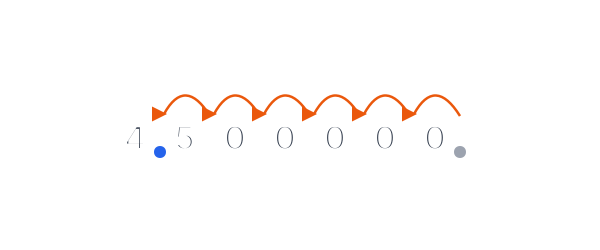
To go back to standard form, move the decimal point the other way. A positive exponent moves it right, which makes the number bigger. A negative exponent moves it left, which makes it smaller.
Worked Examples
Example 1: Write a large number in scientific notation
Write 93,000,000 in scientific notation.
Step 1. Move the decimal point to get one digit in front: 9.3.
Step 2. Count the places. The point moved 7 places left.
Step 3. The number is large, so the exponent is positive.
Answer: 93{,}000{,}000 = 9.3 \times 10^7
Example 2: Write a small number in scientific notation
Write 0.0068 in scientific notation.
Step 1. Move the decimal point to get one nonzero digit in front: 6.8.
Step 2. Count the places. The point moved 3 places right.
Step 3. The number is less than 1, so the exponent is negative.
Answer: 0.0068 = 6.8 \times 10^{-3}
Example 3: Write numbers in standard form
Write 7.05 \times 10^5 and 2.4 \times 10^{-3} in standard form.
Step 1. For 7.05 \times 10^5, move the point 5 places right. Fill empty places with zeros: 705,000.
Step 2. For 2.4 \times 10^{-3}, move the point 3 places left: 0.0024.
Answer: 7.05 \times 10^5 = 705{,}000 and 2.4 \times 10^{-3} = 0.0024
Example 4: Compare numbers in scientific notation
Which is bigger, 3.1 \times 10^5 or 9.8 \times 10^4?
Step 1. Compare the exponents first. 5 is bigger than 4.
Step 2. So 3.1 \times 10^5 is bigger, even though 3.1 is less than 9.8. Check: 310,000 is more than 98,000.
Answer: 3.1 \times 10^5 is bigger. If the exponents are the same, compare the first parts instead.
Example 5: Word problem about the speed of light
Light travels about 300,000 kilometers each second. How far does it travel in 1 minute? Give the answer in scientific notation.
Step 1. One minute is 60 seconds. Multiply: 300{,}000 \times 60 = 18{,}000{,}000.
Step 2. Move the decimal point 7 places left to get 1.8.
Answer: Light travels about 1.8 \times 10^7 kilometers in 1 minute.
Common Mistakes with Scientific Notation
| Mistake | Example of the error | Fix |
|---|---|---|
| First part is 10 or more | 45 \times 10^3 | The first part must be less than 10. Write 4.5 \times 10^4. |
| Wrong sign on the exponent | 0.005 = 5 \times 10^3 | Small numbers get negative exponents: 0.005 = 5 \times 10^{-3}. |
| Counting zeros instead of places | 4{,}500{,}000 = 4.5 \times 10^5 (5 zeros) | Count the places the point moves, which is 6: 4.5 \times 10^6. |
| Comparing only the first parts | 9.8 \times 10^4 \gt 3.1 \times 10^5 because 9.8 \gt 3.1 | Compare exponents first. 10^5 is bigger than 10^4. |
| Moving the point the wrong way | 1.6 \times 10^{-3} = 1600 | A negative exponent makes the number small: 0.0016. |
Multiplying Numbers in Scientific Notation
To multiply, multiply the first parts and add the exponents. For example, (2 \times 10^3) \times (3 \times 10^4) = 6 \times 10^7. You will learn why the exponents add in the exponent rules lesson in Algebra 1.
Calculators also use scientific notation. A display like 6E7 or 6e7 means 6 \times 10^7.
Practice Problems
- Write 62,000 in scientific notation.
- Write 0.0009 in scientific notation.
- Write 150,000,000 in scientific notation.
- Write 0.0000407 in scientific notation.
- Write 8.3 \times 10^4 in standard form.
- Write 1.6 \times 10^{-3} in standard form.
- Write 5 \times 10^6 in standard form.
- Which is bigger, 4.2 \times 10^{-3} or 9.9 \times 10^{-4}?
- Is 12 \times 10^5 in scientific notation? If not, fix it.
Show answers
- 6.2 \times 10^4. The point moves 4 places left.
- 9 \times 10^{-4}. The point moves 4 places right.
- 1.5 \times 10^8. The point moves 8 places left.
- 4.07 \times 10^{-5}. The point moves 5 places right.
- 83,000. Move the point 4 places right.
- 0.0016. Move the point 3 places left.
- 5,000,000. Move the point 6 places right.
- 4.2 \times 10^{-3} is bigger, because −3 is bigger than −4. Check: 0.0042 is more than 0.00099.
- No, because 12 is not less than 10. 12 \times 10^5 = 1{,}200{,}000 = 1.2 \times 10^6.
Scientific Notation FAQ
What is 1 million in scientific notation?
One million is 1,000,000, which has the decimal point 6 places after the 1. So it is 1 \times 10^6.
What does a negative exponent mean in scientific notation?
A negative exponent means the number is less than 1. For example, 3 \times 10^{-2} = 0.03, because you move the decimal point 2 places left.
What does E mean on a calculator?
E stands for “times 10 to the power.” So 2.5E8 means 2.5 \times 10^8, or 250,000,000.
Summary
- Scientific notation has the form a \times 10^n, where a is at least 1 and less than 10.
- The exponent counts how many places the decimal point moves.
- Numbers of 10 or more have positive exponents. Numbers less than 1 have negative exponents.
- To compare, look at the exponents first, then the first parts.
- To multiply, multiply the first parts and add the exponents.
Previous lesson: Cube Roots
Next lesson: Rational and Irrational Numbers
Back to the Pre-Algebra (Math Basics) Index