
Rational and Irrational Numbers
Rational and irrational numbers are the two kinds of real numbers. A rational number is any number you can write as a fraction of two integers, like \frac{3}{4} or -5 = \frac{-5}{1}. Its decimal either ends or repeats. An irrational number cannot be written as a fraction. Its decimal goes on forever with no repeating pattern, like \sqrt{2} and \pi.
Before this lesson: You should know how to convert fractions and decimals and how to find a square root. It also helps to know negative numbers.
Extra practice: The Pre-Algebra Unit 4 Practice Pack has printable problems, answer keys and a cheat sheet for this unit.
What Makes a Number Rational?
The word “rational” comes from “ratio.” A rational number is a ratio of two integers. The bottom integer cannot be 0.
Whole numbers and integers are rational too. You can write any integer over 1. For example, 7 = \frac{7}{1} and 0 = \frac{0}{1}.
Decimals that end, like 0.75, are rational, because 0.75 = \frac{3}{4}. Decimals that repeat, like 0.333…, are rational too, because 0.\overline{3} = \frac{1}{3}. The bar shows the digits that repeat.
What Makes a Number Irrational?
An irrational number has a decimal that never ends and never repeats. No fraction of integers equals it exactly.
- Square roots of numbers that are not perfect squares, like \sqrt{2} = 1.41421356\ldots and \sqrt{50}.
- Pi, the number \pi = 3.14159265\ldots from circles.
- Decimals with a pattern that never repeats, like 1.010010001…, where one more 0 is added each time.
You can round an irrational number, like \pi \approx 3.14. But a rounded value is only close. It is not exactly equal.
The Real Number System
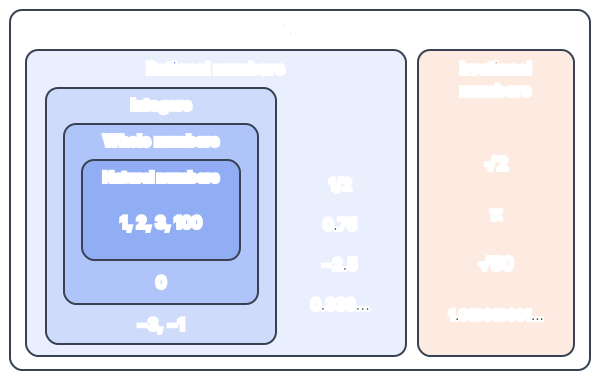
Rational and irrational numbers together make up the real numbers. Each real number is one kind or the other, never both. The rational numbers hold three smaller sets:
- Natural numbers (counting numbers): 1, 2, 3, 4, …
- Whole numbers: 0, 1, 2, 3, …
- Integers: …, −2, −1, 0, 1, 2, …
How to Tell If a Number Is Rational or Irrational
- If it is an integer or a fraction of integers, it is rational.
- If it is a decimal, check whether it ends or repeats. If it does, it is rational.
- If it is a square root, check whether the number inside is a perfect square. If it is, the root is rational. If not, it is irrational.
- If it is \pi, it is irrational.
Worked Examples
Example 1: Show that numbers are rational
Show that 0.125 and −0.4 are rational.
0.125 = \frac{125}{1000} = \frac{1}{8}Step 1. 0.125 is 125 thousandths.
-0.4 = -\frac{4}{10} = -\frac{2}{5}Step 2. −0.4 is 4 tenths, negative.
Answer: Both are rational, because each one is a fraction of integers.
Example 2: Square roots
Is \sqrt{49} rational or irrational? What about \sqrt{20}?
7 \times 7 = 49
Step 1. 49 is a perfect square.
\sqrt{49} = 7Step 2. Take the square root. 7 is a whole number, so it is rational.
Step 3. 20 is not a perfect square. It is between 16 and 25.
\sqrt{20} \approx 4.472\ldotsStep 4. The decimal never ends or repeats, so it is irrational.
Answer: \sqrt{49} is rational, and \sqrt{20} is irrational.
Example 3: A repeating decimal
Is \frac{2}{3} rational, even though its decimal goes on forever?
2 \div 3 = 0.666\ldots
Step 1. Divide. The 6 repeats forever, so we write 0.\overline{6}.
Step 2. A decimal that goes on forever is still rational if it repeats.
Answer: Yes, \frac{2}{3} = 0.\overline{6} is rational. It is already a fraction of integers.
Example 4: Sort a list of numbers
Sort these numbers into rational and irrational: -6, \pi, \frac{5}{9}, \sqrt{36}, \sqrt{8}, 2.75.
Step 1. −6 is an integer, so it is rational. \frac{5}{9} is a fraction, so it is rational.
\sqrt{36} = 6Step 2. Take the square root. 6 is an integer, so it is rational.
Step 3. 2.75 ends, so it is rational.
Step 4. \pi is irrational. 8 is not a perfect square, so \sqrt{8} is irrational.
Answer: Rational: −6, \frac{5}{9}, \sqrt{36}, 2.75. Irrational: \pi, \sqrt{8}.
Example 5: Word problem with a square patio
A square patio has an area of 20 square meters. Is its side length rational or irrational? About how long is each side?
Step 1. The side of a square is the square root of its area. So the side is \sqrt{20} meters.
Step 2. 20 is not a perfect square, so \sqrt{20} is irrational.
\sqrt{20} \approx 4.47Step 3. Round it.
Answer: The side length is irrational. Each side is about 4.47 meters.
Common Mistakes with Rational and Irrational Numbers
| Mistake | Example of the error | Fix |
|---|---|---|
| Thinking every endless decimal is irrational | “0.\overline{3} goes on forever, so it is irrational.” | A repeating decimal is rational: 0.\overline{3} = \frac{1}{3}. |
| Thinking every square root is irrational | “\sqrt{36} is irrational.” | \sqrt{36} = 6. Roots of perfect squares are rational. |
| Treating a rounded value as exact | \pi = 3.14 or \pi = \frac{22}{7} | These are only close: \pi \approx 3.14. Pi is irrational. |
| Thinking negatives can’t be rational | “−4 is not rational.” | -4 = \frac{-4}{1}, so it is rational. |
| Thinking integers aren’t real numbers | “5 is rational, so it is not real.” | All rational and irrational numbers are real numbers. |
Practice Problems
- Is 0.6 rational or irrational? Write it as a fraction if you can.
- Is \sqrt{81} rational or irrational?
- Is \sqrt{15} rational or irrational?
- Is 0.\overline{27} rational or irrational?
- Is −12 rational? Explain.
- Is \frac{\pi}{2} rational or irrational?
- Name the smallest set that contains 0: natural, whole or integers.
- A square rug has an area of 100 square feet. Is its side length rational or irrational?
Show answers
1.
Rational.
0.6 = \frac{6}{10}Write the decimal as a fraction.
\frac{6}{10} = \frac{3}{5}Simplify.
2.
Rational.
\sqrt{81} = 9Take the square root.
3.
Irrational. 15 is not a perfect square.
\sqrt{15} \approx 3.87\ldotsThe decimal never ends or repeats.
4.
Rational. The digits 27 repeat, and every repeating decimal is rational.
5.
-12 = \frac{-12}{1}Yes. Write it as a fraction of integers.
6.
Irrational. Half of pi still never ends or repeats.
7.
Whole numbers. 0 is a whole number but not a natural number.
8.
Rational.
\sqrt{100} = 10Take the square root.
Each side is 10 feet.
Want more practice? The Pre-Algebra Unit 4 Practice Pack has 35 pages of problems on this and the other lessons in the unit, with step-by-step answers and a cheat sheet.
Rational and Irrational Numbers FAQ
Is 0 a rational number?
Yes. Zero can be written as \frac{0}{1}, which is a fraction of integers. So 0 is rational.
Is pi a rational number?
No, pi is irrational. Its decimal, 3.14159…, never ends and never repeats. Values like 3.14 and \frac{22}{7} are only close to pi.
Is the square root of 2 rational or irrational?
The square root of 2 is irrational. Its decimal is 1.41421356… and never repeats, because 2 is not a perfect square.
Summary
- A rational number can be written as a fraction of two integers. Its decimal ends or repeats.
- An irrational number cannot be written as a fraction. Its decimal never ends and never repeats.
- Integers, whole numbers and natural numbers are all rational.
- Square roots of perfect squares are rational. Other square roots are irrational.
- Pi is irrational. The value 3.14 is only close to pi.
- Rational and irrational numbers together make up the real numbers.
Previous lesson: Scientific Notation
Next lesson: Order of Operations
Back to the Pre-Algebra Index