
Converting Fractions and Decimals
Converting fractions and decimals works in both directions. To change a fraction to a decimal, divide the top by the bottom: \frac{3}{4} = 3 \div 4 = 0.75. To change a decimal to a fraction, write its digits over 10, 100 or 1,000 and simplify: 0.75 = \frac{75}{100} = \frac{3}{4}. Some fractions never end, like \frac{1}{3} = 0.333\ldots
Before this lesson: You should know how to simplify fractions and how to divide in operations with decimals.
Fractions and Decimals Name the Same Numbers
A fraction bar means divide. That is why every fraction can also be written as a decimal. They are two names for the same point on the number line.
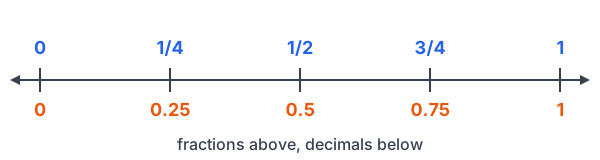
Here are conversions that are worth knowing by heart:
| Fraction | Decimal | Fraction | Decimal |
|---|---|---|---|
| \frac{1}{2} | 0.5 | \frac{1}{5} | 0.2 |
| \frac{1}{4} | 0.25 | \frac{1}{8} | 0.125 |
| \frac{3}{4} | 0.75 | \frac{1}{10} | 0.1 |
| \frac{1}{3} | 0.\overline{3} | \frac{2}{3} | 0.\overline{6} |
How to Convert Fractions and Decimals
Fraction to decimal
- Divide the numerator by the denominator. Add zeros after the decimal point as you need them.
- Stop when the remainder is 0. This is a terminating decimal.
- If the digits start to repeat forever, it is a repeating decimal. Draw a bar over the part that repeats.
A shortcut: if you can make the denominator 10, 100 or 1,000 by multiplying, do that. For example, \frac{3}{20} = \frac{15}{100} = 0.15.
Decimal to fraction
- Read the decimal using place value. The last digit’s place tells you the denominator.
- Write the digits over 10, 100 or 1,000.
- Simplify the fraction.
For example, 0.45 means 45 hundredths, so 0.45 = \frac{45}{100}.
Worked Examples
Example 1: A fraction that terminates
Write \frac{3}{8} as a decimal.
Step 1. Divide 3 by 8. Since 8 doesn’t go into 3, write 3 as 3.000.
Step 2. 8 goes into 30 three times with 6 left. 8 goes into 60 seven times with 4 left. 8 goes into 40 five times with 0 left.
Answer: \frac{3}{8} = 0.375. Check with the shortcut: \frac{3 \times 125}{8 \times 125} = \frac{375}{1000}.
Example 2: A fraction that repeats
Write \frac{2}{3} as a decimal.
Step 1. Divide 2 by 3. 3 goes into 20 six times with 2 left over.
Step 2. The remainder is 2 again, so the 6 repeats forever: 0.666…
Answer: \frac{2}{3} = 0.\overline{6}. Rounded to the nearest hundredth, it is about 0.67.
Example 3: A decimal to a fraction
Write 0.45 as a fraction in simplest form.
Step 1. The last digit is in the hundredths place, so the denominator is 100: 0.45 = \frac{45}{100}.
Step 2. The GCF of 45 and 100 is 5. Divide both by 5.
\frac{45}{100} = \frac{45 \div 5}{100 \div 5} = \frac{9}{20}Answer: 0.45 = \frac{9}{20}.
Example 4: A decimal bigger than 1
Write 2.125 as a mixed number.
Step 1. Keep the whole number 2. The decimal part 0.125 has three decimal places, so it is \frac{125}{1000}.
Step 2. Simplify. The GCF of 125 and 1000 is 125, so \frac{125}{1000} = \frac{1}{8}.
Answer: 2.125 = 2\frac{1}{8}, which is the same as the improper fraction \frac{17}{8}.
Example 5: Word problem
In a survey, 13 out of 20 students chose pizza as their favorite lunch. Write this as a decimal.
Step 1. The fraction is \frac{13}{20}.
Step 2. Multiply the top and bottom by 5 to get a denominator of 100: \frac{13 \times 5}{20 \times 5} = \frac{65}{100}.
Answer: 0.65 of the students chose pizza.
Common Mistakes
| Mistake | What it looks like | How to fix it |
|---|---|---|
| Writing the digits side by side | \frac{3}{4} = 3.4 | The bar means divide: 3 \div 4 = 0.75. |
| Dividing the wrong way | \frac{3}{4} = 4 \div 3 | Always divide the top by the bottom. |
| Reading the place value wrong | 0.08 = \frac{8}{10} | The 8 is in the hundredths place, so 0.08 = \frac{8}{100} = \frac{2}{25}. |
| Treating a rounded decimal as exact | \frac{2}{3} = 0.66 | Write 0.\overline{6}, or say “about 0.67” when you round. |
| Flipping a decimal into a unit fraction | 0.5 = \frac{1}{5} | 0.5 means 5 tenths: \frac{5}{10} = \frac{1}{2}. |
Repeating Decimals and Comparing Numbers
Which fractions repeat
Simplify the fraction first. If the denominator has no prime factors except 2 and 5, the decimal ends. If it has any other prime factor, the decimal repeats. For example, \frac{7}{20} ends because 20 = 2^2 \times 5, but \frac{1}{6} repeats because 6 has a factor of 3. See prime factorization for help.
Comparing a fraction and a decimal
Change the fraction to a decimal, then compare. For example, \frac{5}{8} = 0.625, so it is greater than 0.6. Decimals and fractions also lead straight into percentages, since 0.65 is the same as 65%.
Practice Problems
For problems 1–4, write the fraction as a decimal. For problems 5–8, write the decimal as a fraction or mixed number in simplest form.
- \frac{1}{5}
- \frac{7}{20}
- \frac{5}{8}
- \frac{1}{6}
- 0.6
- 0.125
- 0.04
- 3.75
- Which is greater, \frac{5}{8} or 0.6?
- A recipe calls for 0.75 cup of milk. What fraction of a cup is that?
Show answers
- 1 ÷ 5 = 0.2
- \frac{7 \times 5}{20 \times 5} = \frac{35}{100} = 0.35
- 5 ÷ 8 = 0.625
- 1 ÷ 6 = 0.1666…, so \frac{1}{6} = 0.1\overline{6}. Only the 6 repeats.
- \frac{6}{10} = \frac{3}{5}
- \frac{125}{1000} = \frac{1}{8}
- \frac{4}{100} = \frac{1}{25}
- 3\frac{75}{100} = 3\frac{3}{4}, or \frac{15}{4}
- \frac{5}{8} = 0.625, and 0.625 is greater than 0.600. So \frac{5}{8} is greater.
- 0.75 = \frac{75}{100} = \frac{3}{4} cup
Converting Fractions and Decimals FAQ
What is 1/3 as a decimal?
\frac{1}{3} = 0.333\ldots, which you can write as 0.\overline{3}. Rounded to the nearest hundredth, it is about 0.33.
How do you write a repeating decimal?
Put a bar over the digits that repeat. For example, 0.272727… is written 0.\overline{27}.
How do you know if a decimal will repeat?
Simplify the fraction. If its denominator has only 2s and 5s as prime factors, the decimal ends. Otherwise, it repeats.
Is 0.999… equal to 1?
Yes. Since \frac{1}{3} = 0.333\ldots, three times that is \frac{3}{3} = 0.999\ldots, and \frac{3}{3} = 1.
Summary
- To change a fraction to a decimal, divide the numerator by the denominator.
- A decimal either ends (terminates) or repeats. Use a bar to show repeating digits.
- To change a decimal to a fraction, write the digits over 10, 100 or 1,000, then simplify.
- The place of the last digit tells you the denominator.
- Change both numbers to decimals when you want to compare them.
Previous lesson: Operations with Decimals
Next lesson: Nested Fractions
Back to the Pre-Algebra (Math Basics) Index