
Determinant of a Matrix
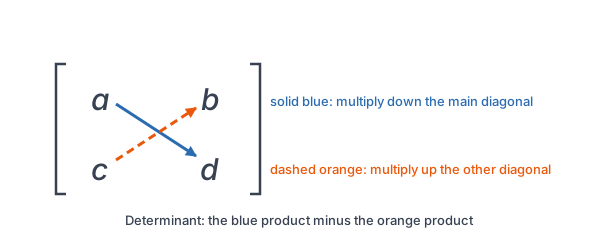
The determinant of a matrix is a single number calculated from a square matrix. For a 2 \times 2 matrix \begin{bmatrix} a & b \\ c & d \end{bmatrix}, the determinant is ad - bc. For a 3 \times 3 matrix, expand along a row using 2 \times 2 determinants. A determinant of 0 means the matrix has no inverse.
Before this lesson: You should know Matrix Multiplication, Solving Systems with Augmented Matrices and Multiplying and Dividing Integers.
What a Determinant Tells You
Only square matrices have determinants. The determinant is written \det(A) or with straight bars, \lvert A \rvert. It packs a lot of information into one number.
If the determinant is 0, the matrix has no inverse, and a system with that coefficient matrix has no unique solution. If it is not 0, the system has exactly one solution. In geometry, the absolute value of a 2 \times 2 determinant is the area scale factor of the matrix, and determinants also give the areas of triangles from their vertices.
Determinant Formulas
2 × 2 matrices
\begin{vmatrix} a & b \\ c & d \end{vmatrix} = ad - bc3 × 3 matrices: expand along row 1
\begin{vmatrix} a & b & c \\ d & e & f \\ g & h & i \end{vmatrix} = a\begin{vmatrix} e & f \\ h & i \end{vmatrix} - b\begin{vmatrix} d & f \\ g & i \end{vmatrix} + c\begin{vmatrix} d & e \\ g & h \end{vmatrix}Each small determinant comes from crossing out the row and column of the entry in front of it. The signs alternate +, -, +. A matrix with 0s on one side of the main diagonal is triangular, and its determinant is just the product of the diagonal entries.
Worked Examples
Example 1: A 2 × 2 determinant
Find \det \begin{bmatrix} 4 & 3 \\ 2 & 5 \end{bmatrix}.
4 \cdot 5 = 20
Multiply down the main diagonal.
3 \cdot 2 = 6
Multiply up the other diagonal.
20 - 6 = 14
Subtract.
Answer: 14
Example 2: Negative entries
Find \det \begin{bmatrix} -2 & 7 \\ 3 & -1 \end{bmatrix}.
(-2)(-1) = 2
Multiply the main diagonal.
7 \cdot 3 = 21
Multiply the other diagonal.
2 - 21 = -19
Subtract.
Answer: −19. Determinants can be negative.
Example 3: A 3 × 3 determinant
Find \det \begin{bmatrix} 2 & 1 & 3 \\ 0 & -1 & 4 \\ 1 & 2 & 0 \end{bmatrix}.
\begin{vmatrix} -1 & 4 \\ 2 & 0 \end{vmatrix} = (-1)(0) - 4(2) = 0 - 8 = -8For the 2, cross out row 1 and column 1.
\begin{vmatrix} 0 & 4 \\ 1 & 0 \end{vmatrix} = 0(0) - 4(1) = -4For the 1, cross out row 1 and column 2.
\begin{vmatrix} 0 & -1 \\ 1 & 2 \end{vmatrix} = 0(2) - (-1)(1) = 0 + 1 = 1For the 3, cross out row 1 and column 3.
2(-8) - 1(-4) + 3(1)
Combine with signs +, -, +.
-16 + 4 + 3 = -9
Multiply.
Answer: −9
Example 4: Solve for an unknown entry
For what value of x is \begin{bmatrix} x & 6 \\ 2 & 3 \end{bmatrix} singular (no inverse)?
3x - 6 \cdot 2 = 0
A matrix is singular when its determinant is 0.
3x - 12 = 0
Multiply.
3x = 12
Add 12 to both sides.
x = 4
Divide by 3.
Answer: x = 4. Then row 1, 4, 6, is exactly 2 times row 2, 2, 3.
Example 5: Word problem with a triangular park
On a city map with a grid in kilometers, a triangular park has corners at (1, 2), (5, 3) and (2, 7). Find its area.
\begin{bmatrix} 1 & 2 & 1 \\ 5 & 3 & 1 \\ 2 & 7 & 1 \end{bmatrix}Use the formula \text{Area} = \frac{1}{2}\lvert \det \rvert, with one row per corner and a column of 1s.
1\begin{vmatrix} 3 & 1 \\ 7 & 1 \end{vmatrix} - 2\begin{vmatrix} 5 & 1 \\ 2 & 1 \end{vmatrix} + 1\begin{vmatrix} 5 & 3 \\ 2 & 7 \end{vmatrix}Expand along row 1.
Find each small determinant: 3 - 7 = -4, 5 - 2 = 3 and 35 - 6 = 29
1(-4) - 2(3) + 1(29) = -4 - 6 + 29 = 19
Combine.
\frac{1}{2}\lvert 19 \rvert = 9.5Take half the absolute value.
Answer: 9.5 square kilometers
Common Mistakes
| Mistake | Example of the error | Fix |
|---|---|---|
| Adding the diagonal products | 4 \cdot 5 + 3 \cdot 2 = 26 | Subtract: ad - bc = 20 - 6 = 14. |
| Subtracting in the wrong order | bc - ad = 6 - 20 = -14 | Main diagonal first: ad - bc. |
| Forgetting the alternating signs | 2(-8) + 1(-4) + 3(1) | The middle term gets a minus: 2(-8) - 1(-4) + 3(1). |
| Sign slips with negatives | (-2)(-1) = -2 | A negative times a negative is positive: 2. |
| Taking a determinant of a non-square matrix | Finding \det of a 2 \times 3 matrix | Only square matrices have determinants. |
Related Methods
Diagonal shortcut for 3 × 3
Copy the first two columns to the right of the matrix. Add the three down-right diagonal products, then subtract the three up-right diagonal products. This shortcut works only for 3 \times 3 matrices.
Expand along a row with zeros
You can expand along any row or column, using a checkerboard of signs. Choosing a row or column with 0s means fewer small determinants to compute.
What comes next
Determinants appear in the formula for an inverse matrix and in Cramer’s rule, which solves a system using only determinants.
Practice Problems
- Find \det \begin{bmatrix} 3 & 1 \\ 2 & 4 \end{bmatrix}.
- Find \det \begin{bmatrix} 5 & -2 \\ 6 & -3 \end{bmatrix}.
- Find \det \begin{bmatrix} 0 & 7 \\ -4 & 9 \end{bmatrix}.
- Find \det \begin{bmatrix} 1 & 2 & 3 \\ 4 & 5 & 6 \\ 7 & 8 & 9 \end{bmatrix}.
- Find \det \begin{bmatrix} 3 & 0 & 2 \\ 1 & 4 & -1 \\ 0 & 2 & 5 \end{bmatrix}.
- Find \det \begin{bmatrix} 2 & 0 & 0 \\ 5 & 3 & 0 \\ 1 & 4 & 6 \end{bmatrix}.
- Solve for x: \det \begin{bmatrix} x & 2 \\ 5 & 4 \end{bmatrix} = 2.
- For what values of k is \begin{bmatrix} k & 6 \\ 2 & k \end{bmatrix} singular?
- Find the area of the triangle with vertices (0, 0), (6, 0) and (2, 5).
- A plot of land is a triangle with corners at (-1, 1), (4, -2) and (3, 5) on a grid where each unit is 100 meters. Find its area in square meters.
Show answers
1.
Main diagonal: 3 \cdot 4 = 12; other diagonal: 1 \cdot 2 = 2
12 - 2 = 10
Subtract.
Answer: 10
2.
Main diagonal: 5(-3) = -15; other diagonal: (-2)(6) = -12
-15 - (-12) = -15 + 12 = -3
Subtract.
Answer: −3
3.
Main diagonal: 0 \cdot 9 = 0; other diagonal: 7(-4) = -28
0 - (-28) = 28
Subtract.
Answer: 28
4.
1(5 \cdot 9 - 6 \cdot 8) - 2(4 \cdot 9 - 6 \cdot 7) + 3(4 \cdot 8 - 5 \cdot 7)
Expand along row 1.
= 1(45 - 48) - 2(36 - 42) + 3(32 - 35) = -3 + 12 - 9
Find each 2-by-2 determinant.
Answer: 0 (the matrix is singular)
5.
3(4 \cdot 5 - (-1)(2)) - 0(\ldots) + 2(1 \cdot 2 - 4 \cdot 0)
Expand by cofactors.
= 3(20 + 2) - 0 + 2(2 - 0) = 66 + 4
Find each 2-by-2 determinant.
Answer: 70
6.
The matrix is triangular, so multiply the diagonal
2 \cdot 3 \cdot 6 = 36
The matrix is triangular, so multiply the diagonal.
Answer: 36
7.
4x - 2 \cdot 5 = 4x - 10
Find the determinant.
4x - 10 = 2
Set equal to 2.
4x = 12
Add 10 to both sides.
Answer: x = 3
8.
k \cdot k - 6 \cdot 2 = k^2 - 12
Find the determinant.
k^2 = 12
Set equal to 0.
k = \pm\sqrt{12} = \pm 2\sqrt{3}Take square roots (see simplifying square roots)
Answer: k = \pm 2\sqrt{3} \approx \pm 3.46
9.
Matrix rows 0, 0, 1; 6, 0, 1; 2, 5, 1
0 - 0 + 1(6 \cdot 5 - 0 \cdot 2) = 30
Expand along row 1.
\frac{1}{2}\lvert 30 \rvert = 15Find the area: half the absolute value of the determinant.
Answer: 15 square units
10.
Matrix rows -1, 1, 1; 4, -2, 1; 3, 5, 1
-1(-2 - 5) - 1(4 - 3) + 1(20 - (-6)) = 7 - 1 + 26 = 32
Expand along row 1 and evaluate.
Area: \frac{1}{2}(32) = 16 square units, and each square unit is 100 \cdot 100 = 10{,}000 m²
Answer: 16 \cdot 10{,}000 = 160{,}000 square meters
FAQ
How do you find the determinant of a 2 × 2 matrix?
Multiply the entries on the main diagonal, multiply the entries on the other diagonal, and subtract: ad - bc.
What does a determinant of 0 mean?
The matrix is singular: it has no inverse. A system of equations with that coefficient matrix has either no solution or infinitely many solutions.
Can a determinant be negative?
Yes. A negative determinant is fine. For area, you take the absolute value, since area can’t be negative.
Which matrices have determinants?
Only square matrices, like 2 \times 2 and 3 \times 3. A matrix with a different number of rows and columns has no determinant.
Summary
- A 2 \times 2 determinant is ad - bc.
- Expand a 3 \times 3 determinant along a row with signs +, -, +, using 2 \times 2 determinants.
- A triangular matrix’s determinant is the product of its diagonal.
- A determinant of 0 means no inverse and no unique solution.
- Half the absolute value of a determinant gives a triangle’s area from its vertices.
Previous lesson: Solving Systems with Augmented Matrices
Next lesson: Inverse Matrices
Back to the Precalculus Index