
Simplifying Square Roots
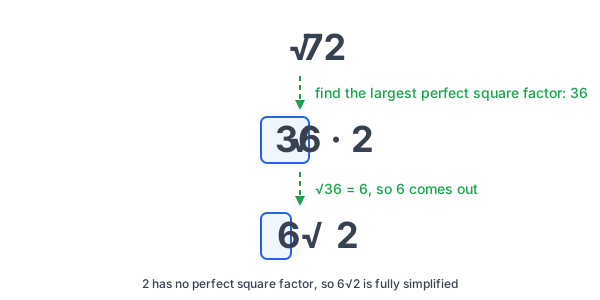
Simplifying square roots means rewriting a square root so no perfect square factor is left under the radical sign. Find the largest perfect square that divides the number, split it out, and take its square root. For example, \sqrt{72} = \sqrt{36 \cdot 2} = 6\sqrt{2}. This is called simplest radical form.
Before this lesson: You should know square roots and perfect squares, prime factorization and the exponent rules.
Extra practice: The Algebra 1 Unit 8 Practice Pack has printable problems, answer keys and a cheat sheet for this unit.
What Does It Mean to Simplify a Square Root?
Some square roots are whole numbers, like \sqrt{36} = 6. Others are not, like \sqrt{72}. Its value is a decimal that never ends or repeats, so it is an irrational number.
You can still write \sqrt{72} in a simpler, exact way. The number 72 has a perfect square hiding inside it: 72 = 36 \cdot 2. The square root of 36 is 6, so 6 can come out in front.
The number under the radical sign is the radicand. A square root is in simplest radical form when the radicand has no perfect square factor other than 1.
The Product Property of Square Roots
\sqrt{ab} = \sqrt{a} \cdot \sqrt{b} \quad \text{for } a \ge 0 \text{ and } b \ge 0This rule lets you split one square root into two. Pick a to be a perfect square. Then \sqrt{a} is a whole number.
| Perfect squares to look for | Tip |
|---|---|
| 4, 9, 16, 25, 36, 49, 64, 81, 100, 121, 144 | Try the largest one that divides the radicand. |
Steps for simplifying a square root
- Find the largest perfect square that divides the radicand.
- Write the radicand as that perfect square times another number.
- Use \sqrt{ab} = \sqrt{a} \cdot \sqrt{b} to split the root.
- Take the square root of the perfect square. Write it in front.
- Check that the number left under the radical has no perfect square factor.
Worked Examples
Example 1: A basic square root
Simplify \sqrt{50}.
Step 1. Find the largest perfect square that divides 50. The perfect squares are 1, 4, 9, 16, 25, 36, 49, … and 25 divides 50.
\sqrt{50} = \sqrt{25 \cdot 2}Step 2. Write 50 as 25 times 2.
\sqrt{25 \cdot 2} = \sqrt{25} \cdot \sqrt{2}Step 3. Split the root into two roots with the product property.
\sqrt{25} \cdot \sqrt{2} = 5\sqrt{2}Step 4. Take the square root of 25, which is 5.
Answer: 5\sqrt{2}
Check: Square the answer: (5\sqrt{2})^2 = 25 \cdot 2 = 50.
Example 2: When you don’t pick the largest square
Simplify \sqrt{72}. Suppose you see 4 first instead of 36.
\sqrt{72} = \sqrt{4 \cdot 18}Step 1. Write 72 as 4 times 18.
\sqrt{4 \cdot 18} = 2\sqrt{18}Step 2. Take the square root of 4, which is 2.
2\sqrt{18} = 2\sqrt{9 \cdot 2}Step 3. The radicand 18 still has a perfect square factor, 9. Write 18 as 9 times 2.
2\sqrt{9 \cdot 2} = 2 \cdot 3\sqrt{2}Step 4. Take the square root of 9, which is 3.
2 \cdot 3\sqrt{2} = 6\sqrt{2}Step 5. Multiply the numbers in front.
Answer: 6\sqrt{2}. Starting with 36 gives the same answer in fewer steps: \sqrt{72} = \sqrt{36 \cdot 2} = 6\sqrt{2}.
Example 3: A number already in front
Simplify 3\sqrt{20}.
3\sqrt{20} = 3\sqrt{4 \cdot 5}Step 1. Find the largest perfect square that divides 20. It is 4. Write 20 as 4 times 5.
3\sqrt{4 \cdot 5} = 3 \cdot 2\sqrt{5}Step 2. Take the square root of 4, which is 2.
3 \cdot 2\sqrt{5} = 6\sqrt{5}Step 3. Multiply the numbers in front.
Answer: 6\sqrt{5}
Example 4: Square roots with variables
Simplify \sqrt{18x^2} and \sqrt{x^5}. Assume x \ge 0.
\sqrt{18x^2} = \sqrt{9 \cdot 2 \cdot x^2}Step 1. Write 18 as 9 times 2.
\sqrt{9 \cdot 2 \cdot x^2} = 3x\sqrt{2}Step 2. Take the square roots of the perfect squares: \sqrt{9} = 3 and \sqrt{x^2} = x. The 2 stays under the radical.
\sqrt{x^5} = \sqrt{x^4 \cdot x}Step 3. For \sqrt{x^5}, split off one x, so the rest is an even power (see exponent rules).
\sqrt{x^4 \cdot x} = x^2\sqrt{x}Step 4. An even power is a perfect square: x^4 = (x^2)^2, so \sqrt{x^4} = x^2.
Answer: \sqrt{18x^2} = 3x\sqrt{2} and \sqrt{x^5} = x^2\sqrt{x}.
Example 5: Word problem
A square patio has an area of 48 square feet. Find the exact length of one side in simplest radical form. Then estimate it, using \sqrt{3} \approx 1.73.
Step 1. The side of a square is the square root of its area, so the side is \sqrt{48} feet.
\sqrt{48} = \sqrt{16 \cdot 3}Step 2. The largest perfect square that divides 48 is 16. Write 48 as 16 times 3.
\sqrt{16 \cdot 3} = 4\sqrt{3}Step 3. Take the square root of 16, which is 4.
4 \cdot 1.73 = 6.92
Step 4. Estimate: replace \sqrt{3} with 1.73 and multiply.
Answer: Each side is 4\sqrt{3} feet, or about 6.92 feet. That is a little less than 7 feet.
Check: (4\sqrt{3})^2 = 16 \cdot 3 = 48.
Common Mistakes
| Mistake | Example of the error | Fix |
|---|---|---|
| Splitting a sum | \sqrt{9 + 16} = 3 + 4 = 7 | The product rule only works for products. \sqrt{9 + 16} = \sqrt{25} = 5. |
| Stopping too soon | \sqrt{72} = 2\sqrt{18} | 18 still has the factor 9. Keep going: 6\sqrt{2}. |
| Putting the square in front | \sqrt{50} = 25\sqrt{2} | Write the square root of 25 in front, not 25: 5\sqrt{2}. |
| Dropping the number in front | 3\sqrt{20} = 2\sqrt{5} | Multiply by the 3 too: 3 \cdot 2\sqrt{5} = 6\sqrt{5}. |
| Taking half of the radicand | \sqrt{16} = 8 | \sqrt{16} = 4, because 4 \cdot 4 = 16. |
Other Ways to Simplify
Using prime factorization
If you can’t spot the perfect square, break the radicand into primes. Each pair of the same prime comes out as one number.
\sqrt{180} = \sqrt{2 \cdot 2 \cdot 3 \cdot 3 \cdot 5} = 2 \cdot 3\sqrt{5} = 6\sqrt{5}Square roots of fractions
When the bottom of a fraction is a perfect square, take the root of the top and the bottom. For example, \sqrt{\frac{5}{9}} = \frac{\sqrt{5}}{3}. Roots on the bottom that are not perfect squares come later, in rationalizing the denominator.
Simplified or not?
| Square root | Simplified? | Why |
|---|---|---|
| \sqrt{30} | Yes | 30 = 2 \cdot 3 \cdot 5 has no perfect square factor |
| \sqrt{28} | No | 28 = 4 \cdot 7, so \sqrt{28} = 2\sqrt{7} |
| 5\sqrt{3} | Yes | 3 has no perfect square factor |
| \sqrt{x^3} | No | \sqrt{x^3} = x\sqrt{x} for x \ge 0 |
Like terms with the same radical can be added and subtracted, much like combining like terms. That is the next skill in this unit, Adding and Subtracting Radicals.
Practice Problems
- Simplify \sqrt{12}.
- Simplify \sqrt{45}.
- Simplify \sqrt{98}.
- Simplify \sqrt{200}.
- Simplify \sqrt{75}.
- Simplify 2\sqrt{27}.
- Simplify \sqrt{49x^2}. Assume x \ge 0.
- Simplify \sqrt{12x^3}. Assume x \ge 0.
- Simplify \sqrt{\frac{11}{36}}.
- A square tile has an area of 32 square inches. Find the exact length of one side. Then estimate it, using \sqrt{2} \approx 1.41.
Show answers
1.
\sqrt{12} = \sqrt{4 \cdot 3}Find the largest perfect square factor of 12: it is 4. Write 12 as 4 times 3.
\sqrt{4 \cdot 3} = 2\sqrt{3}Take the square root of 4, which is 2.
2.
\sqrt{45} = \sqrt{9 \cdot 5}Find the largest perfect square factor of 45: it is 9. Write 45 as 9 times 5.
\sqrt{9 \cdot 5} = 3\sqrt{5}Take the square root of 9, which is 3.
3.
\sqrt{98} = \sqrt{49 \cdot 2}Find the largest perfect square factor of 98: it is 49. Write 98 as 49 times 2.
\sqrt{49 \cdot 2} = 7\sqrt{2}Take the square root of 49, which is 7.
4.
\sqrt{200} = \sqrt{100 \cdot 2}Find the largest perfect square factor of 200: it is 100. Write 200 as 100 times 2.
\sqrt{100 \cdot 2} = 10\sqrt{2}Take the square root of 100, which is 10.
5.
\sqrt{75} = \sqrt{25 \cdot 3}Find the largest perfect square factor of 75: it is 25. Write 75 as 25 times 3.
\sqrt{25 \cdot 3} = 5\sqrt{3}Take the square root of 25, which is 5.
6.
2\sqrt{27} = 2\sqrt{9 \cdot 3}Find the largest perfect square factor of 27: it is 9. Write 27 as 9 times 3.
2\sqrt{9 \cdot 3} = 2 \cdot 3\sqrt{3}Take the square root of 9, which is 3.
2 \cdot 3\sqrt{3} = 6\sqrt{3}Multiply the numbers in front.
7.
\sqrt{49x^2} = \sqrt{49} \cdot \sqrt{x^2}Split the root.
\sqrt{49} \cdot \sqrt{x^2} = 7xBoth parts are perfect squares, so take each root.
8.
Split off the perfect squares: 4 from 12 and x^2 from x^3: \sqrt{12x^3} = \sqrt{4x^2 \cdot 3x}
\sqrt{4x^2 \cdot 3x} = 2x\sqrt{3x}Take the square root of 4x^2, which is 2x. The 3x stays under the radical.
9.
\sqrt{\frac{11}{36}} = \frac{\sqrt{11}}{\sqrt{36}}Take the square root of the top and the bottom.
The bottom is a perfect square: \sqrt{36} = 6. The top, 11, has no perfect square factor, so it stays: \frac{\sqrt{11}}{\sqrt{36}} = \frac{\sqrt{11}}{6}
10.
\sqrt{32} = \sqrt{16 \cdot 2}The side is the square root of the area, \sqrt{32}. Write 32 as 16 times 2.
\sqrt{16 \cdot 2} = 4\sqrt{2}Take the square root of 16, which is 4.
4 \cdot 1.41 = 5.64
Estimate: replace \sqrt{2} with 1.41 and multiply.
Each side is 4\sqrt{2} inches, or about 5.64 inches.
Want more practice? The Algebra 1 Unit 8 Practice Pack has 27 pages of problems on this and the other lessons in the unit, with step-by-step answers and a cheat sheet.
FAQ
What is simplest radical form?
A square root is in simplest radical form when the number under the radical has no perfect square factor other than 1. For example, 6\sqrt{2} is in simplest form, but \sqrt{72} is not.
How do you simplify a square root that is not a perfect square?
Find the largest perfect square that divides the number. Split the root into that square times the rest, and take the square root of the square.
Can you split the square root of a sum?
No. \sqrt{a + b} is not \sqrt{a} + \sqrt{b}. Add first, then take the root.
Is the square root of 8 the same as 2 root 2?
Yes. \sqrt{8} = \sqrt{4 \cdot 2} = 2\sqrt{2}. They have the same value, about 2.83, but 2\sqrt{2} is the simplified form.
Summary
- Use \sqrt{ab} = \sqrt{a} \cdot \sqrt{b} to split a square root into two.
- Find the largest perfect square factor, take its root, and write it in front.
- If the number left still has a perfect square factor, keep going.
- Even powers of a variable are perfect squares: \sqrt{x^4} = x^2 when x \ge 0.
- Never split the square root of a sum.
Previous lesson: Factoring Completely
Next lesson: Adding and Subtracting Radicals
Back to the Algebra 1 Index