
Exponent Rules
Exponent rules are shortcuts for simplifying powers. When the bases match, multiply by adding the exponents: x^a \cdot x^b = x^{a+b}. Divide by subtracting them. For a power of a power, multiply the exponents. For a power of a product or quotient, give the exponent to each factor.
Before this lesson: You should know what exponents mean, how to work with algebraic expressions, and how to do combining like terms.
Extra practice: The Algebra 1 Unit 6 Practice Pack has printable problems, answer keys and a cheat sheet for this unit.
Why the Exponent Rules Work
An exponent counts how many times a base is multiplied. So x^3 means x \cdot x \cdot x. The base is x and the exponent is 3.
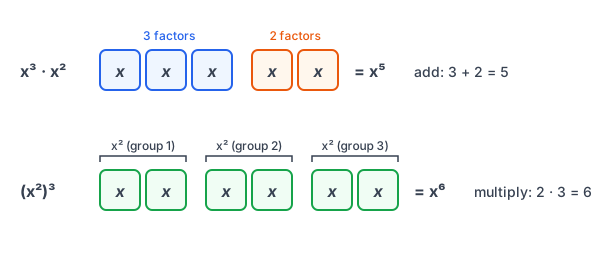
Now multiply x^3 \cdot x^2. Write out every factor: (x \cdot x \cdot x)(x \cdot x). That is 5 factors of x, so the answer is x^5. You added 3 and 2.
Raise x^2 to the 3rd power and you get x^2 \cdot x^2 \cdot x^2. That is 3 groups of 2, or 6 factors. So (x^2)^3 = x^6. You multiplied 2 and 3.
The Exponent Rules
In each rule, a and b are positive whole numbers. The bases can’t be 0 when they are on the bottom of a fraction.
| Rule | In symbols | Example |
|---|---|---|
| Product rule | x^a \cdot x^b = x^{a+b} | x^4 \cdot x^3 = x^7 |
| Quotient rule | \dfrac{x^a}{x^b} = x^{a-b} | \dfrac{x^9}{x^4} = x^5 |
| Power of a power | (x^a)^b = x^{ab} | (x^5)^2 = x^{10} |
| Power of a product | (xy)^a = x^a y^a | (3x)^2 = 9x^2 |
| Power of a quotient | \left(\dfrac{x}{y}\right)^a = \dfrac{x^a}{y^a} | \left(\dfrac{x}{2}\right)^3 = \dfrac{x^3}{8} |
How to Simplify with Exponent Rules
- Multiply or divide the numbers (the coefficients) first.
- Group the same bases together.
- Use the rules on each base: add exponents to multiply, subtract to divide, multiply for a power of a power.
- If a whole product is raised to a power, raise every factor, including the number.
- Write each base once, in alphabetical order.
In this lesson, the quotient rule leaves a positive exponent. What x^0 and negative exponents mean is the next lesson, Zero and Negative Exponents.
Worked Examples
Example 1: Product Rule
Simplify (a) 2^3 \cdot 2^4 and (b) x^5 \cdot x \cdot x^2.
2^3 \cdot 2^4 = 2^{3+4}Step 1. (a) The bases match, so keep the base 2 and add the exponents. Do not multiply the bases. (See exponents.)
2^{3+4} = 2^7Step 2. Add the exponents.
2^7 = 128
Step 3. Find the value: 2^7 is seven 2s multiplied together.
x^5 \cdot x \cdot x^2 = x^5 \cdot x^1 \cdot x^2
Step 4. (b) A plain x has exponent 1. Write it in.
x^{5+1+2} = x^8Step 5. The bases match, so add the exponents.
Answer: (a) 2^7 = 128; (b) x^8
Example 2: Monomials with Coefficients
Simplify (3x^4y)(-5x^2y^3).
3 \cdot (-5) \cdot x^4 \cdot x^2 \cdot y \cdot y^3
Step 1. Group the numbers and the like bases together.
3 \cdot (-5) = -15
Step 2. Multiply the numbers. A positive times a negative is negative (see multiplying and dividing integers).
x^4 \cdot x^2 = x^{4+2} = x^6Step 3. Add the exponents on x.
y^1 \cdot y^3 = y^{1+3} = y^4Step 4. Add the exponents on y. A plain y has exponent 1.
Answer: -15x^6y^4
Example 3: Quotient Rule
Simplify \dfrac{24a^7b^3}{6a^2b}.
\frac{24}{6} = 4Step 1. Divide the numbers.
\frac{a^7}{a^2} = a^{7-2} = a^5Step 2. Subtract the exponents on a: top exponent minus bottom exponent.
\frac{b^3}{b^1} = b^{3-1} = b^2Step 3. Subtract the exponents on b. A plain b has exponent 1.
Answer: 4a^5b^2
Example 4: Power Rules
Simplify (a) (2x^3)^4, (b) (-3y^2)^3 and (c) \left(\dfrac{x^2}{5}\right)^3.
(2x^3)^4 = 2^4 \cdot (x^3)^4
Step 1. (a) Raise each factor to the 4th power.
16 \cdot x^{3 \cdot 4} = 16x^{12}Step 2. Find 2^4 = 16. For a power of a power, multiply the exponents.
(-3y^2)^3 = (-3)^3 \cdot (y^2)^3
Step 3. (b) Raise each factor to the 3rd power.
(-3)^3 = (-3)(-3)(-3) = -27
Step 4. Find the number. An odd power of a negative number is negative.
-27 \cdot y^{2 \cdot 3} = -27y^6Step 5. Multiply the exponents on y.
\left(\frac{x^2}{5}\right)^3 = \frac{(x^2)^3}{5^3}Step 6. (c) Raise the top and the bottom to the 3rd power.
\frac{x^6}{125}Step 7. Multiply the exponents on top, and find 5^3 = 125.
Answer: (a) 16x^{12}; (b) -27y^6; (c) \dfrac{x^6}{125}
Example 5: Word Problem
A cube has edges that are 3x^2 centimeters long. Write its volume as a single term. Then find the volume when x = 2.
V = (3x^2)^3
Step 1. The volume of a cube is the edge cubed.
V = 3^3 \cdot (x^2)^3
Step 2. Use the power of a product rule. Raise each factor to the 3rd power.
V = 27x^6
Step 3. Find 3^3 = 27 and multiply the exponents on x.
V = 27 \cdot 2^6
Step 4. Substitute x = 2.
27 \cdot 64 = 1728
Step 5. Find 2^6 = 64 and multiply.
Answer: The volume is 27x^6 cubic centimeters. When x = 2, it is 1,728 cubic centimeters.
Check: The edge is 3 \cdot 2^2 = 3 \cdot 4 = 12 cm, and 12^3 = 1728.
Common Mistakes
| Mistake | Example of the error | Fix |
|---|---|---|
| Multiplying exponents when multiplying powers | x^3 \cdot x^4 = x^{12} | Add them: x^3 \cdot x^4 = x^7 |
| Multiplying the bases | 2^3 \cdot 2^4 = 4^7 | Keep the base: 2^3 \cdot 2^4 = 2^7 |
| Combining different bases | x^2 \cdot y^3 = (xy)^5 | x^2y^3 can’t be simplified |
| Not raising the number | (2x^3)^4 = 2x^{12} | Raise every factor: 16x^{12} |
| Adding exponents when adding terms | x^2 + x^3 = x^5 | These are not like terms. x^2 + x^3 stays as it is |
| Using the product rule on a sum | (x + y)^2 = x^2 + y^2 | The rule is only for products: (xy)^2 = x^2y^2 |
Checking Your Work with Numbers
Not sure a step is right? Put in a small number and compare both sides. Try x = 2.
| Step to test | Left side | Right side | Match? |
|---|---|---|---|
| x^3 \cdot x^4 = x^7 | 8 \cdot 16 = 128 | 2^7 = 128 | Yes |
| x^3 \cdot x^4 = x^{12} | 128 | 2^{12} = 4096 | No, so this step is wrong |
| (x^2)^3 = x^6 | 4^3 = 64 | 2^6 = 64 | Yes |
Exponent rules are used all the time with powers of 10. In scientific notation, (3 \times 10^4)(2 \times 10^5) = 6 \times 10^9, because 10^4 \cdot 10^5 = 10^9. You will also use them to multiply polynomials in Unit 7.
Practice Problems
- Simplify x^6 \cdot x^3.
- Simplify (4a^2)(7a^5).
- Simplify \dfrac{y^{10}}{y^4}.
- Simplify (m^3)^5.
- Simplify (-2x^4)^3.
- Simplify \dfrac{18x^8y^5}{3x^3y^2}.
- Simplify \left(\dfrac{a}{3}\right)^4.
- Simplify (2x^2y)^3(xy^2).
- Find the value of \dfrac{5^9}{5^7} without a calculator.
- A square tile has sides 4n^3 inches long. Write its area as a single term.
Show answers
1.
x^6 \cdot x^3 = x^{6+3}The bases match, so add the exponents.
x^9
Add.
2.
4 \cdot 7 = 28
Multiply the numbers.
a^2 \cdot a^5 = a^{2+5} = a^7Add the exponents on a.
So the answer is 28a^7.
3.
\frac{y^{10}}{y^4} = y^{10-4}Subtract the exponents.
y^6
Subtract.
4.
(m^3)^5 = m^{3 \cdot 5}For a power of a power, multiply the exponents.
m^{15}Multiply.
5.
(-2x^4)^3 = (-2)^3 \cdot (x^4)^3
Raise each factor to the 3rd power.
(-2)^3 = (-2)(-2)(-2) = -8
Find the number. An odd power of a negative is negative.
(x^4)^3 = x^{12}Multiply the exponents on x.
So the answer is -8x^{12}.
6.
\frac{18}{3} = 6Divide the numbers.
\frac{x^8}{x^3} = x^{8-3} = x^5Subtract the exponents on x.
\frac{y^5}{y^2} = y^{5-2} = y^3Subtract the exponents on y.
So the answer is 6x^5y^3.
7.
\left(\frac{a}{3}\right)^4 = \frac{a^4}{3^4}Raise the top and the bottom to the 4th power.
3^4 = 3 \cdot 3 \cdot 3 \cdot 3 = 81
Find the bottom.
So the answer is \dfrac{a^4}{81}.
8.
(2x^2y)^3 = 2^3 \cdot (x^2)^3 \cdot y^3
Raise each factor in the first part to the 3rd power.
8x^6y^3
Simplify.
8x^6y^3 \cdot xy^2 = 8x^{6+1}y^{3+2}Multiply by xy^2. Add the exponents on each base.
8x^7y^5
Add.
9.
\frac{5^9}{5^7} = 5^{9-7}The bases match, so subtract the exponents.
5^2
Subtract.
5^2 = 25
Find the value.
10.
A = (4n^3)^2
The area of a square is the side squared.
A = 4^2 \cdot (n^3)^2
Raise each factor to the 2nd power.
A = 16n^6
Find 4^2 = 16 and multiply the exponents.
The area is 16n^6 square inches.
Want more practice? The Algebra 1 Unit 6 Practice Pack has 49 pages of problems on this and the other lessons in the unit, with step-by-step answers and a cheat sheet.
FAQ
What are the exponent rules?
The main rules are the product rule (x^a \cdot x^b = x^{a+b}), the quotient rule (\frac{x^a}{x^b} = x^{a-b}) and the power rules. The power rules say (x^a)^b = x^{ab} and (xy)^a = x^a y^a.
When do you add exponents and when do you multiply them?
Add them when you multiply two powers with the same base, like x^2 \cdot x^3 = x^5. Multiply them when you raise a power to a power, like (x^2)^3 = x^6.
Can you use exponent rules with different bases?
Not the product and quotient rules. x^2 \cdot y^3 stays as it is. But if the exponents match, you can group them: x^3y^3 = (xy)^3.
Is (x + y)² the same as x² + y²?
No. The power rule works for products, not sums. For example, (2 + 3)^2 = 25, but 2^2 + 3^2 = 13.
Summary
- Product rule: same base, add the exponents. x^a \cdot x^b = x^{a+b}
- Quotient rule: same base, subtract the exponents. \frac{x^a}{x^b} = x^{a-b}
- Power of a power: multiply the exponents. (x^a)^b = x^{ab}
- Power of a product or quotient: raise every factor, including numbers.
- Numbers multiply or divide as usual. Different bases can’t be combined.
Previous lesson: Systems of Inequalities
Next lesson: Zero and Negative Exponents
Back to the Algebra 1 Index