
Zero and Negative Exponents
Zero and negative exponents follow two rules. Any nonzero number to the zero power is 1, so 7^0 = 1. A negative exponent means “one over” the positive power, so x^{-n} = \dfrac{1}{x^n}. For example, 2^{-3} = \dfrac{1}{8}. A negative exponent never makes the number negative.
Before this lesson: You should know the exponent rules, what exponents mean, and how to work with fractions.
Extra practice: The Algebra 1 Unit 6 Practice Pack has printable problems, answer keys and a cheat sheet for this unit.
Why Zero and Negative Exponents Work
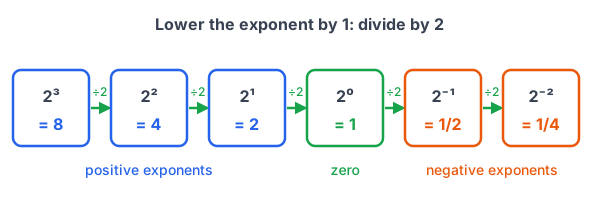
Look at the powers of 2. Each time the exponent goes down by 1, you divide by 2. So 2^3 = 8, 2^2 = 4 and 2^1 = 2.
Keep going. Divide 2 by 2 and you get 1, so 2^0 = 1. Divide again and you get \tfrac{1}{2}, so 2^{-1} = \tfrac{1}{2}. Then 2^{-2} = \tfrac{1}{4}.
The quotient rule says the same thing. \dfrac{x^3}{x^3} = x^{3-3} = x^0. But anything divided by itself is 1. So x^0 has to be 1.
Zero and Negative Exponent Rules
In each rule, x is not 0, and n is a whole number.
| Rule | In symbols | Example |
|---|---|---|
| Zero exponent | x^0 = 1 | 9^0 = 1 |
| Negative exponent | x^{-n} = \dfrac{1}{x^n} | 5^{-2} = \dfrac{1}{25} |
| Negative exponent on the bottom | \dfrac{1}{x^{-n}} = x^n | \dfrac{1}{3^{-2}} = 9 |
| Fraction to a negative power | \left(\dfrac{a}{b}\right)^{-n} = \left(\dfrac{b}{a}\right)^n | \left(\dfrac{2}{3}\right)^{-2} = \dfrac{9}{4} |
A negative exponent moves a factor across the fraction bar. A factor on top moves to the bottom. A factor on the bottom moves to the top. The exponent turns positive when it moves.
How to Rewrite with Positive Exponents
- Find each factor with a zero exponent. Change it to 1.
- Find each factor with a negative exponent. Look at what the exponent is attached to.
- Move only that factor across the fraction bar, and make its exponent positive.
- Leave every other factor where it is, including numbers with no exponent.
- Use the exponent rules to finish. Simplify any numbers.
Worked Examples
Example 1: Evaluate Powers
Find the value of (a) 6^0, (b) (-4)^0, (c) -4^0 and (d) 3^{-2}.
6^0 = 1
Step 1. (a) Any nonzero number to the zero power is 1.
(-4)^0 = 1
Step 2. (b) The base is -4, inside the parentheses. It is a nonzero number, so the power is 1.
-4^0 = -(4^0)
Step 3. (c) There are no parentheses, so the base is just 4. The minus sign stays out front.
-(4^0) = -1
Step 4. Find 4^0 = 1.
3^{-2} = \frac{1}{3^2}Step 5. (d) Move the power to the bottom of a fraction and make the exponent positive.
\frac{1}{3^2} = \frac{1}{9}Step 6. Find 3^2 = 9. (See exponents.)
Answer: (a) 1; (b) 1; (c) -1; (d) \dfrac{1}{9}
Example 2: Watch What the Exponent Is Attached To
Rewrite with positive exponents: (a) x^{-5}, (b) 4y^{-2} and (c) (4y)^{-2}.
x^{-5} = \frac{1}{x^5}Step 1. (a) Move the power to the bottom and make the exponent positive.
4y^{-2} = 4 \cdot \frac{1}{y^2}Step 2. (b) The exponent is on y only. Rewrite y^{-2} and keep the 4 on top.
4 \cdot \frac{1}{y^2} = \frac{4}{y^2}Step 3. Multiply.
(4y)^{-2} = \frac{1}{(4y)^2}Step 4. (c) Now the exponent is on the whole group 4y. Move the group to the bottom.
\frac{1}{(4y)^2} = \frac{1}{16y^2}Step 5. Square both factors: (4y)^2 = 4^2y^2 = 16y^2.
Answer: (a) \dfrac{1}{x^5}; (b) \dfrac{4}{y^2}; (c) \dfrac{1}{16y^2}
Example 3: Negative Exponents on the Bottom
Rewrite with positive exponents: (a) \dfrac{5}{a^{-3}} and (b) \dfrac{m^{-2}}{n^{-4}}.
\frac{5}{a^{-3}} = 5a^3Step 1. (a) The factor a^{-3} is on the bottom. Move it to the top and make the exponent positive.
\frac{m^{-2}}{n^{-4}} = \frac{1}{m^2 n^{-4}}Step 2. (b) Move m^{-2} down. Its exponent turns positive.
\frac{1}{m^2 n^{-4}} = \frac{n^4}{m^2}Step 3. Move n^{-4} up. Its exponent turns positive too.
Answer: (a) 5a^3; (b) \dfrac{n^4}{m^2}
Example 4: Simplify with the Exponent Rules
Simplify. Write the answer with positive exponents only: (a) (2x^{-3}y^4)(5x^7y^{-6}) and (b) \dfrac{12a^2b^{-1}}{3a^5b^2}.
2 \cdot 5 = 10
Step 1. (a) Multiply the numbers.
x^{-3} \cdot x^7 = x^{-3+7} = x^4Step 2. Add the exponents on x (see exponent rules).
y^4 \cdot y^{-6} = y^{4+(-6)} = y^{-2}Step 3. Add the exponents on y.
10x^4y^{-2}Step 4. Put the parts together.
10x^4y^{-2} = \frac{10x^4}{y^2}Step 5. Move y^{-2} to the bottom and make the exponent positive.
\frac{12}{3} = 4Step 6. (b) Divide the numbers.
\frac{a^2}{a^5} = a^{2-5} = a^{-3}Step 7. Subtract the exponents on a.
\frac{b^{-1}}{b^2} = b^{-1-2} = b^{-3}Step 8. Subtract the exponents on b.
4a^{-3}b^{-3}Step 9. Put the parts together.
4a^{-3}b^{-3} = \frac{4}{a^3b^3}Step 10. Move both negative powers to the bottom.
Answer: (a) \dfrac{10x^4}{y^2}; (b) \dfrac{4}{a^3b^3}
Example 5: Word Problem
A ladybug is 4 millimeters long. One millimeter is 10^{-3} meters. (a) Write the ladybug’s length in meters. (b) How many ladybugs, lined up end to end, would make 2 meters?
4 \cdot 10^{-3}Step 1. (a) Multiply the length in millimeters by the size of one millimeter.
4 \cdot \frac{1}{1000} = \frac{4}{1000}Step 2. Rewrite the negative exponent as a fraction.
\frac{4}{1000} = 0.004Step 3. Write the fraction as a decimal (see converting fractions and decimals).
\frac{2}{4 \cdot 10^{-3}}Step 4. (b) Divide the total length by the length of one ladybug.
\frac{2}{4} \cdot \frac{1}{10^{-3}}Step 5. Split the fraction into two parts.
\frac{1}{2} \cdot 10^3Step 6. Simplify \frac{2}{4} and move 10^{-3} to the top.
\frac{1}{2} \cdot 1000 = 500Step 7. Find 10^3 = 1000 and multiply.
Answer: (a) 0.004 meters; (b) 500 ladybugs
Check: 500 \cdot 0.004 = 2 meters.
Common Mistakes
| Mistake | Example of the error | Fix |
|---|---|---|
| Making the number negative | 2^{-3} = -8 | A negative exponent means a fraction: 2^{-3} = \dfrac{1}{8} |
| Multiplying by the exponent | 2^{-3} = -6 | The exponent is not a factor: 2^{-3} = \dfrac{1}{8} |
| Moving the coefficient too | 3x^{-2} = \dfrac{1}{3x^2} | Only x has the exponent: \dfrac{3}{x^2} |
| Saying the zero power is 0 | 8^0 = 0 | 8^0 = 1 |
| Ignoring a minus sign out front | -5^0 = 1 | The base is 5: -5^0 = -1. But (-5)^0 = 1 |
| Leaving a negative exponent in the answer | \dfrac{a^{-2}}{b} | Move it down: \dfrac{1}{a^2b} |
Negative Exponents and Powers of 10
Negative powers of 10 are small decimals. The exponent tells you how many places the 1 sits after the decimal point.
| Power | Fraction | Decimal |
|---|---|---|
| 10^2 | 100 | 100 |
| 10^1 | 10 | 10 |
| 10^0 | 1 | 1 |
| 10^{-1} | \dfrac{1}{10} | 0.1 |
| 10^{-2} | \dfrac{1}{100} | 0.01 |
| 10^{-3} | \dfrac{1}{1000} | 0.001 |
This is how scientific notation writes very small numbers. For example, 7.2 \cdot 10^{-4} = 0.00072. Metric units work the same way: a milligram is 10^{-3} grams.
Practice Problems
- Find the value of 15^0.
- Find the value of 4^{-3}.
- Find the value of -2^{-2}.
- Rewrite 7m^{-4} with positive exponents.
- Rewrite \dfrac{3}{k^{-2}} with positive exponents.
- Find the value of \left(\dfrac{3}{5}\right)^{-2}.
- Simplify x^{-6} \cdot x^{9}.
- Simplify \dfrac{20p^3q^{-2}}{5p^7}. Use positive exponents only.
- Simplify (3a^{-2}b)^2 \cdot a^5. Use positive exponents only.
- A dust grain has a mass of 5 \cdot 10^{-6} grams. Write this as a decimal. Then find the mass of 1,000 grains.
Show answers
1.
15^0 = 1
Any nonzero number to the zero power is 1.
2.
4^{-3} = \frac{1}{4^3}Move the power to the bottom and make the exponent positive.
4^3 = 4 \cdot 4 \cdot 4 = 64
Find the bottom.
So 4^{-3} = \dfrac{1}{64}.
3.
-2^{-2} = -(2^{-2})The base is 2. The minus sign stays out front.
-(2^{-2}) = -\frac{1}{2^2}Rewrite the negative exponent.
-\frac{1}{2^2} = -\frac{1}{4}Find the bottom.
4.
7m^{-4} = 7 \cdot \frac{1}{m^4}The exponent is on m only. Rewrite it.
\frac{7}{m^4}Multiply.
5.
\frac{3}{k^{-2}} = 3k^2Move the factor on the bottom to the top and make the exponent positive.
6.
\left(\frac{3}{5}\right)^{-2} = \left(\frac{5}{3}\right)^2Flip the fraction and make the exponent positive.
\frac{5^2}{3^2} = \frac{25}{9}Square the top and the bottom.
7.
x^{-6} \cdot x^9 = x^{-6+9}The bases match, so add the exponents.
x^3
Add.
8.
\frac{20}{5} = 4Divide the numbers.
\frac{p^3}{p^7} = p^{3-7} = p^{-4}Subtract the exponents on p.
4p^{-4}q^{-2}Put the parts together. The q stays the same.
4p^{-4}q^{-2} = \frac{4}{p^4q^2}Move both negative powers to the bottom.
9.
(3a^{-2}b)^2 = 3^2 \cdot (a^{-2})^2 \cdot b^2Raise each factor to the 2nd power.
9a^{-4}b^2Simplify. Multiply the exponents on a.
9a^{-4}b^2 \cdot a^5 = 9a^{-4+5}b^2Multiply by a^5. Add the exponents on a.
9a^1b^2 = 9ab^2
Add.
10.
5 \cdot 10^{-6} = 5 \cdot \frac{1}{1000000}Rewrite the negative exponent as a fraction.
0.000005
Write it as a decimal. Move the decimal point 6 places left (see scientific notation)
5 \cdot 10^{-6} \cdot 10^3For 1,000 grains, multiply by 10^3.
5 \cdot 10^{-6+3} = 5 \cdot 10^{-3}Add the exponents.
5 \cdot 10^{-3} = 0.005Write it as a decimal.
One grain is 0.000005 grams, and 1,000 grains are 0.005 grams.
Want more practice? The Algebra 1 Unit 6 Practice Pack has 49 pages of problems on this and the other lessons in the unit, with step-by-step answers and a cheat sheet.
FAQ
Why is any number to the zero power equal to 1?
Divide a power by itself. The quotient rule gives \dfrac{x^4}{x^4} = x^0, and anything divided by itself is 1. So x^0 = 1 for any x that is not 0.
What is 0 to the zero power?
0^0 is left undefined in algebra, because the patterns give two different answers. The rule x^0 = 1 is only for nonzero x.
Does a negative exponent make a number negative?
No. A negative exponent makes a fraction. For example, 2^{-4} = \dfrac{1}{16}, which is positive.
How do you get rid of a negative exponent?
Move that factor to the other side of the fraction bar. Then make its exponent positive. Leave every other factor where it is.
Summary
- Any nonzero number to the zero power is 1: x^0 = 1.
- A negative exponent means “one over”: x^{-n} = \dfrac{1}{x^n}.
- A negative exponent on the bottom moves to the top: \dfrac{1}{x^{-n}} = x^n.
- Only the factor attached to the exponent moves. Watch for parentheses.
- A negative exponent never makes the value negative.
Previous lesson: Exponent Rules
Next lesson: Exponential Functions
Back to the Algebra 1 Index