
Exponential Functions
An exponential function has the variable in the exponent. Its form is f(x) = a \cdot b^x, where a is the starting value and b is the number you multiply by each time x goes up by 1. For example, f(x) = 3 \cdot 2^x doubles at every step.
Before this lesson: You should know function notation, the exponent rules, and zero and negative exponents.
Extra practice: The Algebra 1 Unit 6 Practice Pack has printable problems, answer keys and a cheat sheet for this unit.
What Makes a Function Exponential
Fold a sheet of paper in half. It is now 2 layers thick. Fold again and you have 4 layers, then 8, then 16. Each fold multiplies the layers by 2.
After x folds, there are 2^x layers. The number of folds is in the exponent. That is what makes the function exponential.
A linear function adds the same amount each step. An exponential function multiplies by the same amount each step. That number is the base, b.
The Exponential Function Form
f(x) = a \cdot b^x
| Part | Meaning | In f(x) = 3 · 2ˣ |
|---|---|---|
| a | The starting value, or y-intercept. It is the output when x = 0. It can’t be 0. | a = 3 |
| b | The base. Multiply by it each time x goes up by 1. It must be positive and not 1. | b = 2 |
| x | The input. It sits in the exponent. | x |
If b is greater than 1, the function grows. This is exponential growth. If b is between 0 and 1, the function shrinks. This is exponential decay.
How to Tell If a Table Is Exponential
- Check that the x-values go up by the same amount, such as 1.
- Divide each y-value by the one before it. This is the ratio.
- If every ratio is the same, the table is exponential. That ratio is b.
- Find a, the y-value when x = 0. Then write f(x) = a \cdot b^x.
Worked Examples
Example 1: Spot the Exponential Functions
Which are exponential functions? (a) y = 4 \cdot 3^x, (b) y = x^3, (c) y = 10(0.5)^x, (d) y = 5x + 2 and (e) y = 6 \cdot 1^x.
y = 4 \cdot 3^x
Step 1. (a) The variable is in the exponent. Here a = 4 and b = 3. Yes, it is exponential.
y = x^3
Step 2. (b) The variable is in the base, not the exponent. No.
y = 10(0.5)^x
Step 3. (c) The variable is in the exponent. Here a = 10 and b = 0.5. Since 0 \lt 0.5 \lt 1, it is decay. Yes.
y = 5x + 2
Step 4. (d) There is no exponent on x. This is linear. It adds 5 each step. No.
1^x = 1
Step 5. (e) 1 to any power is 1.
y = 6
Step 6. The function is a flat line, not exponential. No.
Answer: (a) and (c)
Example 2: Evaluate an Exponential Function
Let f(x) = 4 \cdot 3^x. Find f(2), f(0) and f(-1).
f(2) = 4 \cdot 3^2
Step 1. Substitute x = 2 (see function notation).
4 \cdot 9 = 36
Step 2. Do the exponent first, then multiply (see order of operations).
f(0) = 4 \cdot 3^0
Step 3. Substitute x = 0.
4 \cdot 1 = 4
Step 4. Any nonzero number to the zero power is 1. This gives the starting value, a.
f(-1) = 4 \cdot 3^{-1}Step 5. Substitute x = -1.
4 \cdot \frac{1}{3}Step 6. Rewrite the negative exponent as a fraction (see zero and negative exponents).
4 \cdot \frac{1}{3} = \frac{4}{3}Step 7. Multiply. The output is still positive.
Answer: f(2) = 36, f(0) = 4, f(-1) = \dfrac{4}{3}
Example 3: Write a Function from a Table
Decide if each table is exponential. If it is, write its function.
| x | 0 | 1 | 2 | 3 |
|---|---|---|---|---|
| Table A | 5 | 10 | 20 | 40 |
| Table B | 81 | 27 | 9 | 3 |
| Table C | 2 | 5 | 8 | 11 |
\frac{10}{5} = 2, \quad \frac{20}{10} = 2, \quad \frac{40}{20} = 2Step 1. Table A: divide each y-value by the one before it.
f(x) = 5 \cdot 2^x
Step 2. The ratios match, so b = 2. At x = 0, y = 5, so a = 5.
\frac{27}{81} = \tfrac{1}{3}, \quad \frac{9}{27} = \tfrac{1}{3}, \quad \frac{3}{9} = \tfrac{1}{3}Step 3. Table B: divide each y-value by the one before it.
f(x) = 81\left(\tfrac{1}{3}\right)^xStep 4. The ratios match, so b = \tfrac{1}{3}. At x = 0, y = 81. This is decay.
\frac{5}{2}, \quad \frac{8}{5}Step 5. Table C: divide each y-value by the one before it.
Step 6. The ratios don’t match, so it is not exponential. It adds 3 each time, so it is linear.
Answer: A is f(x) = 5 \cdot 2^x; B is f(x) = 81\left(\tfrac{1}{3}\right)^x; C is not exponential.
Example 4: Graph Growth and Decay
Graph f(x) = 2^x and g(x) = 8\left(\tfrac{1}{2}\right)^x. Give the domain and range.
f(-1) = 2^{-1}Step 1. Make a table for each function. For example, substitute −1 into f.
2^{-1} = \tfrac{1}{2}Step 2. A negative exponent means one over the power.
g(-1) = 8 \cdot 2
Step 3. Substitute −1 into g. One-half to the −1 power is 2.
8 \cdot 2 = 16
Step 4. Multiply.
| x | −1 | 0 | 1 | 2 | 3 |
|---|---|---|---|---|---|
| f(x) = 2^x | 1/2 | 1 | 2 | 4 | 8 |
| g(x) = 8\left(\tfrac{1}{2}\right)^x | 16 | 8 | 4 | 2 | 1 |
Step 5. Plot the points and join them with a smooth curve. f rises from left to right. g falls.
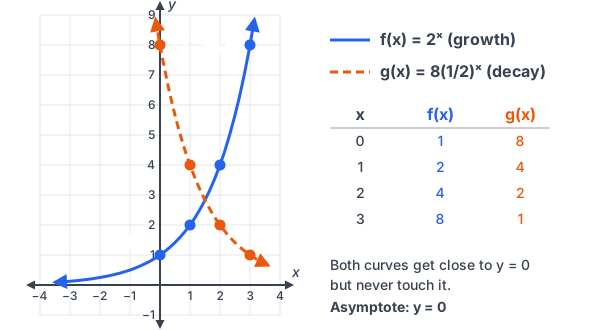
Step 6. Read the y-intercepts: (0, 1) and (0, 8).
Step 7. Each curve gets closer and closer to the x-axis but never touches it. The line y = 0 is called a horizontal asymptote.
y \gt 0
Step 8. Any x-value works, so the domain is all real numbers. The outputs are always positive, so this is the range. (See domain and range.)
Answer: For both functions, the domain is all real numbers and the range is y \gt 0.
Example 5: Word Problem
A new video has 300 views. The number of views triples every day for the first week. Write a function for the views V after d days. Then find the views on day 4. On which day does it first pass 20,000 views?
V(d) = 300 \cdot 3^d
Step 1. The start is 300, so a = 300. Tripling means b = 3.
V(4) = 300 \cdot 3^4
Step 2. Substitute d = 4.
300 \cdot 81
Step 3. Find 3^4 = 81.
300 \cdot 81 = 24{,}300Step 4. Multiply.
V(3) = 300 \cdot 3^3 = 300 \cdot 27 = 8{,}100Step 5. Check the day before.
Step 6. 8,100 is less than 20,000, so day 4 is the first day over.
Answer: V(d) = 300 \cdot 3^d. Day 4 has 24,300 views, and day 4 is the first day over 20,000.
Common Mistakes
| Mistake | Example of the error | Fix |
|---|---|---|
| Multiplying a and b first | 3 \cdot 2^x = 6^x | Do the exponent first: 3 \cdot 2^2 = 3 \cdot 4 = 12, not 6^2 = 36 |
| Mixing up x² and 2ˣ | Calling y = x^2 exponential | Exponential means the variable is in the exponent |
| Checking differences instead of ratios | 2, 6, 18 has differences 4 and 12, so “not a pattern” | Divide: \frac{6}{2} = 3 and \frac{18}{6} = 3. It is exponential with b = 3 |
| Thinking the graph crosses the x-axis | “2^x = 0 when x is very negative” | 2^x gets close to 0 but is always positive |
| Using the first table value as a | Table starts at x = 1, y = 6, so a = 6 | a is the value at x = 0. Work back one step by dividing by b |
Growth vs. Decay at a Glance
| Feature | Growth (b \gt 1) | Decay (0 \lt b \lt 1) |
|---|---|---|
| Example | y = 2^x | y = \left(\tfrac{1}{2}\right)^x |
| Graph from left to right | Rises, faster and faster | Falls, slower and slower |
| Each step | Multiply by more than 1 | Multiply by a number between 0 and 1 |
| y-intercept | (0, a) | (0, a) |
| Horizontal asymptote | y = 0 | y = 0 |
| Domain and range (when a > 0) | All real numbers; y \gt 0 | All real numbers; y \gt 0 |
Real growth and decay are often given as a percent, like “grows 5% per year.” That is the next lesson, Exponential Growth and Decay. Later in this unit, Linear vs. Exponential Functions compares a constant ratio with a constant average rate of change. The domain and range ideas come from domain and range.
Practice Problems
- Is y = 7(1.5)^x an exponential function? If so, give a and b, and say if it is growth or decay.
- Let f(x) = 2 \cdot 5^x. Find f(3).
- Let f(x) = 6\left(\tfrac{1}{2}\right)^x. Find f(-2).
- Write a function for this table: x = 0, 1, 2, 3 and y = 3, 12, 48, 192.
- Is this table exponential? x = 1, 2, 3, 4 and y = 1, 4, 9, 16.
- Give the y-intercept of f(x) = 9\left(\tfrac{2}{3}\right)^x. Is it growth or decay?
- What is the range of f(x) = 5 \cdot 2^x?
- An exponential function passes through (0, 4) and (1, 12). Write its equation.
- Let h(x) = 160\left(\tfrac{1}{2}\right)^x. Find h(4).
- A lab starts with 25 cells. The number of cells doubles every hour. Write a function for the cells after h hours. How many cells are there after 5 hours?
Show answers
1.
The variable is in the exponent, so yes
a = 7, \quad b = 1.5
Read the parts.
Since 1.5 \gt 1, it is growth
Yes. It is exponential growth with a = 7 and b = 1.5.
2.
f(3) = 2 \cdot 5^3
Substitute x = 3.
2 \cdot 125
Do the exponent first.
2 \cdot 125 = 250
Multiply.
3.
f(-2) = 6\left(\tfrac{1}{2}\right)^{-2}Substitute x = −2.
6 \cdot 2^2
A negative exponent flips the fraction.
6 \cdot 4 = 24
Find 2^2 = 4 and multiply.
4.
\frac{12}{3} = 4, \quad \frac{48}{12} = 4, \quad \frac{192}{48} = 4Find the ratios.
f(x) = 3 \cdot 4^x
The ratios match, so b = 4. At x = 0, y = 3, so a = 3.
5.
\frac{4}{1} = 4, \quad \frac{9}{4}, \quad \frac{16}{9}Find the ratios.
The ratios don’t match
No. This table is y = x^2.
6.
f(0) = 9\left(\tfrac{2}{3}\right)^0 = 9 \cdot 1 = 9Substitute x = 0.
Since 0 \lt \tfrac{2}{3} \lt 1, it is decay
The y-intercept is (0, 9), and it is decay.
7.
The starting value 5 is positive, and every power of 2 is positive
So every output is positive, and the curve gets close to 0 but never reaches it
The range is y \gt 0.
8.
a = 4
The point (0, 4) gives the starting value.
b = \frac{12}{4} = 3Divide the outputs to find b.
So f(x) = 4 \cdot 3^x.
9.
h(4) = 160\left(\tfrac{1}{2}\right)^4Substitute x = 4.
\left(\tfrac{1}{2}\right)^4 = \tfrac{1}{16}Find the power.
160 \cdot \tfrac{1}{16} = 10Multiply.
10.
C(h) = 25 \cdot 2^h
The start is 25 and the cells double, so a = 25 and b = 2.
C(5) = 25 \cdot 2^5
Substitute h = 5.
25 \cdot 32 = 800
Find 2^5 = 32 and multiply.
There are 800 cells after 5 hours.
Want more practice? The Algebra 1 Unit 6 Practice Pack has 49 pages of problems on this and the other lessons in the unit, with step-by-step answers and a cheat sheet.
FAQ
What makes a function exponential?
The variable is in the exponent, as in f(x) = a \cdot b^x. In a table, the outputs are multiplied by the same number each time x goes up by 1.
What is the horizontal asymptote of an exponential function?
For f(x) = a \cdot b^x, it is the line y = 0. The graph gets closer and closer to it but never touches it.
Why can’t the base be negative or 1?
With b = 1, every output is the same, so the graph is a flat line. With a negative base, the signs jump back and forth, as in (-2)^1 = -2 and (-2)^2 = 4, so there is no smooth curve.
How do you tell growth from decay?
Look at the base. If b \gt 1, it is growth. If b is between 0 and 1, it is decay.
Summary
- An exponential function has the form f(x) = a \cdot b^x, with the variable in the exponent.
- a is the starting value and the y-intercept. b is the number you multiply by each step.
- Growth when b \gt 1; decay when 0 \lt b \lt 1.
- In a table, the ratios between outputs are all the same.
- The graph never touches its horizontal asymptote, y = 0.
Previous lesson: Zero and Negative Exponents
Next lesson: Exponential Growth and Decay
Back to the Algebra 1 Index