
Linear vs. Exponential Functions
To compare linear vs. exponential functions, look at how the output changes each step. A linear function adds the same amount each time, so its graph is a straight line. An exponential function multiplies by the same number each time, so its graph curves. In the long run, exponential growth always wins.
Before this lesson: You should know slope-intercept form, exponential functions, and average rate of change.
Extra practice: The Algebra 1 Unit 6 Practice Pack has printable problems, answer keys and a cheat sheet for this unit.
What Is the Difference Between Linear and Exponential Functions?
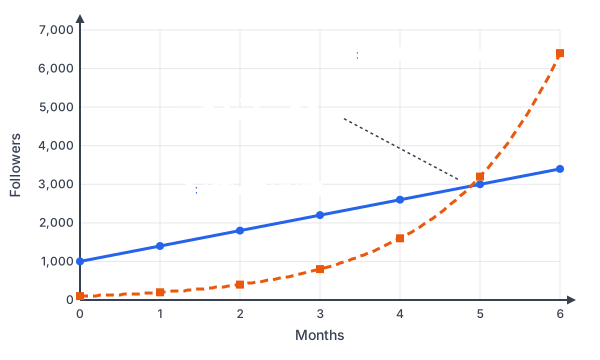
Two new video channels start at the same time. Channel A has 1,000 followers and gains 400 each month. Channel B has only 100 followers, but its count doubles each month.
At first, Channel A is far ahead. But doubling gets bigger every month, while adding 400 stays the same. By month 5, Channel B has 3,200 followers and Channel A has 3,000. After that, B pulls away fast.
Channel A is a linear function. Channel B is an exponential function. The key question is always the same: does the amount add the same number, or multiply by the same number?
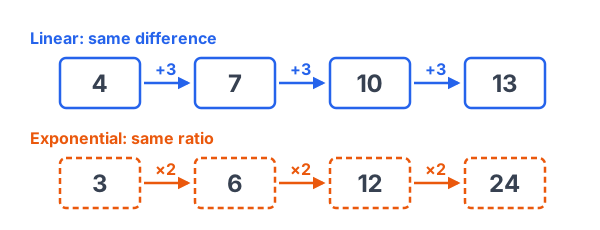
Linear vs. Exponential Functions: The Rules
| Linear function | Exponential function | |
|---|---|---|
| Equation | y = mx + b | y = a \cdot b^x |
| Each step in x | Adds m to y | Multiplies y by b |
| In a table | Same difference | Same ratio |
| Graph | Straight line | Curve |
| Rate of change | Stays the same | Keeps getting bigger (or smaller) |
| Words to look for | “adds 5 each,” “$20 per hour” | “doubles,” “halves,” “grows 5% a year” |
The difference is what you get when you subtract one output from the next. The ratio is what you get when you divide one output by the one before it.
How to Tell Them Apart in a Table
- Check that the x-values go up by the same amount each time.
- Subtract each output from the next one. If every difference is the same, the function is linear.
- If not, divide each output by the one before it. If every ratio is the same, the function is exponential.
- If neither one stays the same, the function is neither linear nor exponential.
- Write the equation. Linear: m is the difference and b is the value at x = 0. Exponential: b is the ratio and a is the value at x = 0.
An exponential function that grows will always pass a linear function that grows, sooner or later. A bigger start only delays it.
Worked Examples
Example 1: Linear, exponential or neither?
Decide whether each table is linear, exponential or neither. Write an equation if you can.
| x | 0 | 1 | 2 | 3 |
|---|---|---|---|---|
| Table A: y | 4 | 7 | 10 | 13 |
| Table B: y | 3 | 6 | 12 | 24 |
| Table C: y | 1 | 2 | 5 | 10 |
7 - 4 = 3, \quad 10 - 7 = 3, \quad 13 - 10 = 3
Step 1. Table A: Subtract each y-value from the next one to find the differences.
y = 3x + 4
Step 2. The differences match, so Table A is linear. The slope is 3 and the start (at x = 0) is 4.
y = 3(2) + 4 = 10
Step 3. Check one point: substitute x = 2.
6 - 3 = 3, \quad 12 - 6 = 6, \quad 24 - 12 = 12
Step 4. Table B: Find the differences.
\frac{6}{3} = 2, \quad \frac{12}{6} = 2, \quad \frac{24}{12} = 2Step 5. The differences don’t match, so Table B is not linear. Divide each y-value by the one before it to find the ratios.
y = 3 \cdot 2^x
Step 6. The ratios match, so Table B is exponential (see exponential functions). The start is 3 and the base is 2.
y = 3 \cdot 2^3 = 24
Step 7. Check one point: substitute x = 3.
2 - 1 = 1, \quad 5 - 2 = 3, \quad 10 - 5 = 5
Step 8. Table C: Find the differences.
\frac{2}{1} = 2, \quad \frac{5}{2} = 2.5, \quad \frac{10}{5} = 2Step 9. The differences don’t match. Find the ratios.
Step 10. The ratios don’t match either, so Table C is neither.
Answer: Table A is linear, y = 3x + 4. Table B is exponential, y = 3 \cdot 2^x. Table C is neither.
Example 2: Linear or exponential from words
Decide whether each situation is linear or exponential. Then write a function. (a) A gym costs $25 to join plus $15 per month. (b) A town of 8,000 people grows 5% per year. (c) A 20 cm candle burns 2 cm per hour. (d) A colony of 50 bacteria cells triples every hour.
Step 1. (a) The cost goes up by the same amount, $15, each month. Adding the same amount means linear.
C = 15m + 25
Step 2. The rate is 15 and the start is 25. Let m be the number of months.
Step 3. (b) The town grows by 5% of its size each year. Growing by a percent means multiplying, so it is exponential.
1 + 0.05 = 1.05
Step 4. Add the rate to 1 to get the factor (see exponential growth and decay).
P = 8000(1.05)^t
Step 5. The start is 8,000. Let t be the number of years.
Step 6. (c) The candle loses the same amount, 2 cm, each hour. Subtracting the same amount means linear.
h = 20 - 2t
Step 7. The start is 20 and the rate is −2. Let t be the number of hours.
Step 8. (d) Tripling means multiplying by 3 each hour, so it is exponential.
N = 50 \cdot 3^t
Step 9. The start is 50 and the base is 3.
Answer: (a) linear, C = 15m + 25; (b) exponential, P = 8000(1.05)^t; (c) linear, h = 20 - 2t; (d) exponential, N = 50 \cdot 3^t
Check: A fixed amount “per month” or “per hour” means add or subtract, so the function is linear. A percent, or words like “doubles” or “triples,” means multiply, so the function is exponential.
Example 3: Write both functions through two points
Write a linear function and an exponential function that both pass through (0, 6) and (2, 54).
m = \frac{54 - 6}{2 - 0} = \frac{48}{2}Step 1. Linear: Find the slope with the slope formula.
\frac{48}{2} = 24Step 2. Divide.
y = 24x + 6
Step 3. The line crosses the y-axis at the point (0, 6), so the start is 6.
y = 24(2) + 6 = 54
Step 4. Check the second point: substitute x = 2.
y = 6 \cdot b^x
Step 5. Exponential: Use y = a \cdot b^x. The point (0, 6) gives the start, a = 6.
6b^2 = 54
Step 6. Substitute the point (2, 54). From x = 0 to x = 2, you multiply by b twice.
b^2 = 9
Step 7. Divide both sides by 6.
b = 3
Step 8. Take the square root of 9. The base of an exponential function must be positive, so use 3, not −3.
y = 6 \cdot 3^x
Step 9. Write the function.
6 \cdot 3^2 = 6 \cdot 9 = 54
Step 10. Check the second point: substitute x = 2.
Answer: Linear: y = 24x + 6. Exponential: y = 6 \cdot 3^x.
Example 4: When does the exponential function pass the line?
Compare f(x) = 50x + 100 and g(x) = 2^x. For which whole numbers is g(x) bigger?
Step 1. Make a table. Substitute each x-value into both functions (see function notation).
| x | 0 | 2 | 4 | 6 | 8 | 9 | 10 |
|---|---|---|---|---|---|---|---|
| f(x) | 100 | 200 | 300 | 400 | 500 | 550 | 600 |
| g(x) | 1 | 4 | 16 | 64 | 256 | 512 | 1024 |
Step 2. The line starts far ahead: at x = 0, f(0) = 100 and g(0) = 1. Look for where g(x) catches up. It is close between 8 and 10.
f(9) = 50(9) + 100 = 550
Step 3. Find f(9).
g(9) = 2^9 = 512
Step 4. Find g(9).
Step 5. Compare: 512 \lt 550, so the line is still ahead at x = 9.
f(10) = 50(10) + 100 = 600
Step 6. Find f(10).
g(10) = 2^{10} = 1024Step 7. Find g(10).
Step 8. Compare: 1024 \gt 600, so g(x) is ahead at x = 10.
Step 9. After that, g(x) doubles each step, but f(x) only adds 50. So g(x) stays ahead.
Answer: g(x) is bigger for every whole number x \ge 10.
Example 5: Word problem with two channels
Channel A has 1,000 followers and gains 400 per month. Channel B has 100 followers and doubles each month. Write a function for each. After how many whole months does B have more followers?
A(m) = 400m + 1000
Step 1. Channel A adds 400 each month, so it is linear. The start is 1,000.
B(m) = 100 \cdot 2^m
Step 2. Channel B doubles each month, so it is exponential. The start is 100 and the base is 2.
Step 3. Make a table of both functions for months 3 to 6.
| Month m | 3 | 4 | 5 | 6 |
|---|---|---|---|---|
| A(m) | 2,200 | 2,600 | 3,000 | 3,400 |
| B(m) | 800 | 1,600 | 3,200 | 6,400 |
A(4) = 400(4) + 1000 = 2600, \quad B(4) = 100 \cdot 2^4 = 1600
Step 4. Find both values at month 4.
Step 5. Compare: 1600 \lt 2600, so A is still ahead at month 4.
A(5) = 400(5) + 1000 = 3000, \quad B(5) = 100 \cdot 2^5 = 3200
Step 6. Find both values at month 5.
Step 7. Compare: 3200 \gt 3000, so B is ahead at month 5. B keeps doubling, so it stays ahead.
Answer: Channel B has more followers after 5 months.
Common Mistakes
| Mistake | Example of the error | Fix |
|---|---|---|
| Checking differences when the x-values skip | x: 0, 1, 3, 4 with y: 2, 4, 8, 10, so “not linear” | First check that x goes up by the same step. Here the slope is 2 every time, so it is linear. |
| Calling every curve exponential | 1, 4, 9, 16 is “exponential” | Check the ratios: 4, 2.25, 1.78. They change, so it is not exponential. |
| Mixing up “5” and “5%” | “Grows 5% a year” written as y = 100 + 5t | A percent means multiply: y = 100(1.05)^t. |
| Thinking a bigger start always wins | “The line starts higher, so it stays higher.” | A growing exponential function always passes a growing line. Make a table to see when. |
| Using the ratio as the slope | 3, 6, 12, 24 written as y = 2x + 3 | A same ratio means exponential: y = 3 \cdot 2^x. |
Comparing Decay: Lines vs. Curves
Decreasing functions follow the same rules. A linear function that goes down subtracts the same amount each step. It will reach zero and then go negative.
An exponential function that decays multiplies by a number between 0 and 1, like \frac{1}{2}. It gets closer and closer to zero but never reaches it. You learned this in exponential growth and decay.
| Time | 0 | 1 | 2 | 3 | 4 |
|---|---|---|---|---|---|
| Linear: subtract 20 | 80 | 60 | 40 | 20 | 0 |
| Exponential: half each step | 80 | 40 | 20 | 10 | 5 |
Sequences work the same way. An arithmetic sequence is linear, and a geometric sequence is exponential.
Practice Problems
- Is this table linear, exponential or neither? x: 0, 1, 2, 3 and y: 2, 8, 32, 128. Write an equation if you can.
- Is this table linear, exponential or neither? x: 0, 1, 2, 3 and y: 10, 7, 4, 1.
- Is this table linear, exponential or neither? x: 1, 2, 3, 4 and y: 1, 4, 9, 16.
- Is this table linear, exponential or neither? x: 0, 1, 2, 3 and y: 81, 27, 9, 3.
- A phone loses 15% of its value each year. Is its value linear or exponential?
- A pool fills at 40 gallons per minute. Is the amount of water linear or exponential?
- Write a linear function and an exponential function through (0, 4) and (1, 12).
- Write a linear function and an exponential function through (0, 2) and (3, 16).
- Compare f(x) = 20x and g(x) = 3^x. What is the first whole number x \gt 0 where g(x) \gt f(x)?
- Maya has $60 and saves $30 more each week. Leo has $5, and his money doubles each week. After how many whole weeks does Leo have more?
Show answers
1.
8 - 2 = 6, \quad 32 - 8 = 24
Find the differences.
\frac{8}{2} = 4, \quad \frac{32}{8} = 4, \quad \frac{128}{32} = 4They don’t match. Find the ratios.
y = 2 \cdot 4^x
The ratios match, so it is exponential. The start is 2 and the base is 4.
Exponential.
2.
7 - 10 = -3, \quad 4 - 7 = -3, \quad 1 - 4 = -3
Find the differences.
y = -3x + 10
They match, so it is linear. The slope is −3 and the start is 10.
Linear.
3.
4 - 1 = 3, \quad 9 - 4 = 5, \quad 16 - 9 = 7
Find the differences.
\frac{4}{1} = 4, \quad \frac{9}{4} = 2.25They don’t match. Find the ratios.
The ratios don’t match either (\frac{16}{9} is about 1.78)
Neither.
4.
\frac{27}{81} = \tfrac{1}{3}, \quad \frac{9}{27} = \tfrac{1}{3}, \quad \frac{3}{9} = \tfrac{1}{3}Find the ratios.
y = 81\left(\tfrac{1}{3}\right)^xThe ratios match, so it is exponential decay. The start is 81.
Exponential decay.
5.
1 - 0.15 = 0.85
Losing a percent each year means multiplying. Find the factor.
Exponential. The value is multiplied by 0.85 each year.
6.
The pool gains the same amount, 40 gallons, each minute. Adding the same amount means linear
Linear.
7.
m = \frac{12 - 4}{1 - 0} = 8Linear: find the slope.
y = 8x + 4
The start is 4.
b = \frac{12}{4} = 3Exponential: the start is 4. Divide to find the base.
y = 4 \cdot 3^x
Write the function.
8.
m = \frac{16 - 2}{3 - 0} = \frac{14}{3}Linear: find the slope.
y = \tfrac{14}{3}x + 2The start is 2.
2b^3 = 16
Exponential: the start is 2. Substitute the point (3, 16)
b^3 = 8
Divide both sides by 2.
b = 2
Take the cube root (see cube roots)
y = 2 \cdot 2^x
Write the function.
9.
f(3) = 20(3) = 60, \quad g(3) = 3^3 = 27
At x = 3, find both values.
27 \lt 60
Compare.
f(4) = 20(4) = 80, \quad g(4) = 3^4 = 81
At x = 4, find both values.
81 \gt 80
Compare.
x = 4
The exponential value is larger here for the first time, so this is the answer.
10.
M = 30w + 60
Maya adds $30 each week, so her function is linear.
L = 5 \cdot 2^w
Leo doubles each week, so his function is exponential.
M = 30(5) + 60 = 210, \quad L = 5 \cdot 2^5 = 160
Find both savings amounts at week 5.
Compare: 160 \lt 210, so Maya is ahead
M = 30(6) + 60 = 240, \quad L = 5 \cdot 2^6 = 320
Find both savings amounts at week 6.
Compare: 320 \gt 240, so Leo is ahead
Leo has more after 6 weeks.
Want more practice? The Algebra 1 Unit 6 Practice Pack has 49 pages of problems on this and the other lessons in the unit, with step-by-step answers and a cheat sheet.
FAQ
How do you tell if a table is linear or exponential?
Find the differences between outputs. If they are all the same, it is linear. If not, find the ratios. If the ratios are all the same, it is exponential.
Which grows faster, linear or exponential?
Exponential growth is faster in the long run. A line adds the same amount forever, but an exponential function multiplies, so its jumps keep getting bigger.
Is y = x² an exponential function?
No. In y = x^2 the variable is in the base, not the exponent. It is a quadratic function. In an exponential function like y = 2^x, the variable is the exponent.
What is the difference between linear and exponential decay?
Linear decay subtracts the same amount each step and reaches zero. Exponential decay multiplies by the same fraction each step and never quite reaches zero.
Summary
- Linear functions add the same amount each step. Exponential functions multiply by the same number each step.
- In a table, a same difference means linear and a same ratio means exponential.
- Linear graphs are straight lines. Exponential graphs curve.
- Words like “per hour” mean linear. Words like “doubles” or “5% a year” mean exponential.
- A growing exponential function always passes a growing linear function in the end.
Previous lesson: Geometric Sequences
Next lesson: Polynomials
Back to the Algebra 1 Index