
Average Rate of Change
The average rate of change of a function tells how much the output changes, on average, for each 1 unit of input over an interval. To find it, divide the change in y by the change in x. It is the slope of the line through the two end points of the interval.
Before this lesson: You should know function notation, how to find slope, and the key features of functions.
What Is Average Rate of Change?
Say you drive 90 miles in 2 hours. You did not drive at exactly the same speed the whole time. You sped up and slowed down. But on average, you went 45 miles each hour.
That average is a rate of change. It tells how fast one amount changes compared with another. Here, miles change compared with hours.
For a function, the input is x and the output is y or f(x). The average rate of change compares the change in output to the change in input between two points. The two inputs mark the ends of an interval, such as 1 \le x \le 4.
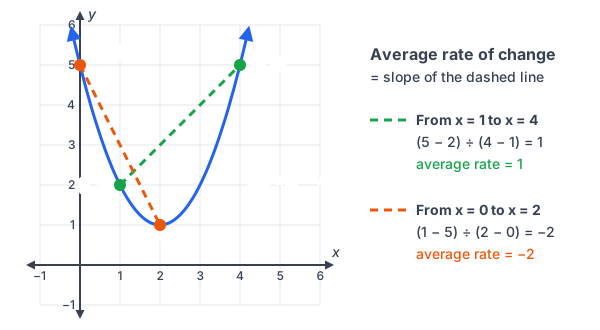
On a graph, draw a straight line through the two end points. That line is called a secant line. Its slope is the average rate of change.
Average Rate of Change Formula
For a function f on the interval from x = a to x = b:
\text{average rate of change} = \dfrac{f(b) - f(a)}{b - a}The top is the change in output, \Delta y. The bottom is the change in input, \Delta x. The symbol \Delta (delta) means “change in.” This is the same as the slope formula, \tfrac{y_2 - y_1}{x_2 - x_1}.
How to Find the Average Rate of Change
- Find the two inputs, a and b.
- Find the outputs f(a) and f(b). Use the equation, a table or a graph.
- Subtract the outputs: f(b) - f(a).
- Subtract the inputs in the same order: b - a.
- Divide. Simplify the fraction and add units if there are any.
A positive answer means the output goes up on average. A negative answer means it goes down. Zero means it ends where it started.
Worked Examples
Example 1: From a Table
A car trip is shown in the table. Find the average rate of change from 0 to 2 hours, and from 2 to 5 hours.
| Time, t (hours) | 0 | 1 | 2 | 5 |
|---|---|---|---|---|
| Distance, d (miles) | 0 | 40 | 90 | 240 |
From 0 to 2 hours: \dfrac{90 - 0}{2 - 0} = \dfrac{90}{2} = 45
From 2 to 5 hours: \dfrac{240 - 90}{5 - 2} = \dfrac{150}{3} = 50
Answer: The car went 45 miles per hour on average for the first 2 hours. It went 50 miles per hour on average from hour 2 to hour 5.
Example 2: From an Equation
Find the average rate of change of f(x) = x^2 + 1 from x = 1 to x = 4.
Step 1: Find the outputs. f(4) = 4^2 + 1 = 17 and f(1) = 1^2 + 1 = 2.
Step 2: Put them in the formula.
\dfrac{f(4) - f(1)}{4 - 1} = \dfrac{17 - 2}{3} = \dfrac{15}{3} = 5Answer: The average rate of change is 5. On average, the output goes up 5 for each 1 the input goes up.
Example 3: A Negative Rate of Change
Find the average rate of change of g(x) = -x^2 + 3x from x = -2 to x = 1.
Step 1: Find the outputs. g(1) = -(1)^2 + 3(1) = -1 + 3 = 2. For x = -2, square first, then make it negative: g(-2) = -(-2)^2 + 3(-2) = -4 - 6 = -10.
Step 2: Use the formula. Subtract in the same order on top and bottom.
\dfrac{g(1) - g(-2)}{1 - (-2)} = \dfrac{2 - (-10)}{3} = \dfrac{12}{3} = 4Answer: The average rate of change is 4. Even with negative numbers, this function goes up on average over this interval.
Example 4: From a Graph
Use the graph of f(x) = x^2 - 4x + 5 above. Find the average rate of change on 1 \le x \le 4 and on 0 \le x \le 2.
Interval 1: Read the points (1, 2) and (4, 5) from the graph. \dfrac{5 - 2}{4 - 1} = \dfrac{3}{3} = 1
Interval 2: Read the points (0, 5) and (2, 1). \dfrac{1 - 5}{2 - 0} = \dfrac{-4}{2} = -2
Answer: The rate is 1 on the first interval and −2 on the second. The graph rises on average from 1 to 4, but falls on average from 0 to 2. For a curve, the rate depends on the interval you pick.
Example 5: Word Problem
At 1:00 pm, a phone battery is at 92%. At 5:00 pm, it is at 40%. Find the average rate of change of the battery level. Explain what it means.
Step 1: The inputs are times: 1 and 5 (hours after noon). The outputs are 92 and 40.
\dfrac{40 - 92}{5 - 1} = \dfrac{-52}{4} = -13Step 2: Add units. The output is in percent and the input is in hours.
Answer: The average rate of change is −13 percent per hour. The battery lost 13 percentage points each hour, on average.
Common Mistakes
| Mistake | Example of the error | Fix |
|---|---|---|
| Subtracting in a different order on top and bottom | \tfrac{17 - 2}{1 - 4} = -5 | Use the same order: \tfrac{17 - 2}{4 - 1} = 5 |
| Putting x on top | \tfrac{4 - 1}{17 - 2} = \tfrac{1}{5} | Output change goes on top: \tfrac{\Delta y}{\Delta x} |
| Using the inputs instead of the outputs | \tfrac{4 - 1}{4 - 1} = 1 | Find f(4) and f(1) first |
| Squaring a negative wrong | (-2)^2 = -4 | (-2)^2 = 4, but -(2)^2 = -4 |
| Dropping the minus sign in a word problem | “The battery changes by 13 percent per hour” | Keep the sign: −13 means it goes down |
Average Rate of Change and Slope
For a straight line, the average rate of change is the same on every interval. It is just the slope. For a curve, it changes from one interval to the next.
| Interval | f(x) = 2x + 1 (line) | f(x) = x^2 (curve) |
|---|---|---|
| 0 \le x \le 1 | 2 | 1 |
| 1 \le x \le 2 | 2 | 3 |
| 2 \le x \le 3 | 2 | 5 |
So if a table has the same rate on every interval, its points lie on a line. You can then write its equation in slope-intercept form. A line through the origin is direct variation.
Average rate of change also helps you describe a graph. A positive rate matches a part where the graph is mostly increasing. A negative rate matches a part where it is mostly decreasing.
Practice Problems
- Find the average rate of change of f(x) = 3x - 4 from x = 1 to x = 5.
- Find the average rate of change of f(x) = x^2 from x = 2 to x = 5.
- Find the average rate of change of f(x) = x^2 on -3 \le x \le 1.
- Find the average rate of change of g(x) = -x^2 + 10 from x = 0 to x = 3.
- A table shows x: 2, 4, 7 and y: 5, 11, 26. Find the average rate of change from x = 2 to x = 7.
- Find the average rate of change of h(x) = 2x^2 - x from x = -1 to x = 2.
- Use the graph of f(x) = x^2 - 4x + 5 from Example 4. Find the average rate of change from x = 2 to x = 5.
- Find the average rate of change of f(x) = \tfrac{1}{2}x + 6 on -4 \le x \le 10. What do you notice?
- A tank has 300 gallons of water at minute 5 and 120 gallons at minute 20. Find the average rate of change and explain it.
- A concert had sold 1,200 tickets by day 1 and 3,000 tickets by day 7. Find the average rate of change in tickets sold.
Show answers
- f(5) = 11 and f(1) = -1. \tfrac{11 - (-1)}{5 - 1} = \tfrac{12}{4} = 3
- \tfrac{25 - 4}{5 - 2} = \tfrac{21}{3} = 7
- f(1) = 1 and f(-3) = 9. \tfrac{1 - 9}{1 - (-3)} = \tfrac{-8}{4} = -2
- g(3) = 1 and g(0) = 10. \tfrac{1 - 10}{3 - 0} = \tfrac{-9}{3} = -3
- \tfrac{26 - 5}{7 - 2} = \tfrac{21}{5}, or 4.2
- h(2) = 8 - 2 = 6 and h(-1) = 2 + 1 = 3. \tfrac{6 - 3}{2 - (-1)} = \tfrac{3}{3} = 1
- f(2) = 1 and f(5) = 10. \tfrac{10 - 1}{5 - 2} = \tfrac{9}{3} = 3
- f(10) = 11 and f(-4) = 4. \tfrac{11 - 4}{10 - (-4)} = \tfrac{7}{14} = \tfrac{1}{2}. It equals the slope, because the function is a line.
- \tfrac{120 - 300}{20 - 5} = \tfrac{-180}{15} = -12. The tank loses 12 gallons per minute, on average.
- \tfrac{3000 - 1200}{7 - 1} = \tfrac{1800}{6} = 300. About 300 tickets were sold per day, on average.
FAQ
What is the formula for average rate of change?
Divide the change in output by the change in input: \tfrac{f(b) - f(a)}{b - a}. Here a and b are the two inputs at the ends of the interval.
Is average rate of change the same as slope?
Yes. It is the slope of the line through the two end points. For a straight line, it equals the line’s slope on every interval.
Can the average rate of change be negative or zero?
Yes. A negative rate means the output went down on average. A rate of 0 means the output ended at the same value it started.
What is the difference between rate of change and average rate of change?
A line has one constant rate of change, its slope. A curve’s rate keeps changing, so we find the average over an interval. Finding the rate at a single point is a calculus idea.
Summary
- Average rate of change = \tfrac{f(b) - f(a)}{b - a}, the change in output over the change in input.
- It is the slope of the secant line through the two end points.
- Subtract in the same order on the top and bottom.
- Positive means the output goes up on average. Negative means it goes down.
- For a line it is always the slope. For a curve it depends on the interval.
Previous lesson: Direct Variation
Next lesson: Arithmetic Sequences
Back to the Algebra 1 Index