
Direct Variation
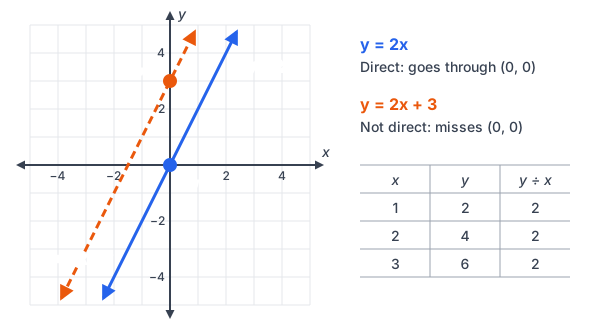
Direct variation is a relationship where y = kx for some number k that is not 0. The number k is the constant of variation. When x doubles, y doubles too. The graph is a straight line through the origin. For example, in y = 3x, the constant is 3.
Before this lesson: You should know proportions, how to find slope, and how to read slope-intercept form.
Extra practice: The Algebra 1 Unit 4 Practice Pack (Part 2) has printable problems, answer keys and a cheat sheet for this unit.
What Is Direct Variation?
Say you earn $15 an hour. Work 0 hours and you earn $0. Work 2 hours and you earn $30. Work 4 hours and you earn $60. Your pay is always 15 times your hours.
That is direct variation. One amount is always the same multiple of the other. We say “y varies directly with x.” Another name is “y is proportional to x.”
Because y = kx, dividing gives \tfrac{y}{x} = k. So in direct variation, the ratio \tfrac{y}{x} is the same for every pair of values.
The Direct Variation Equation
y = kx \qquad k = \frac{y}{x}- k is the constant of variation. It is also the slope of the line, and the unit rate.
- There is no added number. In y = mx + b form, b = 0.
- The graph always passes through (0, 0).
How to tell if a relationship is direct variation
| You are given | It is direct variation if | Example |
|---|---|---|
| An equation | it can be written as y = kx | 3y = 12x becomes y = 4x |
| A table | \tfrac{y}{x} is the same for every pair | \tfrac{14}{4} = \tfrac{21}{6} = \tfrac{7}{2} |
| A graph | it is a straight line through the origin | y = 2x in the graph above |
Steps to solve a direct variation problem
- Find k by dividing: k = \tfrac{y}{x}.
- Write the equation y = kx with your value of k.
- Put in the new x or y and solve.
Worked Examples
Example 1: Which equations are direct variation?
Which of these are direct variation: y = 5x, y = 5x - 2 and 3y = 12x?
Step 1. Look at y = 5x. It is already in the form y = kx, with k = 5. Yes.
Step 2. Look at y = 5x - 2. The -2 means the line misses the origin. No.
y = 4x
Step 3. Look at 3y = 12x. Divide both sides by 3.
Step 4. Now it has the form y = kx, with k = 4. Yes.
Answer: y = 5x and 3y = 12x are direct variation. y = 5x - 2 is not.
Example 2: Is the table direct variation?
Is this table direct variation? If so, write the equation.
| x | 2 | 4 | 6 | 10 |
|---|---|---|---|---|
| y | 7 | 14 | 21 | 35 |
\tfrac{7}{2}Step 1. Find \tfrac{y}{x} for the first pair.
\tfrac{14}{4} = \tfrac{7}{2}Step 2. Find it for the second pair, and simplify (see fractions).
\tfrac{21}{6} = \tfrac{7}{2}Step 3. Find it for the third pair.
\tfrac{35}{10} = \tfrac{7}{2}Step 4. Find it for the fourth pair.
Step 5. All the ratios match, so k = \tfrac{7}{2}.
Answer: Yes. The equation is y = \tfrac{7}{2}x.
Check: Compare a table with x = 1, 2, 3 and y = 4, 7, 10. The ratios are 4, \tfrac{7}{2} and \tfrac{10}{3}. They don’t match, so that table is not direct variation.
Example 3: Find k, then find y
y varies directly with x, and y = 18 when x = 4. Find y when x = 10.
k = \frac{18}{4} = \frac{9}{2}Step 1. Find k by dividing y by x. Simplify the fraction.
y = \tfrac{9}{2}xStep 2. Write the equation y = kx.
y = \tfrac{9}{2}(10)Step 3. Substitute x = 10.
y = \tfrac{90}{2} = 45Step 4. Multiply (see multiplying and dividing fractions).
Answer: y = 45.
Check: \tfrac{45}{10} = \tfrac{9}{2}. It matches.
Example 4: A negative constant
y varies directly with x, and y = -12 when x = 8. Find x when y = 9.
k = \frac{-12}{8} = -\frac{3}{2}Step 1. Find k. Divide, then simplify.
9 = -\tfrac{3}{2}xStep 2. Write the equation and substitute y = 9.
9 \cdot \left(-\tfrac{2}{3}\right) = xStep 3. Multiply both sides by the reciprocal of -\tfrac{3}{2}, which is -\tfrac{2}{3}.
x = -6
Step 4. Multiply. A positive times a negative is negative.
Answer: x = -6. With a negative k, one value is positive when the other is negative.
Example 5: Word problem with hourly pay
Ava’s pay varies directly with the hours she works. She earns $78 for 6 hours. Write an equation for her pay P after h hours. How much does she earn for 15 hours?
k = \frac{78}{6} = 13Step 1. Find k by dividing the pay by the hours.
P = 13h
Step 2. Write the equation P = kh.
P = 13(15)
Step 3. Substitute h = 15.
P = 195
Step 4. Multiply.
Answer: P = 13h. She earns $195 for 15 hours. The constant, 13, is her pay rate: $13 per hour (see unit rates).
Common Mistakes
| Mistake | Example of the error | Fix |
|---|---|---|
| Calling any line direct variation | Saying y = 5x - 2 is direct variation | There must be no added number. The line must pass through (0, 0). |
| Dividing in the wrong order | y = 18 when x = 4: writing k = \tfrac{4}{18} | Divide y by x: k = \tfrac{18}{4} = \tfrac{9}{2}. |
| Checking only one pair in a table | Seeing \tfrac{4}{1} = 4 and stopping | Check every pair. All the ratios must match. |
| Adding k instead of multiplying | Writing y = x + 13 for $13 per hour | Direct variation multiplies: y = 13x. |
Direct Variation and Proportions
Since \tfrac{y}{x} is always the same, you can also solve with a proportion. In Example 3, set the two ratios equal.
\frac{18}{4} = \frac{y}{10} \quad\Rightarrow\quad 4y = 180 \quad\Rightarrow\quad y = 45This is the same answer as before. Use whichever way you like. The y = kx way is faster when you need many values.
The constant k is also the slope of the line. A larger k makes a steeper line. A negative k makes a line that falls from left to right.
Practice Problems
- Is y = -4x direct variation? If so, give k.
- Is y = 4x + 1 direct variation?
- Is 2y = 9x direct variation? If so, give k.
- Is this table direct variation? x: 3, 6, 9 and y: 2, 4, 6. If so, write the equation.
- Is this table direct variation? x: 1, 2, 4 and y: 3, 5, 9.
- y varies directly with x, and y = 20 when x = 5. Find y when x = 12.
- y varies directly with x, and y = 6 when x = 9. Find y when x = 15.
- y varies directly with x, and y = -10 when x = 4. Find x when y = 25.
- A line passes through (0, 0) and (3, -6). Is it direct variation? If so, write the equation.
- Weight on the Moon varies directly with weight on Earth. A 150-pound person weighs 25 pounds on the Moon. How much does an 84-pound dog weigh on the Moon?
Show answers
1.
Compare with y = kx. There is nothing added at the end
k = -4
Read k.
Yes, it is direct variation.
2.
The +1 means the line does not pass through the origin
No, it is not direct variation.
3.
y = \tfrac{9}{2}xDivide both sides by 2.
k = \tfrac{9}{2}Read k.
Yes, it is direct variation.
4.
\tfrac{2}{3}, \quad \tfrac{4}{6} = \tfrac{2}{3}, \quad \tfrac{6}{9} = \tfrac{2}{3}Find \frac{y}{x} for each pair.
k = \tfrac{2}{3}All the ratios match.
Yes. The equation is y = \tfrac{2}{3}x.
5.
\tfrac{3}{1} = 3, \quad \tfrac{5}{2}, \quad \tfrac{9}{4}Find \frac{y}{x} for each pair.
The ratios don’t match
No, it is not direct variation.
6.
k = \tfrac{20}{5} = 4Find k.
y = 4x
Write the equation.
y = 4(12) = 48
Substitute x = 12.
7.
k = \tfrac{6}{9} = \tfrac{2}{3}Find k and simplify.
y = \tfrac{2}{3}xWrite the equation.
y = \tfrac{2}{3}(15) = \tfrac{30}{3} = 10Substitute x = 15.
8.
k = \tfrac{-10}{4} = -\tfrac{5}{2}Find k and simplify.
25 = -\tfrac{5}{2}xSubstitute y = 25.
x = 25 \cdot \left(-\tfrac{2}{5}\right)Multiply both sides by the reciprocal, −2/5.
x = -10
Multiply.
9.
The line goes through the origin, so it is direct variation
k = \tfrac{-6}{3} = -2Find k from the point (3, −6)
Yes. The equation is y = -2x.
10.
k = \tfrac{25}{150} = \tfrac{1}{6}Find k: divide Moon weight by Earth weight, then simplify.
M = \tfrac{1}{6}EWrite the equation.
M = \tfrac{1}{6}(84) = \tfrac{84}{6} = 14Substitute E = 84.
The dog weighs 14 pounds on the Moon.
Want more practice? The Algebra 1 Unit 4 Practice Pack (Part 2) has 38 pages of problems on this and the other lessons in the unit, with step-by-step answers and a cheat sheet.
Direct Variation FAQ
What is direct variation in math?
It is a relationship written as y = kx, where k is a nonzero constant. The ratio \tfrac{y}{x} stays the same, and the graph is a line through the origin.
How do you find the constant of variation?
Divide y by x for any known pair: k = \tfrac{y}{x}. If y = 18 when x = 4, then k = \tfrac{9}{2}.
Is every linear equation direct variation?
No. Only lines that pass through the origin are. y = 2x is direct variation, but y = 2x + 3 is not.
What is the difference between direct and inverse variation?
In direct variation, y = kx, so y grows when x grows. In inverse variation, y = \tfrac{k}{x}, so y shrinks when x grows. Inverse variation is taught in Algebra 2.
Summary
- Direct variation means y = kx, where k is a nonzero constant.
- The constant of variation is k = \tfrac{y}{x}. It is also the slope.
- The graph is a straight line through the origin.
- In a table, every pair must have the same ratio \tfrac{y}{x}.
- To solve a problem, find k, write y = kx, then put in the new value.
Previous lesson: Parallel and Perpendicular Lines
Next lesson: Average Rate of Change
Back to the Algebra 1 Index