
Parallel and Perpendicular Lines
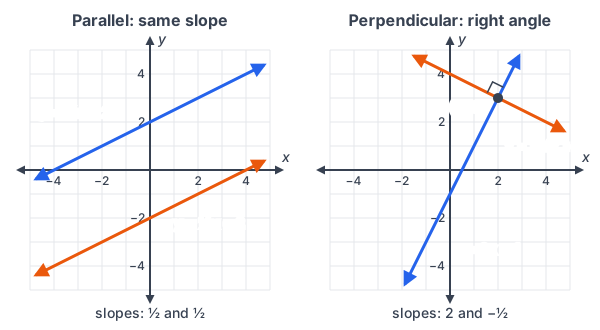
Parallel and perpendicular lines can be spotted by their slopes. Parallel lines have the same slope, so they never meet. Perpendicular lines cross at a right angle, and their slopes are opposite reciprocals. For example, a line with slope \tfrac{2}{3} is perpendicular to a line with slope -\tfrac{3}{2}.
Before this lesson: You should know how to find slope, use slope-intercept form, and write a line in point-slope form.
Extra practice: The Algebra 1 Unit 4 Practice Pack (Part 2) has printable problems, answer keys and a cheat sheet for this unit.
What Are Parallel and Perpendicular Lines?
Think of train tracks. The two rails run side by side and never touch. They are parallel. They have the same steepness, so they have the same slope.
Now think of the corner of a sheet of paper. The two edges meet at a perfect square corner, or a 90° right angle. Lines that meet like that are perpendicular.
For perpendicular lines, one line rises where the other falls. Their slopes are opposite reciprocals. To get one from the other, flip the fraction and change the sign.
Slopes of Parallel and Perpendicular Lines
| Lines | Slope rule | Example |
|---|---|---|
| Parallel | Same slope: m_1 = m_2, but different y-intercepts | y = 3x + 1 and y = 3x - 4 |
| Perpendicular | Opposite reciprocals: m_2 = -\tfrac{1}{m_1}, so m_1 \cdot m_2 = -1 | y = 2x - 1 and y = -\tfrac{1}{2}x + 4 |
| Neither | Slopes are different and don’t multiply to −1 | y = 4x and y = -4x |
Here is how to find an opposite reciprocal. Start with \tfrac{2}{3}. Flip it to get \tfrac{3}{2}. Change the sign to get -\tfrac{3}{2}. Check: \tfrac{2}{3} \cdot \left(-\tfrac{3}{2}\right) = -1.
A whole number works the same way. Write 4 as \tfrac{4}{1}. Its opposite reciprocal is -\tfrac{1}{4}.
Steps to write a parallel or perpendicular line
- Find the slope of the given line. If it isn’t in y = mx + b form, solve for y first.
- For a parallel line, use the same slope. For a perpendicular line, use the opposite reciprocal.
- Put the new slope and the given point into y - y_1 = m(x - x_1).
- Solve for y and check that the point works.
Worked Examples
Example 1: Parallel, perpendicular or neither?
Decide whether each pair of lines is parallel, perpendicular or neither: y = 3x + 1 and y = 3x - 4; y = \tfrac{2}{5}x and y = -\tfrac{5}{2}x + 1; y = 4x and y = -4x.
Step 1. First pair. Both slopes are 3, and the y-intercepts, 1 and -4, are different. The lines are parallel.
\tfrac{2}{5} \cdot \left(-\tfrac{5}{2}\right) = -\tfrac{10}{10} = -1Step 2. Second pair. Multiply the slopes (see multiplying and dividing fractions).
Step 3. The product is −1, so the lines are perpendicular.
4 \cdot (-4) = -16
Step 4. Third pair. The slopes are 4 and −4, so they are not equal. Multiply them.
Step 5. The product is not −1. The signs are opposite, but 4 was not flipped. The lines are neither.
Answer: Parallel; perpendicular; neither.
Example 2: Lines in standard form
Are 2x + 3y = 6 and 4x + 6y = -12 parallel, perpendicular or neither?
3y = -2x + 6
Step 1. Solve the first equation for y. Subtract 2x from both sides (see literal equations).
y = -\tfrac{2}{3}x + 2Step 2. Divide every term by 3.
6y = -4x - 12
Step 3. Solve the second equation for y. Subtract 4x from both sides.
y = -\tfrac{2}{3}x - 2Step 4. Divide every term by 6, and simplify the fraction.
Step 5. Compare. Both slopes are -\tfrac{2}{3}, and the y-intercepts are 2 and -2.
Answer: The lines are parallel.
Example 3: Write a parallel line
Write the equation of the line parallel to y = -2x + 5 that passes through (3, 1).
Step 1. A parallel line has the same slope, so m = -2.
y - 1 = -2(x - 3)
Step 2. Put the slope and the point into point-slope form.
y - 1 = -2x + 6
Step 3. Distribute the −2 (see distributive property).
y = -2x + 7
Step 4. Add 1 to both sides.
Answer: y = -2x + 7.
Check: -2(3) + 7 = -6 + 7 = 1. It works.
Example 4: Write a perpendicular line
Write the equation of the line perpendicular to y = \tfrac{2}{3}x - 1 that passes through (4, -1).
m = -\tfrac{3}{2}Step 1. The given slope is \tfrac{2}{3}. Flip it and change the sign to get the opposite reciprocal.
y - (-1) = -\tfrac{3}{2}(x - 4)Step 2. Put the slope and the point into point-slope form.
y + 1 = -\tfrac{3}{2}(x - 4)Step 3. Subtracting −1 is adding 1.
y + 1 = -\tfrac{3}{2}x + 6Step 4. Distribute. Notice that -\tfrac{3}{2} \cdot (-4) = 6.
y = -\tfrac{3}{2}x + 5Step 5. Subtract 1 from both sides.
Answer: y = -\tfrac{3}{2}x + 5.
Check: -\tfrac{3}{2}(4) + 5 = -6 + 5 = -1. It works.
Example 5: Word problem with a street map
On a city map, Main Street passes through (0, 2) and (4, 4). The city plans a new road that crosses Main Street at (4, 4) at a right angle. Write the equation of the new road.
m = \tfrac{4 - 2}{4 - 0} = \tfrac{2}{4} = \tfrac{1}{2}Step 1. Find the slope of Main Street with the slope formula.
m = -2
Step 2. The new road is perpendicular, so flip 1/2 and change the sign.
y - 4 = -2(x - 4)
Step 3. Put the slope and the point (4, 4) into point-slope form.
y - 4 = -2x + 8
Step 4. Distribute the −2.
y = -2x + 12
Step 5. Add 4 to both sides.
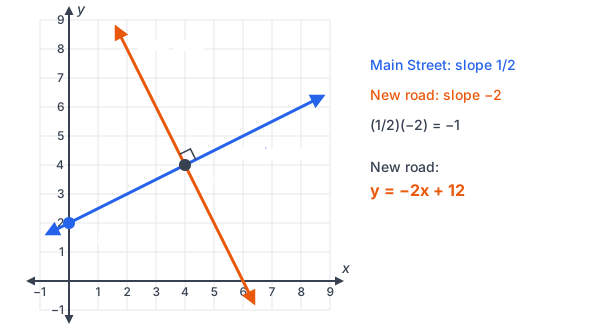
Answer: The new road is y = -2x + 12.
Common Mistakes
| Mistake | Example of the error | Fix |
|---|---|---|
| Flipping but not changing the sign | Perpendicular to slope \tfrac{2}{3}: using \tfrac{3}{2} | Flip and change the sign: -\tfrac{3}{2}. |
| Changing the sign but not flipping | Perpendicular to slope 4: using -4 | Flip too: -\tfrac{1}{4}. |
| Reading slope before solving for y | Saying 2x + 3y = 6 has slope 2 | Solve for y first: the slope is -\tfrac{2}{3}. |
| Calling the same line parallel | y = 2x + 1 and 2y = 4x + 2 | They are the same line. Parallel lines need different y-intercepts. |
Special Cases and Other Uses
- Horizontal and vertical lines are always perpendicular. For example, y = 3 and x = -1 meet at a right angle. You can’t multiply their slopes, because a vertical line has no slope. See horizontal and vertical lines.
- Two horizontal lines, like y = 1 and y = 5, are parallel. So are two vertical lines.
- Standard form shortcut: lines in standard form with the same A and B, like 3x - y = 4 and 3x - y = 7, are parallel.
- Systems: two parallel lines never cross, so their system has no solution. See number of solutions for systems of equations.
- Right angles in shapes: if two sides of a triangle have slopes that multiply to −1, the triangle has a right angle.
Practice Problems
For 1–3, decide if the lines are parallel, perpendicular or neither.
- y = 5x - 2 and y = 5x + 3
- y = -\tfrac{3}{4}x + 1 and y = \tfrac{4}{3}x - 2
- y = 2x + 1 and y = \tfrac{1}{2}x + 1
- Find the slope of a line parallel to y = -6x + 1 and the slope of a line perpendicular to it.
- Are 3x - y = 4 and 6x - 2y = 10 parallel, perpendicular or neither?
- Write the line parallel to y = 4x - 3 through (1, 6).
- Write the line perpendicular to y = -3x + 2 through (6, 1).
- Write the line perpendicular to 2x + 5y = 10 through (2, 3).
- Write the line perpendicular to y = 4 through (-3, 2).
- A triangle has corners P(0, 0), Q(3, 1) and R(2, 4). Is angle Q a right angle?
Show answers
1.
Read the slopes: 5 and 5. They are equal
Read the y-intercepts: −2 and 3. They are different
Parallel.
2.
-\tfrac{3}{4} \cdot \tfrac{4}{3} = -\tfrac{12}{12} = -1The slopes are different, so multiply them.
Perpendicular.
3.
2 \cdot \tfrac{1}{2} = 1The slopes are 2 and 1/2. They are different, so multiply them.
The product is 1, not −1. They are reciprocals, but the sign did not change
Neither.
4.
m = -6
A parallel line has the same slope.
m = \tfrac{1}{6}A perpendicular line has the opposite reciprocal. Flip −6/1 and change the sign.
5.
-y = -3x + 4
Solve the first for y. Subtract 3x.
y = 3x - 4
Divide by −1.
-2y = -6x + 10
Solve the second for y. Subtract 6x.
y = 3x - 5
Divide by −2.
Same slope, different y-intercepts
Parallel.
6.
y - 6 = 4(x - 1)
Use the same slope, 4, and the point (1, 6)
y - 6 = 4x - 4
Distribute the 4.
y = 4x + 2
Add 6 to both sides.
7.
m = \tfrac{1}{3}Flip −3 and change the sign.
y - 1 = \tfrac{1}{3}(x - 6)Use the point (6, 1)
y - 1 = \tfrac{1}{3}x - 2Distribute.
y = \tfrac{1}{3}x - 1Add 1 to both sides.
8.
5y = -2x + 10
Solve for y. Subtract 2x.
y = -\tfrac{2}{5}x + 2Divide every term by 5.
m = \tfrac{5}{2}Flip −2/5 and change the sign.
y - 3 = \tfrac{5}{2}(x - 2)Use the point (2, 3)
y - 3 = \tfrac{5}{2}x - 5Distribute.
y = \tfrac{5}{2}x - 2Add 3 to both sides.
9.
y = 4 is horizontal, so a perpendicular line is vertical
x = -3
A vertical line through (−3, 2) keeps x = −3.
10.
\tfrac{1 - 0}{3 - 0} = \tfrac{1}{3}Find the slope of PQ.
\tfrac{4 - 1}{2 - 3} = \tfrac{3}{-1} = -3Find the slope of QR.
\tfrac{1}{3} \cdot (-3) = -1Multiply the slopes.
The product is −1, so the sides are perpendicular. Yes, angle Q is a right angle.
Want more practice? The Algebra 1 Unit 4 Practice Pack (Part 2) has 38 pages of problems on this and the other lessons in the unit, with step-by-step answers and a cheat sheet.
Parallel and Perpendicular Lines FAQ
How do you know if two lines are parallel?
Write both in y = mx + b form. If the slopes are equal and the y-intercepts are different, the lines are parallel.
How do you find the slope of a perpendicular line?
Take the opposite reciprocal: flip the fraction and change the sign. The slope \tfrac{3}{5} becomes -\tfrac{5}{3}, and the two slopes multiply to -1.
Are horizontal and vertical lines perpendicular?
Yes. They always meet at a right angle. The slope rule doesn’t apply, because a vertical line has no slope.
Do perpendicular lines have to cross at the origin?
No. They can cross at any point. In Example 4, the lines cross at (4, -1).
Summary
- Parallel lines have the same slope and different y-intercepts. They never meet.
- Perpendicular lines meet at a right angle. Their slopes are opposite reciprocals that multiply to -1.
- To find an opposite reciprocal, flip the fraction and change the sign.
- To write a parallel or perpendicular line, find the new slope, then use point-slope form with the given point.
- Horizontal and vertical lines are perpendicular to each other.
Previous lesson: Standard Form of a Linear Equation
Next lesson: Direct Variation
Back to the Algebra 1 Index