
Point-Slope Form
Point-slope form is a way to write the equation of a line when you know its slope and one point on it. The form is y - y_1 = m(x - x_1), where m is the slope and (x_1, y_1) is the point. For slope 3 through (2, 5), the equation is y - 5 = 3(x - 2).
Before this lesson: You should know how to find slope, use slope-intercept form, and use the distributive property.
Extra practice: The Algebra 1 Unit 4 Practice Pack (Part 2) has printable problems, answer keys and a cheat sheet for this unit.
What Is Point-Slope Form?
A line is set once you know two things: how steep it is and one place it passes through. Point-slope form uses exactly those two facts.
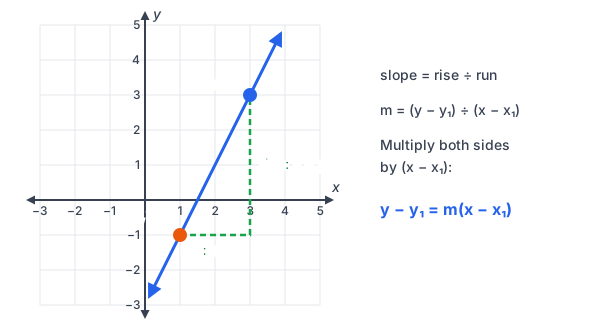
Here is where it comes from. Pick a fixed point (x_1, y_1) on the line. Let (x, y) be any other point on the line. The slope between them is the rise over the run.
m = \frac{y - y_1}{x - x_1}Multiply both sides by x - x_1. You get point-slope form. Every point (x, y) on the line makes it true.
The Point-Slope Form Formula
y - y_1 = m(x - x_1)
- m is the slope.
- (x_1, y_1) is one known point on the line.
- x and y stay as letters. They stand for every point on the line.
The formula has minus signs built in. So a negative coordinate turns into a plus sign. For the point (-4, 3), you get y - 3 = m(x + 4).
Steps to write an equation in point-slope form
- Find the slope m. If you have two points, use the slope formula.
- Pick one point (x_1, y_1) on the line.
- Put m, x_1 and y_1 into y - y_1 = m(x - x_1).
- Clean up any double signs, like x - (-1), which becomes x + 1.
- If asked, distribute and solve for y to get slope-intercept form.
Worked Examples
Example 1: Slope and a point
Write the equation of the line with slope 3 through (2, 5). Then write it in slope-intercept form.
y - 5 = 3(x - 2)
Step 1. Name the parts: m = 3, x_1 = 2 and y_1 = 5. Put them in the formula.
y - 5 = 3x - 6
Step 2. Use the distributive property on the right side.
y = 3x - 1
Step 3. Add 5 to both sides.
Answer: y - 5 = 3(x - 2), or y = 3x - 1.
Check: When x = 2, y = 3(2) - 1 = 6 - 1 = 5. It works.
Example 2: A negative slope and a negative coordinate
Write the equation of the line with slope -2 through (-1, 4).
y - 4 = -2(x - (-1))
Step 1. Name the parts: m = -2, x_1 = -1 and y_1 = 4. Put them in the formula.
y - 4 = -2(x + 1)
Step 2. Subtracting −1 is the same as adding 1 (see adding and subtracting integers).
y - 4 = -2x - 2
Step 3. Distribute −2 to both terms in the parentheses.
y = -2x + 2
Step 4. Add 4 to both sides.
Answer: y - 4 = -2(x + 1), or y = -2x + 2. Notice how x - (-1) became x + 1.
Example 3: Two points
Write the equation of the line through (1, -3) and (4, 3).
m = \frac{3 - (-3)}{4 - 1}Step 1. Find the slope with the slope formula.
m = \frac{6}{3} = 2Step 2. Simplify the top and bottom, then divide.
y - (-3) = 2(x - 1)
Step 3. Use either point. With (1, -3), put m = 2, x₁ = 1 and y₁ = −3 in the formula.
y + 3 = 2(x - 1)
Step 4. Subtracting −3 is the same as adding 3.
y + 3 = 2x - 2
Step 5. Distribute the 2.
y = 2x - 5
Step 6. Subtract 3 from both sides.
Answer: y + 3 = 2(x - 1), or y = 2x - 5.
Check: Use the other point: 2(4) - 5 = 8 - 5 = 3. It works. If you use (4, 3) instead, you get y - 3 = 2(x - 4). That looks different, but it also simplifies to y = 2x - 5. It is the same line.
Example 4: Graph a line from point-slope form
Graph y - 1 = -\tfrac{3}{4}(x + 2).
x + 2 = x - (-2)
Step 1. Rewrite the inside so it matches y - y_1 = m(x - x_1).
(-2, 1)
Step 2. Read the point and plot it.
-\tfrac{3}{4}Step 3. Read the slope. It means down 3 and right 4.
1 - 3 = -2
Step 4. From (−2, 1), go down 3 to find the new y-value.
-2 + 4 = 2
Step 5. Then go right 4 to find the new x-value. Plot (2, −2).
Step 6. Draw a line through the two points.
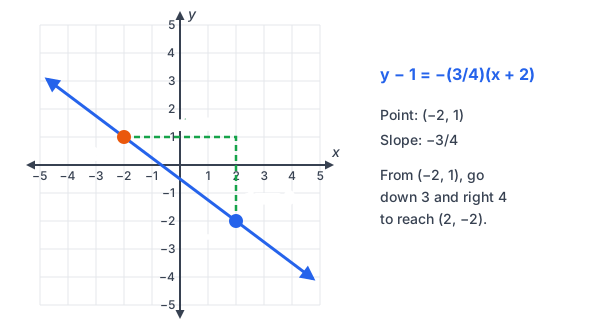
Answer: The line through (-2, 1) and (2, -2).
Check: Put (2, -2) into the equation. Left side: -2 - 1 = -3. Right side: -\tfrac{3}{4}(2 + 2) = -\tfrac{3}{4}(4) = -3. Both sides match.
Example 5: Word problem with a water tank
A tank fills at a steady 12 gallons per minute. After 3 minutes, it holds 50 gallons. Write an equation for the water y after x minutes. How much water is in the tank after 10 minutes?
Step 1. The rate is the slope, so m = 12. The fact “after 3 minutes, 50 gallons” is the point (3, 50).
y - 50 = 12(x - 3)
Step 2. Put them in the formula.
y - 50 = 12x - 36
Step 3. Distribute the 12.
y = 12x + 14
Step 4. Add 50 to both sides.
y = 12(10) + 14
Step 5. Substitute x = 10.
y = 120 + 14 = 134
Step 6. Multiply, then add.
Answer: y = 12x + 14. The tank holds 134 gallons after 10 minutes. The 14 also tells you the tank started with 14 gallons.
Common Mistakes
| Mistake | Example of the error | Fix |
|---|---|---|
| Keeping the sign of a negative coordinate | Point (-4, 3): writing y - 3 = m(x - 4) | x - (-4) is x + 4: y - 3 = m(x + 4). |
| Swapping the coordinates | Point (2, 5): writing y - 2 = 3(x - 5) | y_1 goes with y: y - 5 = 3(x - 2). |
| Distributing to only the first term | y - 5 = 3(x - 2) becomes y - 5 = 3x - 2 | Multiply both terms: 3x - 6. |
| Forgetting to move y₁ when solving for y | y - 5 = 3x - 6 becomes y = 3x - 6 | Add 5 to both sides: y = 3x - 1. |
Point-Slope Form vs. Other Forms
A line can be written in more than one form. Each form is handy for a different job.
| Form | Equation | Best when you know |
|---|---|---|
| Point-slope form | y - y_1 = m(x - x_1) | the slope and any point, or two points |
| Slope-intercept form | y = mx + b | the slope and the y-intercept (0, b) |
| Standard form | Ax + By = C | you want to find both intercepts fast |
Point-slope form is often the fastest way to start. Then you can change it to slope-intercept form by distributing and solving for y. To graph with x- and y-intercepts, standard form works best. The next lesson covers standard form.
One more note: a horizontal line has slope 0. In point-slope form, y + 2 = 0(x - 4) becomes y = -2. A vertical line has no slope, so it can’t be written in point-slope form. See horizontal and vertical lines.
Practice Problems
- Write the equation in point-slope form: slope 4 through (1, 3).
- Write the equation in point-slope form: slope -5 through (2, -1).
- Write the equation in point-slope form: slope \tfrac{2}{3} through (-3, 4).
- Name the point and the slope: y + 6 = -\tfrac{1}{2}(x - 8).
- Write y - 7 = 2(x + 3) in slope-intercept form.
- Write y + 4 = -3(x - 2) in slope-intercept form.
- Write the equation of the line through (2, 3) and (6, 11). Give both forms.
- Write the equation of the line through (-1, 5) and (3, -3). Give both forms.
- Write the equation of the line with slope 0 through (4, -2).
- A gym charges a sign-up fee plus $25 per month. After 5 months, Leo has paid $185 in all. Write an equation for the total cost y after x months. What is the sign-up fee?
Show answers
1.
Name the parts: m = 4, x₁ = 1, y₁ = 3
y - 3 = 4(x - 1)
Put them in the formula.
2.
Name the parts: m = −5, x₁ = 2, y₁ = −1
y - (-1) = -5(x - 2)
Put them in the formula.
y + 1 = -5(x - 2)
Subtracting −1 is adding 1.
3.
Name the parts: m = 2/3, x₁ = −3, y₁ = 4
y - 4 = \tfrac{2}{3}(x - (-3))Put them in the formula.
y - 4 = \tfrac{2}{3}(x + 3)Subtracting −3 is adding 3.
4.
y + 6 = y - (-6)
Rewrite the left side as y minus something.
(8, -6)
Read the point: x₁ = 8 and y₁ = −6.
m = -\tfrac{1}{2}Read the number in front of the parentheses.
5.
y - 7 = 2x + 6
Distribute the 2.
y = 2x + 13
Add 7 to both sides.
6.
y + 4 = -3x + 6
Distribute the −3. A negative times a negative is positive.
y = -3x + 2
Subtract 4 from both sides.
7.
m = \tfrac{11 - 3}{6 - 2} = \tfrac{8}{4} = 2Find the slope.
y - 3 = 2(x - 2)
Use the point (2, 3)
y - 3 = 2x - 4
Distribute the 2.
y = 2x - 1
Add 3 to both sides.
y - 3 = 2(x - 2)
Point-slope. Slope-intercept: y = 2x - 1.
8.
m = \tfrac{-3 - 5}{3 - (-1)} = \tfrac{-8}{4} = -2Find the slope.
y - 5 = -2(x - (-1))
Use the point (−1, 5)
y - 5 = -2(x + 1)
Subtracting −1 is adding 1.
y - 5 = -2x - 2
Distribute the −2.
y = -2x + 3
Add 5 to both sides.
y - 5 = -2(x + 1)
Point-slope. Slope-intercept: y = -2x + 3.
9.
y - (-2) = 0(x - 4)
Put m = 0 and the point (4, −2) in the formula.
y + 2 = 0
Simplify both sides. Zero times anything is 0.
y = -2
Subtract 2 from both sides.
This is a horizontal line.
10.
y - 185 = 25(x - 5)
The slope is 25, and the point is (5, 185)
y - 185 = 25x - 125
Distribute the 25.
y = 25x + 60
Add 185 to both sides.
The sign-up fee is the y-intercept, $60.
Want more practice? The Algebra 1 Unit 4 Practice Pack (Part 2) has 38 pages of problems on this and the other lessons in the unit, with step-by-step answers and a cheat sheet.
Point-Slope Form FAQ
What is the point-slope form of a line?
It is y - y_1 = m(x - x_1). You use it to write a line’s equation from its slope m and one point (x_1, y_1).
How do you change point-slope form to slope-intercept form?
Distribute the slope on the right side. Then add or subtract to get y alone. For example, y - 5 = 3(x - 2) becomes y = 3x - 1.
When should you use point-slope form?
Use it when you know a point and the slope, or when you know two points. It saves you from finding the y-intercept first.
Does it matter which point you use?
No. Any point on the line works. The point-slope equations look different, but they simplify to the same slope-intercept equation.
Summary
- Point-slope form is y - y_1 = m(x - x_1).
- m is the slope and (x_1, y_1) is any known point on the line.
- A negative coordinate flips to a plus sign: the point (-1, 4) gives y - 4 = m(x + 1).
- With two points, find the slope first, then use either point.
- Distribute and solve for y to get slope-intercept form.
Previous lesson: Writing Equations in Slope-Intercept Form
Next lesson: Standard Form of a Linear Equation
Back to the Algebra 1 Index