
Standard Form of a Linear Equation
The standard form of a linear equation is Ax + By = C, where A, B and C are integers and A is not negative. An example is 2x + 3y = 12. The x– and y-terms are on the left, and the number is on the right. This form makes intercepts easy to find.
Before this lesson: You should know slope-intercept form, point-slope form, and how to find x- and y-intercepts.
Extra practice: The Algebra 1 Unit 4 Practice Pack (Part 2) has printable problems, answer keys and a cheat sheet for this unit.
What Is Standard Form?
The same line can be written in more than one way. For example, y = 2x - 3 and 2x - y = 3 are the same line. Every point that works in one works in the other.
Standard form puts both variable terms on one side and the plain number on the other side. It is a tidy, agreed-on way to write a line. That makes answers easy to compare.
The rules for standard form
Ax + By = C
- A, B and C are integers. That means no fractions and no decimals.
- A is not negative. If it is, multiply every term by -1.
- A and B are not both 0.
- Many books also ask that A, B and C share no common factor. So 4x + 6y = 12 becomes 2x + 3y = 6.
How to Write an Equation in Standard Form
- Move the x-term and the y-term to the left side. Move the number to the right side.
- If there are fractions, multiply every term by the least common denominator.
- If A is negative, multiply every term by -1.
- Divide out any common factor, if your class asks for it.
To go the other way, solve for y. From Ax + By = C, you get y = -\tfrac{A}{B}x + \tfrac{C}{B}. So the slope is m = -\tfrac{A}{B}.
Worked Examples
Example 1: Write y = 3x - 2 in standard form
Write y = 3x - 2 in standard form.
-3x + y = -2
Step 1. Subtract 3x from both sides to get the x-term on the left (see two-step equations).
3x - y = 2
Step 2. The A-value is −3, which is negative. Multiply every term by −1 to make it positive.
Answer: 3x - y = 2. Here A = 3, B = -1 and C = 2. B may be negative. Only A must not be.
Example 2: Clear a fraction
Write y = \tfrac{2}{3}x - 4 in standard form.
-\tfrac{2}{3}x + y = -4Step 1. Subtract \tfrac{2}{3}x from both sides.
3\left(-\tfrac{2}{3}x\right) + 3(y) = 3(-4)Step 2. Multiply every term by 3 to clear the fraction (see multiplying and dividing fractions).
-2x + 3y = -12
Step 3. Simplify each product.
2x - 3y = 12
Step 4. A is negative, so multiply every term by −1.
Answer: 2x - 3y = 12.
Check: Use the y-intercept (0, -4): 2(0) - 3(-4) = 0 + 12 = 12. It works.
Example 3: From point-slope form
Write y - 5 = -\tfrac{1}{2}(x + 4) in standard form.
2(y - 5) = -(x + 4)
Step 1. Multiply both sides by 2. That clears the fraction right away.
2y - 10 = -x - 4
Step 2. Use the distributive property on both sides.
x + 2y - 10 = -4
Step 3. Add x to both sides.
x + 2y = 6
Step 4. Add 10 to both sides.
Answer: x + 2y = 6.
Check: Use the point (-4, 5): -4 + 2(5) = -4 + 10 = 6. It works.
Example 4: Graph 3x + 4y = 12
Graph 3x + 4y = 12. Standard form makes the intercepts quick to find.
3x = 12
Step 1. Let y = 0 and simplify.
x = 4
Step 2. Divide both sides by 3. The x-intercept is (4, 0).
4y = 12
Step 3. Let x = 0 and simplify.
y = 3
Step 4. Divide both sides by 4. The y-intercept is (0, 3).
Step 5. Plot both points and draw the line (see x and y intercepts).
m = -\tfrac{3}{4}Step 6. Find the slope with m = -\tfrac{A}{B}.
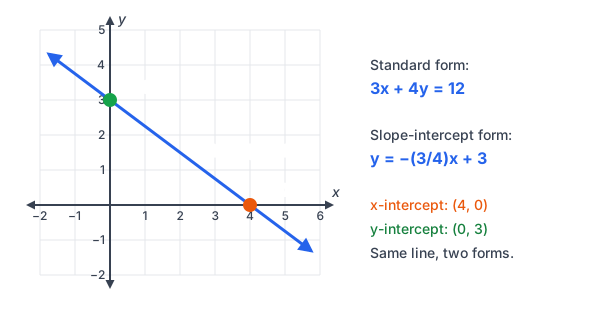
Answer: The line through (4, 0) and (0, 3). In slope-intercept form, it is y = -\tfrac{3}{4}x + 3.
Example 5: Word problem with movie tickets
Adult tickets cost $9 and child tickets cost $6. A group spends exactly $54. Write an equation in standard form. Then find every whole-number answer.
9a + 6c = 54
Step 1. Let a be the number of adult tickets and c the number of child tickets. The cost of adult tickets plus the cost of child tickets is 54.
3a + 2c = 18
Step 2. This is already in standard form. Divide every term by 3 to make the numbers smaller.
Step 3. Find the intercepts. If c = 0, then 3a = 18, so a = 6. If a = 0, then 2c = 18, so c = 9.
3(2) + 2c = 18
Step 4. Try a = 2. Substitute it.
6 + 2c = 18
Step 5. Multiply.
2c = 12
Step 6. Subtract 6 from both sides.
c = 6
Step 7. Divide both sides by 2.
Step 8. Try a = 4 the same way: 12 + 2c = 18, so 2c = 6 and c = 3. Odd values of a give fractions of a ticket, so skip them.
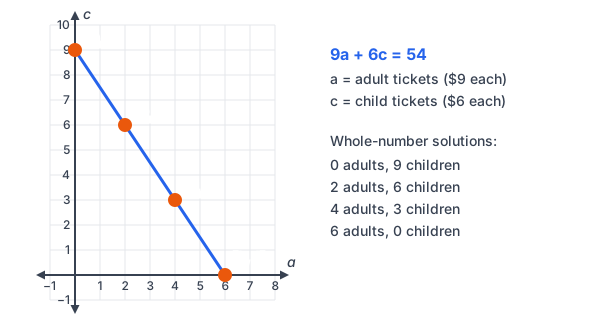
Answer: 9a + 6c = 54. The group could buy 0 adult and 9 child tickets, 2 and 6, 4 and 3, or 6 and 0.
Common Mistakes
| Mistake | Example of the error | Fix |
|---|---|---|
| Sign error when moving a term | y = 3x - 2 becomes 3x + y = -2 | Subtract 3x from both sides: -3x + y = -2, then 3x - y = 2. |
| Leaving A negative | Stopping at -2x + 3y = -12 | Multiply every term by -1: 2x - 3y = 12. |
| Clearing a fraction in only one term | -\tfrac{2}{3}x + y = -4 becomes -2x + y = -4 | Multiply every term by 3: -2x + 3y = -12. |
| Reading the slope as A over B | For 3x + 4y = 12, saying m = \tfrac{3}{4} | The slope is -\tfrac{A}{B} = -\tfrac{3}{4}. |
Changing Between Forms
| Start with | To get standard form | Example |
|---|---|---|
| Slope-intercept, y = mx + b | Move mx left, clear fractions, make A positive | y = -2x + 5 becomes 2x + y = 5 |
| Point-slope, y - y_1 = m(x - x_1) | Distribute, then move terms | y - 1 = 3(x - 2) becomes 3x - y = 5 |
| Standard, Ax + By = C | To get slope-intercept, solve for y | 5x + 2y = 8 becomes y = -\tfrac{5}{2}x + 4 |
Standard form can also show lines that slope-intercept form can’t. The vertical line x = 3 is 1x + 0y = 3. Read more in horizontal and vertical lines.
Later, you will line up two equations in standard form to solve a system. That is the elimination method.
Practice Problems
- Write y = 4x + 7 in standard form.
- Write y = -2x + 5 in standard form.
- Write y = \tfrac{1}{2}x - 3 in standard form.
- Write y = -\tfrac{3}{5}x + 2 in standard form.
- Write y - 1 = 3(x - 2) in standard form.
- Write 5x + 2y = 8 in slope-intercept form.
- Find the x-intercept, the y-intercept and the slope of 6x - 3y = 18.
- Is -4x + 2y = 9 in standard form? If not, fix it.
- Write the equation of the line through (1, 4) and (3, 0) in standard form.
- Granola bars cost $2 and juice boxes cost $3. Write an equation in standard form for spending exactly $24 on g bars and j juices. Find both intercepts and one more whole-number solution.
Show answers
1.
-4x + y = 7
Subtract 4x from both sides.
4x - y = -7
A is negative, so multiply every term by −1.
2.
2x + y = 5
Add 2x to both sides.
A = 2 is already positive, so this is standard form.
3.
-\tfrac{1}{2}x + y = -3Subtract the x-term from both sides.
x - 2y = 6
Multiply every term by −2. This clears the fraction and makes A positive.
4.
\tfrac{3}{5}x + y = 2Add the x-term to both sides.
3x + 5y = 10
Multiply every term by 5.
5.
y - 1 = 3x - 6
Distribute the 3.
-3x + y - 1 = -6
Subtract 3x from both sides.
-3x + y = -5
Add 1 to both sides.
3x - y = 5
Multiply every term by −1.
6.
2y = -5x + 8
Subtract 5x from both sides.
y = -\tfrac{5}{2}x + 4Divide every term by 2.
7.
6x = 18, \text{ so } x = 3Let y = 0.
-3y = 18, \text{ so } y = -6Let x = 0.
m = -\tfrac{A}{B} = -\tfrac{6}{-3} = 2Find the slope.
The intercepts are (3, 0) and (0, -6), and the slope is 2.
8.
Check A. It is −4, which is negative, so this is not standard form
4x - 2y = -9
Multiply every term by −1.
9.
m = \tfrac{0 - 4}{3 - 1} = \tfrac{-4}{2} = -2Find the slope.
y - 4 = -2(x - 1)
Use point-slope form with (1, 4)
y - 4 = -2x + 2
Distribute the −2.
y = -2x + 6
Add 4 to both sides.
2x + y = 6
Add 2x to both sides.
10.
2g + 3j = 24
Write the cost equation.
2g = 24, \text{ so } g = 12Let j = 0.
3j = 24, \text{ so } j = 8Let g = 0.
Check another pair, 6 bars and 4 juices: 2(6) + 3(4) = 12 + 12 = 24
The intercepts are (12, 0), 12 bars and no juice, and (0, 8), 8 juices and no bars. Another solution is 6 bars and 4 juices.
Want more practice? The Algebra 1 Unit 4 Practice Pack (Part 2) has 38 pages of problems on this and the other lessons in the unit, with step-by-step answers and a cheat sheet.
Standard Form FAQ
What is the standard form of a linear equation?
It is Ax + By = C, where A, B and C are integers and A is not negative. For example, 4x - 5y = 20.
Can A be negative in standard form?
Most textbooks say no. If A is negative, multiply every term by -1. The line stays the same.
How do you find the slope from standard form?
Use m = -\tfrac{A}{B}. For 2x + 5y = 10, the slope is -\tfrac{2}{5}. You can also solve for y and read the slope.
Why use standard form?
It makes the intercepts easy to find. It also keeps whole numbers, which helps in word problems and when solving systems of equations.
Summary
- Standard form is Ax + By = C, with integer A, B and C, and A not negative.
- Move the variable terms left and the number right. Clear fractions by multiplying every term.
- If A is negative, multiply every term by -1.
- The slope is -\tfrac{A}{B}. The intercepts come from setting x or y to 0.
- Many word problems with two kinds of items fit standard form.
Previous lesson: Point-Slope Form
Next lesson: Parallel and Perpendicular Lines
Back to the Algebra 1 Index