
Literal Equations
A literal equation is an equation with two or more variables, like a formula. To solve a literal equation for one variable, get that variable alone with inverse operations, just like any equation. For example, solving d = rt for t gives t = \frac{d}{r}.
Before this lesson: You should know how to solve two-step equations and multi-step equations.
Extra practice: The Algebra 1 Unit 2 Practice Pack has printable problems, answer keys and a cheat sheet for this unit.
What Is a Literal Equation?
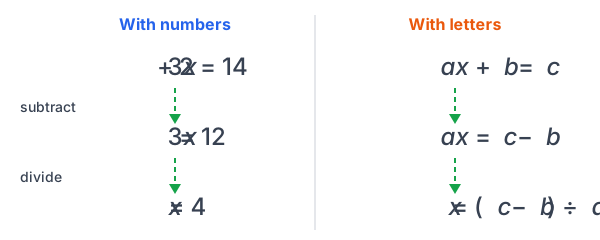
Most equations you have solved had one variable, like 3x + 2 = 14. A literal equation has two or more variables. “Literal” means it is made of letters.
Formulas are literal equations. A = lw (area of a rectangle) and d = rt (distance equals rate times time) are both examples.
Solving a literal equation for a variable means getting that one variable alone on one side. The answer is not a number. It is a new formula.
How to Solve Literal Equations
The steps are the same ones you already use. The only change is that you treat the other letters like numbers.
- Find the variable you are solving for. It may help to circle it.
- Treat every other letter like a number.
- Undo adding or subtracting first. Move those terms to the other side.
- Undo multiplying or dividing. Divide the whole other side.
- Check by putting in numbers that fit the original formula.
\begin{aligned}
ax + b &= c \\
ax &= c - b & &\text{subtract } b \\
x &= \frac{c - b}{a} & &\text{divide by } a
\end{aligned}
Note: You can’t divide by zero. So this answer works only when a \ne 0.
Worked Examples
Example 1: Distance, rate and time
Solve d = rt for t.
\frac{d}{r} = \frac{rt}{r}Step 1. t is multiplied by r. Divide both sides by r.
\frac{d}{r} = tStep 2. Simplify. The r‘s on the right cancel.
t = \frac{d}{r}Step 3. Write the variable you solved for first.
Answer: t = \frac{d}{r}
Check: A car drives 150 miles at 50 miles per hour. Then t = \frac{150}{50} = 3 hours, and 50 \cdot 3 = 150. It works.
Example 2: Perimeter of a rectangle
Solve P = 2l + 2w for w.
P - 2l = 2l + 2w - 2l
Step 1. Subtract 2l from both sides.
P - 2l = 2w
Step 2. Simplify the right side.
\frac{P - 2l}{2} = \frac{2w}{2}Step 3. Divide both sides by 2.
\frac{P - 2l}{2} = wStep 4. Simplify the right side.
w = \frac{P - 2l}{2}Step 5. Write the variable you solved for first.
Answer: w = \frac{P - 2l}{2}. You can also write it as w = \frac{P}{2} - l.
Check: Use l = 5 and w = 3. Then P = 2(5) + 2(3) = 16, and \frac{16 - 2(5)}{2} = \frac{6}{2} = 3. It works.
Example 3: Solve y = mx + b for x
Solve y = mx + b for x.
y - b = mx + b - b
Step 1. Subtract b from both sides.
y - b = mx
Step 2. Simplify the right side.
\frac{y - b}{m} = \frac{mx}{m}Step 3. Divide both sides by m.
\frac{y - b}{m} = xStep 4. Simplify the right side.
x = \frac{y - b}{m}Step 5. Write the variable you solved for first.
Answer: x = \frac{y - b}{m}
Check: Use m = 2, b = 1 and x = 4. Then y = 2(4) + 1 = 9, and \frac{9 - 1}{2} = \frac{8}{2} = 4. It works.
Example 4: Solve a two-variable equation for y
Solve 3x + 4y = 12 for y.
3x + 4y - 3x = 12 - 3x
Step 1. Subtract 3x from both sides.
4y = -3x + 12
Step 2. Simplify. Write the right side as -3x + 12 so the x-term comes first.
\frac{4y}{4} = \frac{-3x}{4} + \frac{12}{4}Step 3. Divide every term by 4.
y = -\frac{3}{4}x + 3Step 4. Simplify each term.
Answer: y = -\frac{3}{4}x + 3. This is slope-intercept form, which makes the line easy to graph.
Check: Try x = 4. The original gives 12 + 4y = 12, so y = 0. The new form gives -\frac{3}{4}(4) + 3 = -3 + 3 = 0. It works.
Example 5: Word problem
The formula F = \frac{9}{5}C + 32 changes degrees Celsius (C) to degrees Fahrenheit (F). Solve it for C. Then find the Celsius temperature when it is 77°F.
F - 32 = \frac{9}{5}C + 32 - 32Step 1. Subtract 32 from both sides.
F - 32 = \frac{9}{5}CStep 2. Simplify the right side.
\frac{5}{9}(F - 32) = \frac{5}{9} \cdot \frac{9}{5}CStep 3. Multiply both sides by \frac{5}{9}, the reciprocal of \frac{9}{5}. (See multiplying and dividing fractions.)
\frac{5}{9}(F - 32) = CStep 4. Simplify the right side. \frac{5}{9} \cdot \frac{9}{5} = 1.
C = \frac{5}{9}(F - 32)Step 5. Write the variable you solved for first.
C = \frac{5}{9}(77 - 32)Step 6. Put in F = 77.
C = \frac{5}{9}(45)Step 7. Subtract inside the parentheses.
C = 25
Step 8. Multiply. \frac{5}{9} \cdot 45 = \frac{225}{9} = 25.
Answer: C = \frac{5}{9}(F - 32), and 77°F is 25°C.
Check: \frac{9}{5}(25) + 32 = 45 + 32 = 77. It works.
Common Mistakes
| Mistake | What it looks like | How to fix it |
|---|---|---|
| Dividing only one term | 2w = P - 2l becomes w = P - l | Divide the whole side: w = \frac{P - 2l}{2}, or \frac{P}{2} - l. |
| Undoing in the wrong order | y = mx + b becomes \frac{y}{m} = x + b | Subtract b first. Or divide every term by m. |
| Losing a sign | 3x + 4y = 12 becomes 4y = 3x + 12 | Subtracting 3x leaves -3x: 4y = -3x + 12. |
| Leaving the variable on both sides | w = P - 2l - w | Get every w-term on one side before you divide. |
| Dividing by something that could be zero | x = \frac{c - b}{a} with a = 0 | Note the limit: the answer works when a \ne 0. |
Common Formulas Solved for Another Variable
Solving a formula once saves time when you need to use it many times. Here are some you will see often.
| Formula | Solved for | Result |
|---|---|---|
| A = lw (area of a rectangle) | w | w = \frac{A}{l} |
| A = \frac{1}{2}bh (area of a triangle) | h | h = \frac{2A}{b} |
| I = Prt (simple interest) | r | r = \frac{I}{Pt} |
| C = 2\pi r (circumference) | r | r = \frac{C}{2\pi} |
Practice Problems
Solve each equation for the variable given.
- A = lw for l
- x - y = 7 for x
- A = \frac{1}{2}bh for h
- I = Prt for r
- 2x + y = 9 for y
- 5x - 2y = 10 for y
- ax + b = c for x
- C = 2\pi r for r
- V = lwh for h
- The perimeter of a rectangle is P = 2l + 2w. Solve for l. Then find the length when the perimeter is 30 cm and the width is 6 cm.
Answers
Show answers
1.
\frac{A}{w} = \frac{lw}{w}Divide both sides by w.
\frac{A}{w} = lSimplify.
l = \frac{A}{w}Write the variable first.
2.
x - y + y = 7 + y
Add y to both sides.
x = y + 7
Simplify.
3.
2A = bh
Multiply both sides by 2.
\frac{2A}{b} = \frac{bh}{b}Divide both sides by b.
\frac{2A}{b} = hSimplify.
h = \frac{2A}{b}Write the variable first.
4.
\frac{I}{Pt} = \frac{Prt}{Pt}Divide both sides by Pt.
\frac{I}{Pt} = rSimplify.
r = \frac{I}{Pt}Write the variable first.
5.
2x + y - 2x = 9 - 2x
Subtract 2x from both sides.
y = -2x + 9
Simplify, x-term first.
6.
5x - 2y - 5x = 10 - 5x
Subtract 5x from both sides.
-2y = -5x + 10
Simplify, x-term first.
\frac{-2y}{-2} = \frac{-5x}{-2} + \frac{10}{-2}Divide every term by -2.
y = \frac{5}{2}x - 5Simplify each term.
7.
ax + b - b = c - b
Subtract b from both sides.
ax = c - b
Simplify.
\frac{ax}{a} = \frac{c - b}{a}Divide both sides by a.
x = \frac{c - b}{a}Simplify.
8.
\frac{C}{2\pi} = \frac{2\pi r}{2\pi}Divide both sides by 2\pi.
\frac{C}{2\pi} = rSimplify.
r = \frac{C}{2\pi}Write the variable first.
9.
\frac{V}{lw} = \frac{lwh}{lw}Divide both sides by lw.
\frac{V}{lw} = hSimplify.
h = \frac{V}{lw}Write the variable first.
10.
P - 2w = 2l
Subtract 2w from both sides.
\frac{P - 2w}{2} = lDivide both sides by 2.
l = \frac{P - 2w}{2}Write the variable first.
l = \frac{30 - 2(6)}{2}Put in P = 30 and w = 6.
l = \frac{30 - 12}{2}Multiply.
l = \frac{18}{2}Subtract.
l = 9
Divide.
Check: 2(9) + 2(6) = 18 + 12 = 30
The length is 9 cm.
Want more practice? The Algebra 1 Unit 2 Practice Pack has 51 pages of problems on this and the other lessons in the unit, with step-by-step answers and a cheat sheet.
Literal Equations FAQ
What is a literal equation?
It is an equation with two or more variables. Formulas like d = rt and A = lw are literal equations.
How do you solve literal equations?
Pick the variable you want and treat the other letters like numbers. Undo adding or subtracting, then undo multiplying or dividing, until that variable is alone.
Why do we solve literal equations?
It lets you rewrite a formula to find the value you need. If you know the distance and the rate, solving for time gives you a formula you can use again and again.
Is the answer to a literal equation a number?
Usually not. The answer is an expression with the other variables, like t = \frac{d}{r}. You get a number only after you put in values.
Summary
- A literal equation has two or more variables. Formulas are literal equations.
- Solve it with the same inverse operations you use for any equation.
- Treat the other letters like numbers.
- Undo adding or subtracting first, then multiplying or dividing.
- When you divide, divide the whole side, and never divide by zero.
Previous lesson: Equations with Variables on Both Sides
Next lesson: One-Step Inequalities
Back to the Algebra 1 Index