
Simple Interest
Simple interest is money you earn on savings, or pay on a loan, based only on the starting amount. Use the formula I = Prt. Multiply the principal P by the yearly interest rate r, written as a decimal, and the time t in years. For example, $500 at 4% for 3 years earns 500 \times 0.04 \times 3 = 60, or $60.
Before this lesson: You should know how to find the percent of a number from percentages and how to solve percent word problems.
Extra practice: The Pre-Algebra Unit 3 Practice Pack has printable problems, answer keys and a cheat sheet for this unit.
What Is Simple Interest?
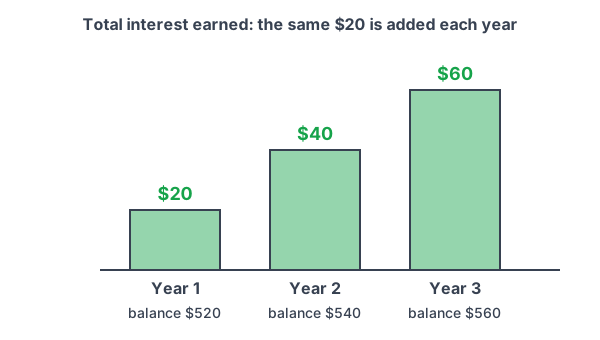
When you put money in a savings account, the bank pays you extra money called interest. When you borrow money, you pay interest to the lender. With simple interest, the interest is the same amount every year, because it is always based on the starting amount.
The Simple Interest Formula
I = Prt
| Letter | Meaning | Example |
|---|---|---|
| I | Interest, the extra money earned or owed | $60 |
| P | Principal, the starting amount | $500 |
| r | Yearly interest rate, as a decimal | 4% = 0.04 |
| t | Time in years | 3 years |
In Prt, the letters are written side by side, which means multiply. To find the total amount A at the end, add the interest to the principal.
A = P + I
If the time is in months, divide by 12 to change it to years. For example, 6 months is \frac{6}{12} = 0.5 year.
Worked Examples
Example 1: Find the interest
You save $500 at 4% simple interest for 3 years. How much interest do you earn?
Step 1. Write the values: P = 500, r = 0.04 and t = 3.
I = 500 \times 0.04 \times 3 = 60
Step 2. Multiply.
Answer: You earn $60 in interest.
Example 2: Find the total owed
You borrow $1,200 at 6% simple interest for 2 years. How much do you pay back in all?
I = 1200 \times 0.06 \times 2 = 144
Step 1. Find the interest.
A = 1200 + 144 = 1344
Step 2. Add it to the principal.
Answer: You pay back $1,344.
Example 3: Time in months
Find the simple interest on $800 at 5% for 6 months.
t = \frac{6}{12} = 0.5Step 1. Change 6 months to years.
I = 800 \times 0.05 \times 0.5 = 20
Step 2. Multiply.
Answer: The interest is $20.
Example 4: Find the rate
A $2,000 deposit earns $150 in simple interest in 3 years. What is the yearly interest rate?
150 = 2000 \times r \times 3
Step 1. Put the values into the formula.
150 = 6000r
Multiply 2000 by 3.
r = 150 \div 6000 = 0.025
Step 2. Divide both sides by 6,000.
Answer: The rate is 0.025, which is 2.5% per year.
Example 5: Word problem
Maria borrows $3,000 to buy a used car. She pays 7% simple interest for 4 years. How much does she pay in all? If she pays the same amount every month, how much is each payment?
I = 3000 \times 0.07 \times 4 = 840
Step 1. Find the interest.
Step 2. Find the total: 3,000 + 840 = 3,840.
Step 3. There are 4 × 12 = 48 months. Divide: 3,840 ÷ 48 = 80.
Answer: Maria pays $3,840 in all, which is $80 per month.
Common Mistakes
| Mistake | What it looks like | How to fix it |
|---|---|---|
| Using the percent as a whole number | 500 \times 4 \times 3 = 6000 | Write the rate as a decimal: 4% = 0.04. |
| Using months as years | 6 months: 800 \times 0.05 \times 6 | Divide months by 12 first: 6 months = 0.5 year. |
| Giving the interest when asked for the total | “She pays $840 in all” | Add the interest to the principal: $3,840. |
| Adding interest on interest | Year 2 interest of $20.80 on a $520 balance | Simple interest always uses the starting principal, so it is $20 every year. |
Simple Interest vs. Compound Interest
With compound interest, you also earn interest on the interest you already earned, so it grows faster. Here is $1,000 at 10% for 3 years:
| After | Simple interest | Compound interest (yearly) |
|---|---|---|
| 1 year | $1,100 | $1,100 |
| 2 years | $1,200 | $1,210 |
| 3 years | $1,300 | $1,331 |
Compound interest is taught in Algebra 1 (coming soon). Simple interest problems also use rates and careful decimal operations.
Practice Problems
- Find the simple interest on $400 at 5% for 2 years.
- Find the simple interest on $1,500 at 3% for 4 years.
- You save $250 at 6% for 1 year. Find the interest and the total.
- Find the simple interest on $900 at 4% for 18 months.
- Find the simple interest on $2,500 at 8% for 3 months.
- An $800 deposit earns $96 in 3 years. What is the yearly rate?
- How many years does it take $1,200 at 5% to earn $180 in simple interest?
- A loan at 6% for 2 years has $72 in interest. What was the principal?
- You borrow $5,000 at 9% simple interest for 2 years. How much do you pay back in all?
- Jada puts $750 in a savings account at 2.5% simple interest for 4 years. How much will she have?
Show answers
1.
400 \times 0.05 \times 2 = 40, so $40.
2.
1500 \times 0.03 \times 4 = 180, so $180.
3.
250 \times 0.06 \times 1 = 15. Interest: $15. Total: $265.
4.
18 months = 1.5 years. 900 \times 0.04 \times 1.5 = 54, so $54.
5.
3 months = 0.25 year. 2500 \times 0.08 \times 0.25 = 50, so $50.
6.
96 = 800 \times r \times 3 = 2400r, so r = 0.04, which is 4%.
7.
180 = 1200 \times 0.05 \times t = 60t, so t = 3 years.
8.
72 = P \times 0.06 \times 2 = 0.12P, so P = 600. The principal was $600.
9.
5000 \times 0.09 \times 2 = 900
Interest. Total: $5,900.
10.
750 \times 0.025 \times 4 = 75
Interest. Total: $825.
Want more practice? The Pre-Algebra Unit 3 Practice Pack has 45 pages of problems on this and the other lessons in the unit, with step-by-step answers and a cheat sheet.
Simple Interest FAQ
What is the formula for simple interest?
I = Prt, where P is the principal, r is the yearly rate as a decimal and t is the time in years.
How do you find the total amount with simple interest?
Add the interest to the principal: A = P + I. For $500 that earns $60, the total is $560.
What is the difference between simple and compound interest?
Simple interest is figured only on the principal, so it is the same each year. Compound interest is also figured on past interest, so it grows faster over time.
Is the interest rate always per year?
In most problems, yes. If the time is given in months or days, change it to years before you use the formula.
Summary
- Simple interest is based only on the starting amount, the principal.
- Use I = Prt with the rate as a decimal and the time in years.
- The total amount is A = P + I.
- Change months to years by dividing by 12.
- Simple interest adds the same amount every year.
Previous lesson: Percent Word Problems
Next lesson: Exponents
Back to the Pre-Algebra Index