
Equations with Variables on Both Sides
To solve equations with variables on both sides, get all the variable terms on one side and all the numbers on the other. Add or subtract a variable term from both sides first. Then solve the two-step equation that is left. For example, 5x + 2 = 3x + 10 becomes 2x + 2 = 10, so x = 4.
Before this lesson: You should know how to solve multi-step equations, combine like terms and use the distributive property.
Extra practice: The Algebra 1 Unit 2 Practice Pack has printable problems, answer keys and a cheat sheet for this unit.
What Does “Variables on Both Sides” Mean?
In the equations you have solved so far, the variable was on one side only. Now it shows up on both sides, like 5x + 2 = 3x + 10. You can’t divide yet, because there are two x-terms in different places.
Think of an equation as a balance scale. You can take the same thing off both sides and it stays balanced. That includes variable terms. Subtract 3x from both sides, and only one x-term is left.
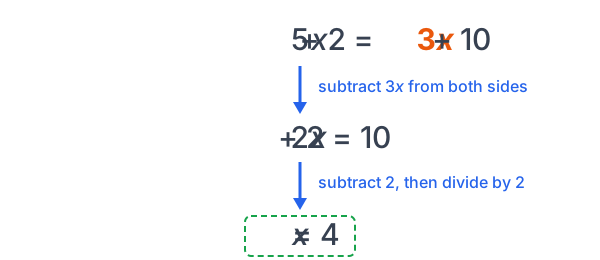
How to Solve Equations with Variables on Both Sides
- Simplify each side. Distribute and combine like terms.
- Move the variable terms to one side. Add or subtract a variable term on both sides.
- Move the numbers to the other side.
- Divide by the coefficient (the number in front of the variable).
- Check your answer in the original equation.
Tip: Move the smaller variable term. In 5x + 2 = 3x + 10, 3x is smaller than 5x. Subtracting 3x keeps the coefficient positive, so there are fewer negative signs to track.
\begin{aligned}
5x + 2 &= 3x + 10 \\
2x + 2 &= 10 & &\text{subtract } 3x \\
2x &= 8 & &\text{subtract 2} \\
x &= 4 & &\text{divide by 2}
\end{aligned}
Check: 5(4) + 2 = 22 and 3(4) + 10 = 22. Both sides match.
Worked Examples
Example 1: Basic equation
Solve 6x - 5 = 2x + 11.
6x - 5 - 2x = 2x + 11 - 2x
Step 1. Subtract 2x from both sides to get the variable on one side.
4x - 5 = 11
Step 2. Simplify each side (see combining like terms).
4x - 5 + 5 = 11 + 5
Step 3. Add 5 to both sides.
4x = 16
Step 4. Simplify.
\frac{4x}{4} = \frac{16}{4}Step 5. Divide both sides by 4.
x = 4
Step 6. Simplify.
Answer: x = 4
Check: 6(4) - 5 = 19 and 2(4) + 11 = 19. It works.
Example 2: A negative variable term
Solve 4n - 9 = -2n + 21.
4n - 9 + 2n = -2n + 21 + 2n
Step 1. The right side has -2n. Add 2n to both sides to cancel it.
6n - 9 = 21
Step 2. Simplify each side.
6n - 9 + 9 = 21 + 9
Step 3. Add 9 to both sides.
6n = 30
Step 4. Simplify.
\frac{6n}{6} = \frac{30}{6}Step 5. Divide both sides by 6.
n = 5
Step 6. Simplify.
Answer: n = 5
Check: 4(5) - 9 = 11 and -2(5) + 21 = 11. It works.
Example 3: Parentheses on both sides
Solve 3(a + 4) = 5(a - 2).
3a + 12 = 5a - 10
Step 1. Distribute on each side.
3a + 12 - 3a = 5a - 10 - 3a
Step 2. Subtract 3a from both sides. The variable ends up on the right, and that’s fine.
12 = 2a - 10
Step 3. Simplify each side.
12 + 10 = 2a - 10 + 10
Step 4. Add 10 to both sides.
22 = 2a
Step 5. Simplify.
\frac{22}{2} = \frac{2a}{2}Step 6. Divide both sides by 2.
a = 11
Step 7. Simplify, and write the variable first.
Answer: a = 11
Check: 3(11 + 4) = 45 and 5(11 - 2) = 45. It works.
Example 4: Fractions
Solve \frac{1}{2}x + 3 = \frac{1}{4}x + 5.
4 \cdot \frac{1}{2}x + 4 \cdot 3 = 4 \cdot \frac{1}{4}x + 4 \cdot 5Step 1. Clear the fractions. The least common multiple of 2 and 4 is 4, so multiply every term by 4.
2x + 12 = x + 20
Step 2. Simplify each product.
2x + 12 - x = x + 20 - x
Step 3. Subtract x from both sides.
x + 12 = 20
Step 4. Simplify.
x + 12 - 12 = 20 - 12
Step 5. Subtract 12 from both sides.
x = 8
Step 6. Simplify.
Answer: x = 8
Check: \frac{1}{2}(8) + 3 = 7 and \frac{1}{4}(8) + 5 = 7. It works.
Example 5: Word problem
Bike Shop A charges $12 plus $3 per hour. Bike Shop B charges $4 plus $5 per hour. After how many hours do the two shops cost the same?
12 + 3h = 4 + 5h
Step 1. Let h = the number of hours. Shop A costs 12 + 3h. Shop B costs 4 + 5h. Set the costs equal.
12 + 3h - 3h = 4 + 5h - 3h
Step 2. Subtract 3h from both sides.
12 = 4 + 2h
Step 3. Simplify.
12 - 4 = 4 + 2h - 4
Step 4. Subtract 4 from both sides.
8 = 2h
Step 5. Simplify.
\frac{8}{2} = \frac{2h}{2}Step 6. Divide both sides by 2.
h = 4
Step 7. Simplify, and write the variable first.
Step 8. Find the cost. Shop A: 12 + 3(4) = 24. Shop B: 4 + 5(4) = 24. Both cost $24.
Answer: The shops cost the same, $24, after 4 hours.
Common Mistakes
| Mistake | What it looks like | How to fix it |
|---|---|---|
| Changing only one side | 5x + 2 = 3x + 10 becomes 2x + 2 = 3x + 10 | Subtract 3x from both sides: 2x + 2 = 10. |
| Adding when you should subtract | 5x + 2 = 3x + 10 becomes 8x + 2 = 10 | To remove +3x, subtract 3x. Do the opposite operation. |
| Losing the sign of a negative term | 4n - 9 = -2n + 21 becomes 2n - 9 = 21 | To remove -2n, add 2n: 6n - 9 = 21. |
| Distributing to only one term | 5(a - 2) becomes 5a - 2 | Multiply both terms: 5a - 10. |
| Reading a true statement as “x = 0” | 3x + 6 = 3x + 6 gives 6 = 6, so “x = 0” | A true statement means every number works. The answer is all real numbers. |
When the Variables Cancel Out
Sometimes the variable terms cancel on both sides. Then you are left with only numbers. Look at that statement to decide the answer.
| What is left | Example | Answer |
|---|---|---|
| A false statement, like 5 = 1 | 2x + 5 = 2x + 1 gives 5 = 1 | No solution. No number makes it true. |
| A true statement, like 6 = 6 | 3(x + 2) = 3x + 6 gives 6 = 6 | Infinitely many solutions. Every number works. |
An equation that is true for every number is called an identity. Both sides are the same expression, written two ways.
You will see the same idea later with lines. Two parallel lines never meet, which matches “no solution.” See number of solutions for systems of equations.
Practice Problems
Solve each equation. If there is no solution or every number works, say so.
- 6x + 1 = 4x + 9
- 9k - 5 = 4k + 20
- 2m + 7 = 5m - 14
- 8 - 2y = 3y + 23
- 4(b - 1) = 2(b + 5)
- 0.5x + 6 = 0.2x + 9
- \frac{x}{3} + 2 = \frac{x}{6} + 5
- Maya has $50 and saves $8 a week. Leo has $90 and saves $3 a week. After how many weeks will they have the same amount? How much will each have?
- 5(t + 2) - t = 4t + 10
- 3(2w - 1) = 6w + 4
Answers
Show answers
1.
2x + 1 = 9
Subtract 4x from both sides.
2x = 8
Subtract 1 from both sides.
x = 4
Divide both sides by 2.
2.
5k - 5 = 20
Subtract 4k from both sides.
5k = 25
Add 5 to both sides.
k = 5
Divide both sides by 5.
3.
7 = 3m - 14
Subtract 2m from both sides.
21 = 3m
Add 14 to both sides.
7 = m
Divide both sides by 3.
m = 7
Write the variable first.
4.
8 = 5y + 23
Add 2y to both sides.
-15 = 5y
Subtract 23 from both sides.
-3 = y
Divide both sides by 5.
y = -3
Write the variable first.
5.
4b - 4 = 2b + 10
Distribute on each side.
2b - 4 = 10
Subtract 2b from both sides.
2b = 14
Add 4 to both sides.
b = 7
Divide both sides by 2.
6.
0.3x + 6 = 9
Subtract 0.2x from both sides.
0.3x = 3
Subtract 6 from both sides.
x = 10
Divide both sides by 0.3 (see operations with decimals)
7.
6 \cdot \frac{x}{3} + 6 \cdot 2 = 6 \cdot \frac{x}{6} + 6 \cdot 5Multiply every term by 6.
2x + 12 = x + 30
Simplify each product.
x + 12 = 30
Subtract x from both sides.
x = 18
Subtract 12 from both sides.
8.
50 + 8w = 90 + 3w
Let w = the number of weeks. Set the amounts equal.
50 + 5w = 90
Subtract 3w from both sides.
5w = 40
Subtract 50 from both sides.
w = 8
Divide both sides by 5.
50 + 8(8) = 50 + 64 = 114
Find Maya’s amount.
Check Leo’s amount: 90 + 3(8) = 90 + 24 = 114
After 8 weeks, each has $114.
9.
5t + 10 - t = 4t + 10
Distribute the 5.
4t + 10 = 4t + 10
Combine like terms.
10 = 10
Subtract 4t from both sides.
This is always true, so there are infinitely many solutions (all real numbers).
10.
6w - 3 = 6w + 4
Distribute the 3.
-3 = 4
Subtract 6w from both sides.
This is false, so there is no solution.
Want more practice? The Algebra 1 Unit 2 Practice Pack has 51 pages of problems on this and the other lessons in the unit, with step-by-step answers and a cheat sheet.
Equations with Variables on Both Sides FAQ
How do you solve equations with variables on both sides?
Add or subtract a variable term on both sides so the variable is on one side only. Then move the numbers to the other side and divide by the coefficient.
Which side should the variable go on?
Either side works and gives the same answer. Moving the smaller variable term usually keeps the coefficient positive, which means fewer sign mistakes.
What does it mean when the variables cancel out?
Look at what is left. A false statement, like 5 = 1, means there is no solution. A true statement, like 6 = 6, means every number is a solution.
Can the answer be on the left side, like 11 = a?
Yes. 11 = a means the same thing as a = 11. You can flip the sides of an equation at any time.
Summary
- Get the variable terms on one side by adding or subtracting a variable term on both sides.
- Simplify first: distribute and combine like terms on each side.
- Move the smaller variable term to keep the coefficient positive.
- If the variables cancel and the result is false, there is no solution.
- If the variables cancel and the result is true, every number is a solution.
Previous lesson: Multi-Step Equations
Next lesson: Literal Equations
Back to the Algebra 1 Index