
Function Notation
Function notation is a way to name a function and show its input. In f(x) = 2x + 3, f is the name of the function, x is the input, and f(x) is the output. To evaluate f(4), replace x with 4: f(4) = 2(4) + 3 = 11.
Before this lesson: You should know what a function is from relations and functions, and how to evaluate algebraic expressions.
Extra practice: The Algebra 1 Unit 3 Practice Pack has printable problems, answer keys and a cheat sheet for this unit.
What Does f(x) Mean?
You read f(x) as “f of x.” It does not mean f times x. It means “the output of the function f when the input is x.”
Think of a function as a machine. You drop in an input. The machine follows its rule. Out comes one output. The notation f(4) asks, “What comes out when 4 goes in?”
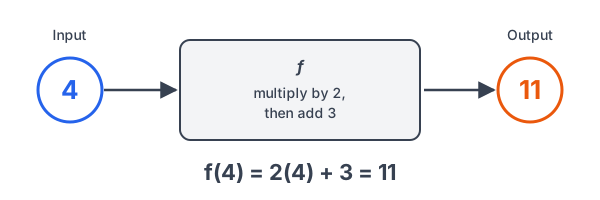
Function notation is just a label for y. The equation y = 2x + 3 and the function f(x) = 2x + 3 make the same line. The fact f(4) = 11 means the point (4, 11) is on the graph.
Why use it? The name tells you which function you mean, and the input is right there. If a problem has two functions, you can call them f and g and never mix them up.
How to Evaluate a Function
To evaluate a function means to find the output for a given input.
- Write the rule. Replace every x with the input. Put the input in parentheses.
- Simplify with the order of operations.
- Write the answer as f(\text{input}) = \text{output}.
Some problems go the other way. They give the output and ask for the input. For “Find x when f(x) = 19,” set the rule equal to 19 and solve the equation.
| The question | What it asks | What you do |
|---|---|---|
| Find f(3) | The output when the input is 3 | Replace x with 3 and simplify |
| Solve f(x) = 3 | The input that gives an output of 3 | Set the rule equal to 3 and solve |
Function Notation Examples
Example 1: Evaluate a linear function
Let f(x) = 3x - 5. Find f(4).
f(4) = 3(4) - 5
Step 1. Replace x with 4.
f(4) = 12 - 5
Step 2. Multiply first, following the order of operations.
f(4) = 7
Step 3. Subtract.
Answer: f(4) = 7.
Example 2: A negative input and a square
Let g(x) = x^2 - 2x + 1. Find g(-3).
g(-3) = (-3)^2 - 2(-3) + 1
Step 1. Replace both x‘s with (-3). The parentheses keep the sign with the number.
g(-3) = 9 - 2(-3) + 1
Step 2. Square first: (-3)^2 = 9. A negative times a negative is positive. (See multiplying and dividing integers.)
g(-3) = 9 + 6 + 1
Step 3. Multiply: -2(-3) = 6.
g(-3) = 16
Step 4. Add from left to right.
Answer: g(-3) = 16.
Example 3: Find the input from the output
Let h(x) = 4x + 7. Find x when h(x) = 19.
4x + 7 = 19
Step 1. Replace h(x) with its rule. Now you have an equation to solve, like the ones in two-step equations.
4x = 12
Step 2. Subtract 7 from both sides.
x = 3
Step 3. Divide both sides by 4.
Answer: x = 3.
Check: h(3) = 4(3) + 7 = 12 + 7 = 19. It works.
Example 4: Read a function from a graph
The graph shows f(x) = 2x - 1. Find f(2). Then find x when f(x) = -3.
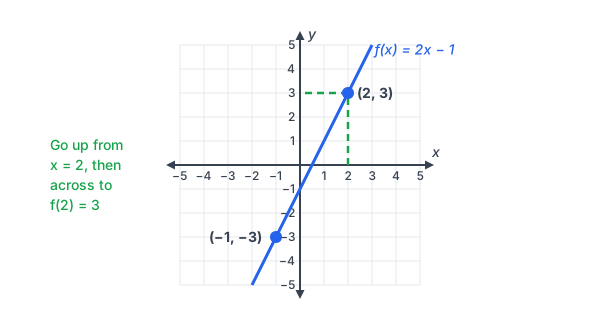
Step 1. To find f(2), start at 2 on the x-axis.
f(2) = 3
Step 2. Go straight up to the line. You land at the point (2, 3), so the height is 3.
f(2) = 2(2) - 1 = 4 - 1 = 3
Step 3. Check with the rule.
Step 4. To solve f(x) = -3, start at -3 on the y-axis.
Step 5. Go straight across to the line. It meets the line at the point (-1, -3), so x = -1.
f(-1) = 2(-1) - 1 = -2 - 1 = -3
Step 6. Check with the rule.
Answer: f(2) = 3, and f(x) = -3 when x = -1.
Example 5: Word problem
A plumber charges a $60 trip fee plus $45 per hour. The cost for h hours is C(h) = 45h + 60 dollars. Find C(3) and explain what it means. Then find how many hours cost $285.
C(3) = 45(3) + 60
Step 1. Replace h with 3.
C(3) = 135 + 60
Step 2. Multiply.
C(3) = 195
Step 3. Add.
Step 4. Explain it. C(3) = 195 means a 3-hour job costs $195.
45h + 60 = 285
Step 5. To find the hours for $285, set the rule equal to 285.
45h = 225
Step 6. Subtract 60 from both sides.
h = 5
Step 7. Divide both sides by 45.
Answer: A 3-hour job costs $195. A bill of $285 is for 5 hours of work.
Check: C(5) = 45(5) + 60 = 225 + 60 = 285.
Common Mistakes
| Mistake | Example of the error | Fix |
|---|---|---|
| Reading f(x) as multiplication | Writing f(2) = 2f | f(2) means the output when the input is 2. |
| Leaving out parentheses with a negative input | For x^2 at x = -3, writing -3^2 = -9 | Write (-3)^2 = 9. |
| Mixing up f(3) and f(x) = 3 | Plugging in 3 when asked to solve f(x) = 3 | f(x) = 3 gives the output. Set the rule equal to 3 and solve. |
| Replacing only one x | For g(x) = x^2 - 2x, finding g(4) = 16 - 2x | Replace every x with the input. |
Function Notation in Tables and Other Letters
A function can be given as a table. To find f(1), find 1 in the x row and read the output below it.
| x | -1 | 0 | 1 | 2 |
|---|---|---|---|---|
| f(x) | 4 | 1 | -2 | -5 |
Here f(1) = -2. To solve f(x) = 4, find 4 in the bottom row. Its input is -1, so x = -1.
Functions don’t have to use f and x. Word problems often use letters that match the meaning, like C(h) for cost after h hours or d(t) for distance after t seconds. The steps are the same.
You will use function notation for lines in slope-intercept form: f(x) = mx + b is the same line as y = mx + b.
Practice Problems
Use f(x) = 5x + 2, g(x) = x^2 - 4 and h(x) = -2x + 9 for problems 1–7.
- Find f(3).
- Find f(-2).
- Find g(5).
- Find g(-1).
- Find h(0).
- Find x when f(x) = 27.
- Find x when h(x) = 15.
- Let p(x) = \frac{x}{2} + 3. Find p(-6).
- Use the table in the section above. Find f(1), and find x when f(x) = 4.
- A phone plan costs C(m) = 0.10m + 15 dollars for m minutes. Find C(200). How many minutes cost $40?
Show answers
1.
f(3) = 5(3) + 2
Substitute 3.
f(3) = 15 + 2
Multiply.
f(3) = 17
Add.
2.
f(-2) = 5(-2) + 2
Substitute −2.
f(-2) = -10 + 2
Multiply.
f(-2) = -8
Add.
3.
g(5) = 5^2 - 4
Substitute 5.
g(5) = 25 - 4
Square.
g(5) = 21
Subtract.
4.
g(-1) = (-1)^2 - 4
Substitute −1 in parentheses.
g(-1) = 1 - 4
Square.
g(-1) = -3
Subtract.
5.
h(0) = -2(0) + 9
Substitute 0.
h(0) = 0 + 9
Multiply.
h(0) = 9
Add.
6.
5x + 2 = 27
Set the rule equal to 27.
5x = 25
Subtract 2 from both sides.
x = 5
Divide both sides by 5.
7.
-2x + 9 = 15
Set the rule equal to 15.
-2x = 6
Subtract 9 from both sides.
x = -3
Divide both sides by −2.
8.
p(-6) = \frac{-6}{2} + 3Substitute −6.
p(-6) = -3 + 3
Divide.
p(-6) = 0
Add.
9.
f(1) = -2
Find 1 in the x row and read the output below it.
x = -1
Find 4 in the bottom row and read the input above it.
10.
C(200) = 0.10(200) + 15
Substitute 200.
C(200) = 20 + 15
Multiply.
C(200) = 35
Add.
So 200 minutes cost $35. For $40, set the rule equal to 40: 0.10m + 15 = 40
0.10m = 25
Subtract 15 from both sides.
m = 250
Divide both sides by 0.10.
So $40 buys 250 minutes.
Want more practice? The Algebra 1 Unit 3 Practice Pack has 39 pages of problems on this and the other lessons in the unit, with step-by-step answers and a cheat sheet.
Function Notation FAQ
What does f(x) mean?
f(x) means the output of the function f when the input is x. You read it as “f of x.”
How do you evaluate a function?
Replace every x in the rule with the input, using parentheses. Then simplify with the order of operations.
Is f(x) the same as y?
Yes, for graphing. The graph of f(x) = 2x + 3 is the same as the graph of y = 2x + 3. Function notation also shows the input.
Does f(x) mean f times x?
No. The parentheses here hold the input. They do not mean multiplication.
Summary
- f(x) is read “f of x.” It is the output when the input is x.
- To find f(a), replace every x with a in parentheses, then simplify.
- To solve f(x) = c, set the rule equal to c and solve for x.
- f(a) = b means the point (a, b) is on the graph.
- Functions can use any letters, like C(h) for cost after h hours.
Previous lesson: Relations and Functions
Next lesson: Domain and Range
Back to the Algebra 1 Index