
Domain and Range
The domain of a function is the set of all its inputs, the x-values. The range is the set of all its outputs, the y-values. To find them, list the x– and y-values in a set of points or a table. On a graph, see how far it reaches left to right (domain) and bottom to top (range).
Before this lesson: You should know relations and functions and function notation. Domains on graphs use the inequality signs from compound inequalities.
Extra practice: The Algebra 1 Unit 3 Practice Pack has printable problems, answer keys and a cheat sheet for this unit.
What Are Domain and Range?
Think of a function as a vending machine again. The domain is every button you are allowed to press. The range is every snack that can come out.
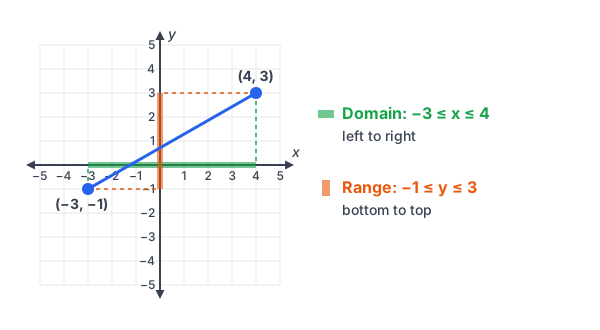
On a graph, picture a light shining down from above. The graph casts a shadow on the x-axis. That shadow is the domain. Now shine a light from the side. The shadow on the y-axis is the range.
A memory trick: D comes before R in the alphabet, and x comes before y. So domain goes with x, and range goes with y.
How to Find Domain and Range
From ordered pairs or a table
- List every x-value. That list is the domain.
- List every y-value. That list is the range.
- Write each number only once, from smallest to largest, inside braces { }.
From a graph
- Find the leftmost and rightmost points. The domain is every x between them.
- Find the lowest and highest points. The range is every y between them.
- A closed dot means the end is included. Use \le or \ge.
- An open dot means the end is not included. Use \lt or \gt.
- An arrow means the graph keeps going forever in that direction.
From an equation or a word problem
For a line like y = 2x + 1, you can put in any number. So the domain is all real numbers. In a word problem, the story sets limits. You can’t sell -3 shirts or half a ticket.
Domain and Range Examples
Example 1: A set of ordered pairs
Find the domain and range of \{(-3, 5), (0, 2), (1, 5), (4, -1)\}.
Step 1. List the x-values, the first number in each pair: -3, 0, 1 and 4. They form the domain.
Step 2. List the y-values, the second number in each pair: 5, 2, 5 and -1.
Step 3. Write each output only once, from least to greatest. The 5 appears twice, so write it once.
Answer: Domain \{-3, 0, 1, 4\}. Range \{-1, 2, 5\}.
Example 2: A line segment
Find the domain and range of the segment in the graph above. It runs from (-3, -1) to (4, 3), with closed dots at both ends.
Step 1. Read the graph from left to right. It starts at x = -3 and ends at x = 4.
Step 2. Read the graph from bottom to top. It starts at y = -1 and ends at y = 3.
Step 3. Both dots are closed, so the endpoints are included. Use \le on both ends (see compound inequalities).
-3 \le x \le 4
Step 4. Write the domain.
-1 \le y \le 3
Step 5. Write the range.
Answer: Domain -3 \le x \le 4. Range -1 \le y \le 3.
Example 3: A graph with an arrow
Find the domain and range of the ray in the left graph.
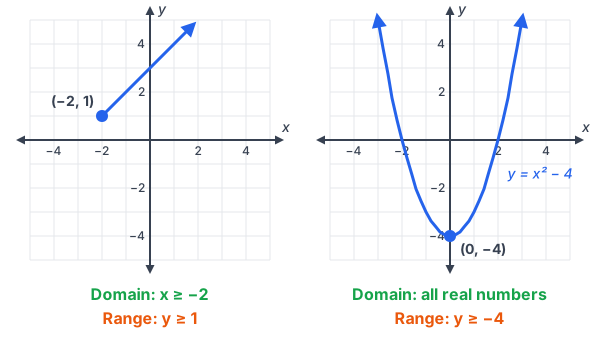
Step 1. Find where the graph starts. It starts at a closed dot at (-2, 1), so that point is included.
Step 2. Follow the arrow. It shows the graph goes up and to the right forever.
x \ge -2
Step 3. Read the domain. The x-values start at -2 and keep growing.
y \ge 1
Step 4. Read the range. The y-values start at 1 and keep growing.
Answer: Domain x \ge -2. Range y \ge 1.
Example 4: A U-shaped graph
Find the domain and range of y = x^2 - 4, the right graph above.
Step 1. Find the domain. You can square any number, so every x works.
y = 0^2 - 4 = 0 - 4 = -4
Step 2. Find the lowest point. A square is never negative, so x^2 is smallest when x = 0.
Step 3. Read the range. The lowest point is (0, -4). The arms go up forever, so the graph never goes below -4.
Answer: Domain: all real numbers. Range y \ge -4.
Example 5: Word problem
A school club has 40 T-shirts to sell at $12 each. The money earned is M(s) = 12s, where s is the number of shirts sold. Find the domain and range.
Step 1. Find the inputs. The club can sell 0, 1, 2 and so on, up to 40 shirts. It can’t sell part of a shirt, so s is a whole number from 0 to 40.
M(0) = 12(0) = 0
Step 2. Find the smallest output. Selling 0 shirts earns nothing.
M(1) = 12(1) = 12
Step 3. Find the next output. Each shirt adds $12.
M(40) = 12(40) = 480
Step 4. Find the largest output. Selling all 40 shirts earns the most.
Answer: Domain: the whole numbers 0, 1, 2, …, 40. Range: 0, 12, 24, …, 480 dollars.
Common Mistakes
| Mistake | Example of the error | Fix |
|---|---|---|
| Swapping domain and range | Listing the y-values as the domain | Domain is x (inputs). Range is y (outputs). |
| Listing a value twice | Range \{2, 5, 5\} | Write each value once: \{2, 5\}. |
| Mixing up open and closed dots | Writing x \lt 4 for a closed dot at 4 | Closed dot: \le or \ge. Open dot: \lt or \gt. |
| Ignoring an arrow | Writing -2 \le x \le 3 for a ray that keeps going right | An arrow means no end: x \ge -2. |
| Giving a U-shape a range of all numbers | Saying y = x^2 - 4 has range all real numbers | Find the lowest point. The range starts there. |
Domain and Range in Real Life
In word problems, ask what inputs make sense. Here are some common limits.
| Input | What makes sense | Domain |
|---|---|---|
| Number of people, tickets or shirts | Whole numbers, no negatives | 0, 1, 2, 3, … |
| Time after something starts | Zero or more, parts allowed | t \ge 0 |
| Gallons of gas in a 15-gallon tank | From empty to full | 0 \le g \le 15 |
Some functions have a range of just one number. The horizontal line y = 4 has domain all real numbers and range \{4\}. See horizontal and vertical lines.
Practice Problems
Find the domain and range of each function.
- \{(2, 7), (4, 9), (6, 7)\}
- \{(-1, 0), (-1, 3), (5, 3)\}
- A table with x: 0, 1, 2, 3 and y: -4, -2, 0, 2
- A segment from (-5, 2) to (1, 6), closed dots at both ends
- A segment from a closed dot at (0, -3) to an open dot at (6, 0)
- A ray that starts at a closed dot at (3, -2) and goes up and to the left forever
- y = 2x - 7
- y = 4
- y = -x^2 + 5, an upside-down U with its highest point at (0, 5)
- A car goes 30 miles per gallon and its tank holds 15 gallons. The distance it can go is d(g) = 30g, where g is gallons of gas (parts of a gallon allowed).
Show answers
1.
List the x-values: 2, 4 and 6
List the y-values: 7, 9 and 7. Write 7 once
Domain \{2, 4, 6\}. Range \{7, 9\}.
2.
List the x-values: -1, -1 and 5. Write -1 once
List the y-values: 0, 3 and 3. Write 3 once
Domain \{-1, 5\}. Range \{0, 3\}. (This relation is not a function, but it still has a domain and range.)
3.
Read the x-row: 0, 1, 2 and 3
Read the y-row: -4, -2, 0 and 2
Domain \{0, 1, 2, 3\}. Range \{-4, -2, 0, 2\}.
4.
Left to right, x goes from -5 to 1
Bottom to top, y goes from 2 to 6
Both dots are closed, so use \le on both ends
Domain -5 \le x \le 1. Range 2 \le y \le 6.
5.
Left to right, x goes from 0 to 6
Bottom to top, y goes from -3 to 0
The dot at 0 is closed, so use \le. The dot at (6, 0) is open, so use \lt
Domain 0 \le x \lt 6. Range -3 \le y \lt 0.
6.
The ray starts at the closed dot (3, -2)
It goes to the left forever, so x gets smaller without stopping
It goes up forever, so y gets larger without stopping
Domain x \le 3. Range y \ge -2.
7.
This is a slanted line. You can put in any x
A slanted line goes up and down forever, so it reaches every y
Domain: all real numbers. Range: all real numbers.
8.
This is a horizontal line. You can put in any x
Every output is 4
Domain: all real numbers. Range \{4\}.
9.
You can square any number, so every x works
y = -(0)^2 + 5 = 5
Find the highest point.
The arms go down forever, so the graph never goes above 5
Domain: all real numbers. Range y \le 5.
10.
0 \le g \le 15
Find the inputs: the tank holds 0 to 15 gallons, and parts of a gallon are allowed.
d(0) = 30(0) = 0
Find the smallest output.
d(15) = 30(15) = 450
Find the largest output.
Domain 0 \le g \le 15. Range 0 \le d \le 450 miles.
Want more practice? The Algebra 1 Unit 3 Practice Pack has 39 pages of problems on this and the other lessons in the unit, with step-by-step answers and a cheat sheet.
Domain and Range FAQ
What is the domain and range of a function?
The domain is every input (x-value) the function can use. The range is every output (y-value) it gives.
How do you find domain and range from a graph?
Read the domain from left to right and the range from bottom to top. Check whether each end has a closed dot, an open dot or an arrow.
What is the domain of a linear function?
All real numbers, unless the line is vertical or a word problem limits it. The range is also all real numbers, except for a horizontal line, whose range is one number.
Is the domain x or y?
The domain is the x-values, and the range is the y-values. D comes before R, just like x comes before y.
Summary
- Domain: all the inputs (x-values). Range: all the outputs (y-values).
- For points or tables, list each value once in braces.
- On a graph, read the domain left to right and the range bottom to top.
- Closed dot: \le or \ge. Open dot: \lt or \gt. Arrow: no end.
- In word problems, the story limits the domain.
Previous lesson: Function Notation
Next lesson: Key Features of Functions
Back to the Algebra 1 Index