
Arithmetic Sequences
An arithmetic sequence is a list of numbers where you add the same amount each time to get the next number. That amount is the common difference, d. For example, 3, 7, 11, 15, … adds 4 each time. The formula a_n = a_1 + (n - 1)d finds any term.
Before this lesson: You should know function notation, two-step equations and slope-intercept form.
Extra practice: The Algebra 1 Unit 4 Practice Pack (Part 2) has printable problems, answer keys and a cheat sheet for this unit.
What Is an Arithmetic Sequence?
A sequence is a list of numbers in order. Each number in the list is a term. The first term is the 1st, the next is the 2nd, and so on.
Say you stack chairs. One chair is 32 inches tall. Each chair you add makes the stack 4 inches taller. The heights are 32, 36, 40, 44, … inches. They go up by the same amount every time. That is an arithmetic sequence.
We name the terms a_1, a_2, a_3, \ldots The small number is the term number, n. So a_5 means the 5th term. To find the common difference, subtract any term from the term right after it.
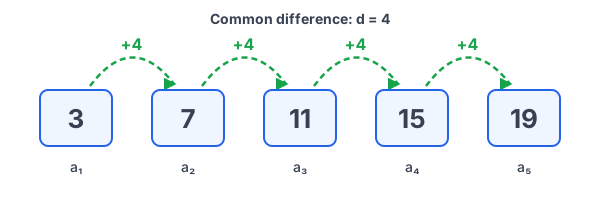
A list like 2, 4, 8, 16 is not arithmetic. It adds 2, then 4, then 8. The difference must be the same every time.
Arithmetic Sequence Formulas
There are two ways to write a rule for an arithmetic sequence.
Explicit Formula
a_n = a_1 + (n - 1)d
Here a_1 is the first term, d is the common difference, and n is the term number. Use it to jump straight to any term. To get to the nth term, you add d a total of n - 1 times.
Recursive Formula
a_1 = \text{first term}, \quad a_n = a_{n-1} + dThe term a_{n-1} means “the term before.” A recursive formula says how to get the next term from the one before. It must also give the first term.
How to Write the Explicit Formula
- Find the first term, a_1.
- Find d. Subtract each term from the next one. Check that the answer is the same every time.
- Put a_1 and d into a_n = a_1 + (n - 1)d.
- Distribute and combine like terms to simplify.
- Check your formula with n = 1 and n = 2.
Worked Examples
Example 1: Is It Arithmetic?
Decide if each sequence is arithmetic. If it is, find the common difference.
a) 5, 9, 13, 17, …
b) 20, 14, 8, 2, …
c) 2, 4, 8, 16, …
9 - 5 = 4, \quad 13 - 9 = 4, \quad 17 - 13 = 4
Step 1. For a), subtract each term from the next one.
Step 2. The differences are all 4. So a) is arithmetic, with d = 4.
14 - 20 = -6, \quad 8 - 14 = -6, \quad 2 - 8 = -6
Step 3. For b), subtract each term from the next one.
Step 4. The differences are all -6. So b) is arithmetic, with d = -6. The terms go down, so d is negative.
4 - 2 = 2, \quad 8 - 4 = 4
Step 5. For c), subtract each term from the next one.
Step 6. The differences are not the same, so c) is not arithmetic.
Answer: a) Yes, d = 4. b) Yes, d = -6. c) No.
Example 2: Write the Formula and Find a Term
Write an explicit formula for 7, 10, 13, 16, … Then find the 25th term.
Step 1. Find the first term and the common difference: a_1 = 7 and d = 10 - 7 = 3.
a_n = 7 + (n - 1)(3)
Step 2. Put them in the formula.
a_n = 7 + 3n - 3
Step 3. Use the distributive property.
a_n = 3n + 4
Step 4. Combine the numbers (see combining like terms).
Step 5. Check. a_1 = 3(1) + 4 = 7 and a_2 = 3(2) + 4 = 10. Both match.
a_{25} = 3(25) + 4 = 75 + 4 = 79Step 6. Substitute n = 25.
Answer: a_n = 3n + 4, and a_{25} = 79.
Example 3: Find the Term Number
The sequence 40, 33, 26, 19, … keeps going. Which term is −23?
a_n = 40 + (n - 1)(-7)
Step 1. Find a_1 = 40 and d = 33 - 40 = -7. Put them in the formula.
a_n = 40 - 7n + 7
Step 2. Distribute the −7. A negative times a negative is positive.
a_n = 47 - 7n
Step 3. Combine the numbers.
47 - 7n = -23
Step 4. Set the formula equal to −23. Solve it like the equations in two-step equations.
-7n = -70
Step 5. Subtract 47 from both sides.
n = 10
Step 6. Divide both sides by −7.
Answer: −23 is the 10th term.
Check: 47 - 7(10) = 47 - 70 = -23. If n had come out as a fraction or a negative, the number would not be in the sequence.
Example 4: Given Two Terms
In an arithmetic sequence, a_4 = 17 and a_9 = 42. Write the explicit formula.
9 - 4 = 5
Step 1. Count the steps from the 4th term to the 9th term.
42 - 17 = 25
Step 2. Find how much the terms went up.
d = \tfrac{25}{5} = 5Step 3. Divide to find the common difference.
a_1 = 17 - 3(5) = 17 - 15 = 2
Step 4. Go back 3 steps from a_4 to reach a_1.
a_n = 2 + (n - 1)(5)
Step 5. Put them in the formula.
a_n = 2 + 5n - 5
Step 6. Distribute the 5.
a_n = 5n - 3
Step 7. Combine the numbers.
Answer: a_n = 5n - 3.
Check: a_4 = 5(4) - 3 = 20 - 3 = 17 and a_9 = 5(9) - 3 = 45 - 3 = 42.
Example 5: Word Problem
A theater has 18 seats in the first row. Each row has 2 more seats than the row in front of it. Write a recursive formula and an explicit formula. How many seats are in row 20?
a_1 = 18, \quad a_n = a_{n-1} + 2Step 1. The first term is 18 and d = 2. Write the recursive formula.
a_n = 18 + (n - 1)(2)
Step 2. For the explicit formula, put the first term and d in the formula.
a_n = 18 + 2n - 2
Step 3. Distribute the 2.
a_n = 2n + 16
Step 4. Combine the numbers.
a_{20} = 2(20) + 16 = 40 + 16 = 56Step 5. Substitute n = 20.
Answer: Row 20 has 56 seats. The recursive formula would make you find all 19 rows before it. The explicit formula gets there in one step.
Common Mistakes
| Mistake | Example of the error | Fix |
|---|---|---|
| Using n instead of n - 1 | a_{25} = 7 + 25(3) = 82 | a_{25} = 7 + 24(3) = 79 |
| Subtracting in the wrong order | 40, 33, …: 40 - 33 = 7, so d = 7 | Later term minus earlier term: d = 33 - 40 = -7 |
| Checking only one pair | 2, 4, 8, 16: 4 - 2 = 2, so it is arithmetic | Check every pair: 8 - 4 = 4, so it is not |
| Distributing wrong | 7 + (n - 1)3 = 3n + 6 | 7 + 3n - 3 = 3n + 4 |
| Leaving out the first term in a recursive formula | a_n = a_{n-1} + 3 only | Also give a_1 = 7 |
Arithmetic Sequences and Linear Functions
An arithmetic sequence is a linear function whose inputs are the term numbers 1, 2, 3, … Plot the points (n, a_n). They line up on a straight line.
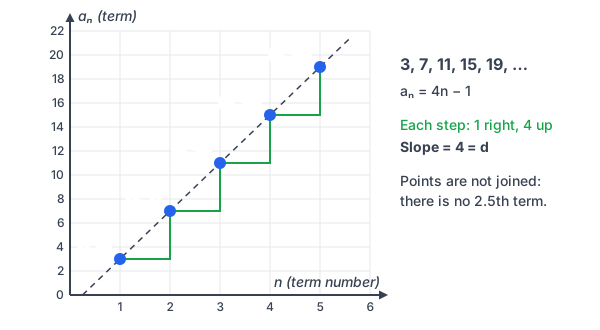
The slope of that line is the common difference d. That is because each step of 1 in n adds d to the term. So d is also the rate of change.
| Arithmetic sequence | Linear function | |
|---|---|---|
| Rule | a_n = 4n - 1 | f(x) = 4x - 1 |
| Inputs | n = 1, 2, 3, \ldots | Any real number |
| Graph | Separate points | A solid line |
| Constant change | Common difference d = 4 | Slope m = 4 |
The points are not joined, because there is no 2.5th term. The domain is the whole numbers 1, 2, 3, … You can write the sequence with function notation as f(n) = 4n - 1. Sequences that multiply by the same number each time are geometric sequences, in Unit 6.
Practice Problems
- Find the common difference and the next two terms: 11, 17, 23, 29, …
- Find the common difference and the next term: \tfrac{1}{2}, \tfrac{5}{4}, 2, \tfrac{11}{4}, \ldots
- Is 1, 4, 9, 16, … arithmetic? Explain.
- Write an explicit formula for 2, 9, 16, 23, … Then find the 30th term.
- Find the 12th term of 15, 11, 7, 3, …
- Which term of 6, 11, 16, 21, … is 101?
- In an arithmetic sequence, a_3 = 10 and a_8 = 30. Write the explicit formula.
- Write a recursive formula for 9, 5, 1, −3, …
- A sequence has a_1 = -2 and a_n = a_{n-1} + 6. List the first four terms and write the explicit formula.
- Maya saves $45 the first week. Then she adds $15 each week. How much has she saved after week 12? After which week will she have $300?
Show answers
1.
17 - 11 = 6
Subtract one term from the next.
29 + 6 = 35
Add 6 to the last term.
35 + 6 = 41
Add 6 again.
d = 6. The next two terms are 35 and 41.
2.
d = \tfrac{5}{4} - \tfrac{1}{2} = \tfrac{5}{4} - \tfrac{2}{4} = \tfrac{3}{4}Subtract the first two terms with a common denominator (see adding and subtracting fractions)
\tfrac{11}{4} + \tfrac{3}{4} = \tfrac{14}{4} = \tfrac{7}{2}Add d to the last term.
The next term is \tfrac{7}{2}.
3.
4 - 1 = 3, \quad 9 - 4 = 5, \quad 16 - 9 = 7
Find the differences.
The differences are not the same
No, it is not arithmetic.
4.
a_1 = 2, \quad d = 7
Find the first term and d.
a_n = 2 + (n - 1)(7)
Put them in the formula.
a_n = 2 + 7n - 7 = 7n - 5
Distribute and combine.
a_{30} = 7(30) - 5 = 210 - 5 = 205Substitute n = 30.
5.
a_1 = 15, \quad d = 11 - 15 = -4
Find the first term and d.
a_n = 15 + (n - 1)(-4)
Put them in the formula.
a_n = 15 - 4n + 4 = 19 - 4n
Distribute and combine.
a_{12} = 19 - 4(12) = 19 - 48 = -29Substitute n = 12.
6.
a_1 = 6, \quad d = 5
Find the first term and d.
a_n = 6 + (n - 1)(5) = 5n + 1
Write the formula.
5n + 1 = 101
Set it equal to 101.
5n = 100
Subtract 1 from both sides.
n = 20
Divide both sides by 5.
101 is the 20th term.
7.
d = \tfrac{30 - 10}{8 - 3} = \tfrac{20}{5} = 4Find d. Divide the change in terms by the number of steps.
a_1 = 10 - 2(4) = 10 - 8 = 2
Go back 2 steps from the 3rd term.
a_n = 2 + (n - 1)(4) = 2 + 4n - 4 = 4n - 2
Write the formula and simplify.
8.
d = 5 - 9 = -4
Find d.
a_1 = 9, \quad a_n = a_{n-1} - 4Write the first term and the rule.
9.
-2, \quad -2 + 6 = 4, \quad 4 + 6 = 10, \quad 10 + 6 = 16
Add 6 each time.
a_n = -2 + (n - 1)(6) = -2 + 6n - 6 = 6n - 8
Write the explicit formula.
10.
a_n = 45 + (n - 1)(15) = 45 + 15n - 15 = 15n + 30
Write the formula.
a_{12} = 15(12) + 30 = 180 + 30 = 210Substitute n = 12.
15n + 30 = 300
Set the formula equal to 300.
15n = 270
Subtract 30 from both sides.
n = 18
Divide both sides by 15.
She has $210 after week 12, and $300 after week 18.
Want more practice? The Algebra 1 Unit 4 Practice Pack (Part 2) has 38 pages of problems on this and the other lessons in the unit, with step-by-step answers and a cheat sheet.
FAQ
What is the formula for an arithmetic sequence?
The explicit formula is a_n = a_1 + (n - 1)d. Here a_1 is the first term, d is the common difference, and n is the term number.
How do you find the common difference?
Subtract any term from the term right after it. Check a few pairs to make sure the difference is always the same.
What is the difference between explicit and recursive formulas?
An explicit formula finds any term from its term number, like a_n = 3n + 4. A recursive formula finds each term from the one before, like a_n = a_{n-1} + 3 with a_1 = 7.
Is an arithmetic sequence a linear function?
Yes. Its graph is a set of points on a line, and the common difference is the slope. The only difference is that the inputs are the term numbers 1, 2, 3, …
Summary
- An arithmetic sequence adds the same number, the common difference d, each time.
- Find d by subtracting a term from the next term. It can be negative or a fraction.
- Explicit formula: a_n = a_1 + (n - 1)d.
- Recursive formula: give a_1, then a_n = a_{n-1} + d.
- An arithmetic sequence is a linear function. Its slope is d.
Previous lesson: Average Rate of Change
Next lesson: Systems of Equations
Back to the Algebra 1 Index