
Geometric Sequences
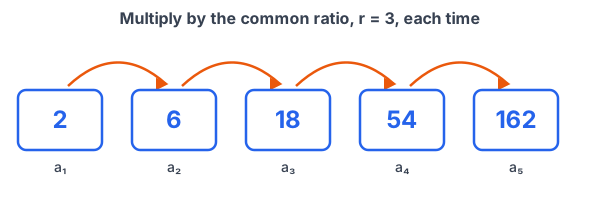
A geometric sequence is a list of numbers where you multiply by the same number each time to get the next term. That number is the common ratio, r. For example, 2, 6, 18, 54, … multiplies by 3. The formula a_n = a_1 \cdot r^{n-1} finds any term.
Before this lesson: You should know arithmetic sequences, exponential functions, and zero and negative exponents.
Extra practice: The Algebra 1 Unit 6 Practice Pack has printable problems, answer keys and a cheat sheet for this unit.
What Is a Geometric Sequence?
A rumor starts with 2 people. Each person tells 3 new people the next day. So 2 people know on day 1, then 6, then 18, then 54. Each day’s number is 3 times the day before.
That is a geometric sequence. An arithmetic sequence adds the same number each time. A geometric sequence multiplies by the same number each time.
To find the common ratio, divide any term by the term right before it. Check that you get the same answer for every pair.
Geometric Sequence Formulas
Explicit Formula
a_n = a_1 \cdot r^{\,n-1}Here a_1 is the first term, r is the common ratio, and n is the term number. To reach the nth term, you multiply by r a total of n - 1 times. That is why the exponent is n - 1, not n.
Recursive Formula
a_1 = \text{first term}, \quad a_n = a_{n-1} \cdot rThis says each term is the term before it times r. Like any recursive formula, it must also give the first term.
How to Write the Explicit Formula
- Find the first term, a_1.
- Find r. Divide each term by the term before it. Check that the answer is the same every time.
- Put a_1 and r into a_n = a_1 \cdot r^{n-1}.
- Do not multiply a_1 and r together. The exponent goes on r only.
- Check your formula with n = 1 and n = 2.
Worked Examples
Example 1: Is It Geometric?
Decide if each sequence is geometric. If it is, find the common ratio.
- a) 3, 6, 12, 24, …
- b) 2, 5, 8, 11, …
- c) 81, −27, 9, −3, …
- d) 1, 4, 9, 16, …
\frac{6}{3} = 2, \quad \frac{12}{6} = 2, \quad \frac{24}{12} = 2Step 1. a) Divide each term by the term before it.
Step 2. The ratios match, so it is geometric with r = 2.
\frac{5}{2} = 2.5, \quad \frac{8}{5} = 1.6Step 3. b) Divide each term by the term before it.
Step 4. The ratios don’t match, so it is not geometric. It adds 3 each time, so it is arithmetic (see arithmetic sequences).
\frac{-27}{81} = -\tfrac{1}{3}, \quad \frac{9}{-27} = -\tfrac{1}{3}, \quad \frac{-3}{9} = -\tfrac{1}{3}Step 5. c) Divide each term by the term before it. A negative divided by a positive is negative (see multiplying and dividing integers).
Step 6. The ratios match, so r = -\tfrac{1}{3}. A negative ratio makes the signs switch back and forth.
\frac{4}{1} = 4, \quad \frac{9}{4} = 2.25Step 7. d) Divide each term by the term before it.
Step 8. The ratios don’t match, so it is not geometric. These are the square numbers.
Answer: a) geometric, r = 2; b) not geometric; c) geometric, r = -\tfrac{1}{3}; d) not geometric
Example 2: Write the Formula and Find a Term
Write an explicit formula for 5, 15, 45, … Then find the 8th term.
r = \frac{15}{5} = 3Step 1. The first term is a_1 = 5. Divide to find the ratio.
a_n = 5 \cdot 3^{n-1}Step 2. Substitute into a_n = a_1 \cdot r^{n-1}.
Step 3. Check the first term: a_1 = 5 \cdot 3^0 = 5 \cdot 1 = 5. Check the second: a_2 = 5 \cdot 3^1 = 15.
a_8 = 5 \cdot 3^7
Step 4. For the 8th term, substitute n = 8. The exponent is 8 - 1 = 7.
a_8 = 5 \cdot 2187
Step 5. Find 3^7 = 2187 (see exponents).
5 \cdot 2187 = 10{,}935Step 6. Multiply.
Answer: a_n = 5 \cdot 3^{n-1}, and a_8 = 10{,}935.
Example 3: A Ratio That Is a Fraction
Write a recursive formula and an explicit formula for 64, 32, 16, 8, … Then find the 7th term.
r = \frac{32}{64} = \tfrac{1}{2}Step 1. Divide to find the ratio.
Step 2. The terms get smaller, because the ratio is between 0 and 1.
a_1 = 64, \quad a_n = a_{n-1} \cdot \tfrac{1}{2}Step 3. Write the recursive formula: the first term, then the rule for each next term.
a_n = 64\left(\tfrac{1}{2}\right)^{n-1}Step 4. Write the explicit formula.
a_7 = 64\left(\tfrac{1}{2}\right)^6Step 5. For the 7th term, substitute n = 7. The exponent is 6.
a_7 = 64 \cdot \tfrac{1}{64}Step 6. Find the power: \left(\tfrac{1}{2}\right)^6 = \tfrac{1}{64}.
64 \cdot \tfrac{1}{64} = 1Step 7. Multiply (see multiplying and dividing fractions).
Answer: a_7 = 1
Example 4: Find the Term Number
The sequence 2, 6, 18, … keeps going. Which term is 1,458?
a_n = 2 \cdot 3^{n-1}Step 1. Find the first term and the ratio: a_1 = 2 and r = \frac{6}{2} = 3.
2 \cdot 3^{n-1} = 1458Step 2. Set the formula equal to 1,458.
3^{n-1} = 729Step 3. Divide both sides by 2.
3^6 = 729
Step 4. Find the power of 3 that makes 729. Multiply 3s until you reach it: 3, 9, 27, 81, 243, 729.
n - 1 = 6
Step 5. The exponents must match.
n = 7
Step 6. Add 1 to both sides.
Answer: 1,458 is the 7th term.
Check: 2 \cdot 3^6 = 2 \cdot 729 = 1458.
Example 5: Word Problem
A ball is dropped from 81 feet. Each bounce reaches 2/3 of the height of the bounce before. The first bounce goes up 54 feet. How high is the 4th bounce?
81 \cdot \tfrac{2}{3} = 54Step 1. The bounce heights form a geometric sequence with a_1 = 54 and r = \tfrac{2}{3}. Check the first bounce.
a_n = 54\left(\tfrac{2}{3}\right)^{n-1}Step 2. Write the explicit formula.
a_4 = 54\left(\tfrac{2}{3}\right)^3Step 3. For the 4th bounce, substitute n = 4. The exponent is 3.
a_4 = 54 \cdot \tfrac{8}{27}Step 4. Find the power: \left(\tfrac{2}{3}\right)^3 = \tfrac{8}{27}.
54 \cdot \tfrac{8}{27} = 16Step 5. Multiply: \frac{54}{27} = 2, and 2 \cdot 8 = 16.
Answer: The 4th bounce is 16 feet high. The bounces are 54, 36, 24 and 16 feet.
Common Mistakes
| Mistake | Example of the error | Fix |
|---|---|---|
| Using n instead of n - 1 | a_8 = 5 \cdot 3^8 | a_8 = 5 \cdot 3^7 |
| Multiplying a_1 and r first | 5 \cdot 3^{n-1} = 15^{n-1} | The exponent is on 3 only. Do the power first |
| Subtracting instead of dividing | 3, 6, 12: 6 - 3 = 3, so r = 3 | Divide: \frac{6}{3} = 2, so r = 2 |
| Dividing in the wrong order | 64, 32: \frac{64}{32} = 2 | \frac{\text{later term}}{\text{earlier term}}: \frac{32}{64} = \tfrac{1}{2} |
| Losing the negative sign | 81, −27: r = \tfrac{1}{3} | \frac{-27}{81} = -\tfrac{1}{3}. The signs alternate |
Geometric Sequences and Exponential Functions
A geometric sequence is an exponential function whose inputs are the term numbers 1, 2, 3, … For example, a_n = 2 \cdot 3^{n-1} gives the same outputs as f(n) = 2 \cdot 3^{n-1} for whole numbers. The graph is a set of separate points on an exponential curve.
| Arithmetic sequence | Geometric sequence | |
|---|---|---|
| Next term | Add d | Multiply by r |
| Example | 3, 7, 11, 15, … | 3, 6, 12, 24, … |
| Explicit formula | a_n = a_1 + (n - 1)d | a_n = a_1 \cdot r^{n-1} |
| Recursive formula | a_n = a_{n-1} + d | a_n = a_{n-1} \cdot r |
| Same kind of function as | Linear | Exponential |
Many growth and decay problems are geometric sequences. A balance that earns compound interest once a year makes a geometric sequence with r = 1 + \text{rate}. Adding up the terms of a sequence is a series, which comes in Algebra 2.
Practice Problems
- Is 4, 12, 36, 108, … geometric? If so, find r.
- Is 10, 5, 5/2, 5/4, … geometric? If so, find r.
- Find the next two terms of 2, −8, 32, …
- Write an explicit formula for 7, 14, 28, 56, …
- Find a_6 for a_n = 3 \cdot 2^{n-1}.
- Write a recursive formula for 100, 20, 4, …
- A geometric sequence has a_1 = 4 and r = -3. Find a_5.
- A geometric sequence has a_2 = 12 and a_5 = 96. Find r and a_1.
- Which term of 3, 6, 12, … is 384?
- A tournament starts with 64 teams. Half the teams are knocked out in each round. Write a formula for the number of teams in round n. How many teams play in round 6?
Show answers
1.
\frac{12}{4} = 3, \quad \frac{36}{12} = 3, \quad \frac{108}{36} = 3Divide each term by the one before it.
r = 3
The ratios match. Yes.
2.
5 \div 10 = \tfrac{1}{2}, \quad \tfrac{5}{2} \div 5 = \tfrac{1}{2}, \quad \tfrac{5}{4} \div \tfrac{5}{2} = \tfrac{1}{2}Divide each term by the one before it.
r = \tfrac{1}{2}The ratios match. Yes.
3.
r = \frac{-8}{2} = -4Find the ratio.
32(-4) = -128
Multiply the last term by the ratio.
-128(-4) = 512
Multiply again.
The next two terms are −128 and 512.
4.
a_1 = 7, \quad r = \frac{14}{7} = 2Find the first term and the ratio.
a_n = 7 \cdot 2^{n-1}Substitute into the formula.
5.
a_6 = 3 \cdot 2^5
Substitute n = 6. The exponent is 5.
a_6 = 3 \cdot 32
Find 2^5 = 32.
3 \cdot 32 = 96
Multiply.
6.
r = \frac{20}{100} = \tfrac{1}{5}Find the ratio.
a_1 = 100, \quad a_n = a_{n-1} \cdot \tfrac{1}{5}Write the first term and the rule.
7.
a_5 = 4(-3)^4
Substitute n = 5. The exponent is 4.
(-3)^4 = 81
An even power of a negative is positive.
4 \cdot 81 = 324
Multiply.
8.
12 \cdot r^3 = 96
From the 2nd term to the 5th term is 3 steps, so multiply by r three times.
r^3 = 8
Divide both sides by 12.
r = 2
Find the number that cubes to 8.
a_1 = \frac{12}{2} = 6Go back one step from the 2nd term to find the 1st.
9.
a_n = 3 \cdot 2^{n-1}The formula is.
3 \cdot 2^{n-1} = 384Set it equal to 384.
2^{n-1} = 128Divide both sides by 3.
2^{n-1} = 2^7Write 128 as a power of 2.
n - 1 = 7
The exponents match.
n = 8
Add 1 to both sides.
384 is the 8th term.
10.
a_n = 64\left(\tfrac{1}{2}\right)^{n-1}Start with 64 teams and keep half each round.
a_6 = 64\left(\tfrac{1}{2}\right)^5Substitute n = 6. The exponent is 5.
\left(\tfrac{1}{2}\right)^5 = \tfrac{1}{32}Find the power.
64 \cdot \tfrac{1}{32} = 2Multiply.
2 teams play in round 6 (the final).
Want more practice? The Algebra 1 Unit 6 Practice Pack has 49 pages of problems on this and the other lessons in the unit, with step-by-step answers and a cheat sheet.
FAQ
What is the difference between an arithmetic and a geometric sequence?
An arithmetic sequence adds the same number each time. A geometric sequence multiplies by the same number each time. Check the differences for arithmetic and the ratios for geometric.
How do you find the common ratio?
Divide any term by the term right before it. For 5, 15, 45, … the ratio is \frac{15}{5} = 3. Check at least two pairs.
Can the common ratio be negative or a fraction?
Yes. A negative ratio makes the signs switch, as in 81, −27, 9, −3. A ratio between 0 and 1 makes the terms shrink, as in 64, 32, 16. The ratio can’t be 0.
Is a geometric sequence an exponential function?
Yes. The formula a_n = a_1 \cdot r^{n-1} has the variable in the exponent. The only difference is that the inputs are the whole numbers 1, 2, 3, …
Summary
- A geometric sequence multiplies by the same number, the common ratio r, each time.
- Find r by dividing a term by the term before it.
- Explicit formula: a_n = a_1 \cdot r^{n-1}. Recursive formula: a_n = a_{n-1} \cdot r, with a_1 given.
- The exponent is n - 1, and it goes on r only.
- A geometric sequence is an exponential function with inputs 1, 2, 3, …
Previous lesson: Compound Interest
Next lesson: Linear vs. Exponential Functions
Back to the Algebra 1 Index