
Compound Interest
Compound interest is interest earned on both the money you put in and the interest it has already earned. The formula is A = P\left(1 + \dfrac{r}{n}\right)^{nt}, where P is the starting amount, r is the yearly rate as a decimal, n is how many times a year interest is added, and t is the number of years.
Before this lesson: You should know simple interest, exponential growth and decay, and the exponent rules.
Extra practice: The Algebra 1 Unit 6 Practice Pack has printable problems, answer keys and a cheat sheet for this unit.
Interest on Interest
Put $1,000 in a savings account that pays 10% a year. After one year, you earn $100, so you have $1,100.
With simple interest, you earn $100 every year, because the interest is always 10% of the first $1,000. With compound interest, the second year pays 10% of $1,100, which is $110. Your interest starts earning interest too.
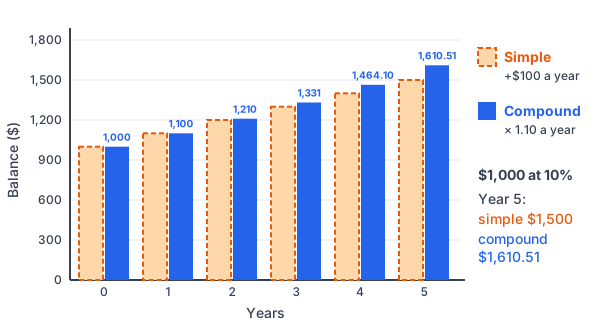
After 5 years, simple interest gives $1,500. Compound interest gives $1,610.51. The longer you wait, the bigger the gap.
Compound Interest Formula
A = P\left(1 + \dfrac{r}{n}\right)^{nt}| Symbol | Meaning |
|---|---|
| A | Amount at the end (starting money plus interest) |
| P | Principal: the starting amount |
| r | Yearly interest rate, as a decimal (6% is 0.06) |
| n | Number of times per year interest is added |
| t | Number of years |
Interest is “added” or compounded at the end of each period. The interest earned is A - P.
| Compounded | n | Rate each period |
|---|---|---|
| Annually (yearly) | 1 | r |
| Semiannually (twice a year) | 2 | \frac{r}{2} |
| Quarterly | 4 | \frac{r}{4} |
| Monthly | 12 | \frac{r}{12} |
| Daily | 365 | \frac{r}{365} |
How to Use the Formula
- Write down P, r, n and t. Change the percent to a decimal.
- Find the rate per period, \tfrac{r}{n}, and add 1.
- Find the number of periods, nt.
- Raise the factor to that power. Then multiply by P.
- Round money to the nearest cent at the end, not in the middle.
When interest is added once a year (n = 1), the formula becomes A = P(1 + r)^t. That is the growth formula from the last lesson.
Worked Examples
Example 1: Compounded Annually
You put $2,000 in an account that pays 5% interest, compounded annually. How much is in the account after 3 years? How much interest did you earn?
P = 2000, \quad r = 0.05, \quad n = 1, \quad t = 3
Step 1. List the values. 5% as a decimal is 0.05 (see percentages). Annually means once a year, so n = 1.
A = 2000\left(1 + \tfrac{0.05}{1}\right)^{1 \cdot 3}Step 2. Substitute into A = P\left(1 + \frac{r}{n}\right)^{nt}.
A = 2000(1.05)^3
Step 3. Simplify inside the parentheses and the exponent.
1.05 \cdot 1.05 = 1.1025
Step 4. Work out the power one step at a time. First square 1.05 (see operations with decimals).
1.1025 \cdot 1.05 = 1.157625
Step 5. Multiply by 1.05 again.
A = 2000 \cdot 1.157625 = 2315.25
Step 6. Multiply by 2,000.
2315.25 - 2000 = 315.25
Step 7. Subtract the deposit to find the interest.
Answer: $2,315.25 in the account, with $315.25 in interest.
Example 2: Compounded Semiannually
You invest $1,000 at 10% interest, compounded semiannually. How much do you have after 2 years?
P = 1000, \quad r = 0.10, \quad n = 2, \quad t = 2
Step 1. List the values. Semiannually means twice a year, so n = 2.
\frac{0.10}{2} = 0.05Step 2. Find the rate per period.
nt = 2 \cdot 2 = 4
Step 3. Find the number of periods.
A = 1000(1.05)^4
Step 4. Substitute into the formula.
1.05^4 = 1.1025 \cdot 1.1025 = 1.21550625
Step 5. Square 1.05 first: 1.05^2 = 1.1025. Then square that result.
A = 1000 \cdot 1.21550625 = 1215.50625
Step 6. Multiply by 1,000.
A \approx 1215.51
Step 7. Round to the nearest cent.
Answer: $1,215.51. Compounded once a year, the same deposit would give $1,210, so adding interest more often earns $5.51 more.
Check: Once a year: 1000(1.1)^2 = 1000 \cdot 1.21 = 1210, and 1215.51 - 1210 = 5.51.
Example 3: Compounded Quarterly
Find the balance after 1 year if $5,000 earns 8% interest, compounded quarterly.
\frac{0.08}{4} = 0.02Step 1. Quarterly means 4 times a year, so n = 4. Find the rate per period.
4 \cdot 1 = 4
Step 2. Find the number of periods.
A = 5000(1.02)^4
Step 3. Substitute into the formula.
1.02 \cdot 1.02 = 1.0404
Step 4. Square 1.02.
1.0404 \cdot 1.0404 = 1.08243216
Step 5. Square that result to get the 4th power.
A = 5000 \cdot 1.08243216 = 5412.1608
Step 6. Multiply by 5,000.
A \approx 5412.16
Step 7. Round to the nearest cent.
Answer: $5,412.16
Example 4: Simple vs. Compound Interest
Compare $1,000 at 10% for 3 years with simple interest and with interest compounded annually.
I = 1000 \cdot 0.10 \cdot 3 = 300
Step 1. Simple interest uses I = Prt (see simple interest).
1000 + 300 = 1300
Step 2. Add the interest to the deposit.
A = 1000(1.1)^3
Step 3. For compound interest, substitute into the formula with n = 1.
1.1 \cdot 1.1 \cdot 1.1 = 1.331
Step 4. Work out the power.
1000 \cdot 1.331 = 1331
Step 5. Multiply by 1,000.
1331 - 1300 = 31
Step 6. Subtract to compare.
Answer: Compound interest gives $1,331, which is $31 more than the $1,300 from simple interest.
Example 5: Word Problem
Maya has $10,000 to save for one year. Bank A pays 6% compounded annually. Bank B pays 6% compounded semiannually. Which bank gives more, and by how much?
A = 10{,}000(1.06)^1 = 10{,}600Step 1. Bank A: one period at 6%.
\frac{0.06}{2} = 0.03Step 2. Bank B: find the rate per period. There are 2 periods.
A = 10{,}000(1.03)^2Step 3. Substitute.
1.03 \cdot 1.03 = 1.0609
Step 4. Work out the power.
10{,}000 \cdot 1.0609 = 10{,}609Step 5. Multiply by 10,000.
10{,}609 - 10{,}600 = 9Step 6. Subtract to compare.
Answer: Bank B gives $9 more, because its interest is added twice and starts earning sooner.
Common Mistakes
| Mistake | Example of the error | Fix |
|---|---|---|
| Using the percent, not the decimal | 1000(1 + 5)^3 | 5% is 0.05: 1000(1.05)^3 |
| Forgetting to divide r by n | Quarterly at 8%: (1.08)^4 | Divide first: (1.02)^4 |
| Using t instead of nt | Semiannual for 2 years: (1.05)^2 | There are 2 \cdot 2 = 4 periods: (1.05)^4 |
| Multiplying before the exponent | 2000(1.05)^3 = 2100^3 | Do the power first, then multiply by P |
| Rounding too early | Rounding 1.1025 to 1.10, then squaring | Keep all the digits. Round to cents only at the end |
| Giving A when the question asks for interest | Interest = $2,315.25 | Interest is A - P = 315.25 |
Compounding More Often
Here is $1,000 at 12% for 1 year, compounded different ways. More periods give a little more money, because interest starts earning sooner.
| Compounded | n | Formula | Balance |
|---|---|---|---|
| Annually | 1 | 1000(1.12)^1 | $1,120.00 |
| Semiannually | 2 | 1000(1 + 0.12/2)^{2} | $1,123.60 |
| Quarterly | 4 | 1000(1 + 0.12/4)^{4} | $1,125.51 |
Loans and credit cards use the same formula. When you owe money, compound interest makes the debt grow faster, so paying early saves money.
Practice Problems
- $3,000 is invested at 4% interest, compounded quarterly, for 5 years. Give P, r, n and t, and write the formula with the numbers in it.
- $500 earns 6% interest, compounded annually. Find the balance after 2 years.
- How much interest was earned in problem 2?
- $1,000 earns 4% interest, compounded semiannually. Find the balance after 1 year.
- $800 earns 12% interest, compounded quarterly. Find the balance after 1 year. Round to the nearest cent.
- $4,000 earns 5% interest, compounded annually. Find the balance after 2 years.
- $2,000 is saved for 2 years at 10%. How much more does compound interest (annually) give than simple interest?
- What is n for interest compounded monthly? For daily?
- $7,500 is invested at 3.6% interest, compounded monthly, for 10 years. Write the formula with the numbers in it. Do not solve.
- A credit card balance of $1,000 has 24% yearly interest, compounded monthly. No payments are made. What is the balance after 2 months?
Show answers
1.
P = 3000, \quad r = 0.04, \quad n = 4, \quad t = 5
List the values. Quarterly means n = 4.
A = 3000\left(1 + \tfrac{0.04}{4}\right)^{4 \cdot 5}Substitute into the formula.
Simplify: \frac{0.04}{4} = 0.01 and 4 · 5 = 20: A = 3000(1.01)^{20}
2.
A = 500(1.06)^2
Substitute with n = 1 and t = 2.
1.06 \cdot 1.06 = 1.1236
Work out the power.
500 \cdot 1.1236 = 561.80
Multiply.
The balance is $561.80.
3.
561.80 - 500 = 61.80
Subtract the deposit from the balance.
The interest is $61.80.
4.
\frac{0.04}{2} = 0.02Find the rate per period.
A = 1000(1.02)^2
There are 2 · 1 = 2 periods. Substitute.
1.02 \cdot 1.02 = 1.0404
Work out the power.
1000 \cdot 1.0404 = 1040.40
Multiply.
The balance is $1,040.40.
5.
\frac{0.12}{4} = 0.03Find the rate per period.
A = 800(1.03)^4
There are 4 · 1 = 4 periods. Substitute.
1.03 \cdot 1.03 = 1.0609
Square 1.03.
1.0609 \cdot 1.0609 = 1.12550881
Square that result.
800 \cdot 1.12550881 = 900.407048
Multiply.
A \approx 900.41
Round to the nearest cent.
The balance is $900.41.
6.
A = 4000(1.05)^2
Substitute with n = 1 and t = 2.
1.05 \cdot 1.05 = 1.1025
Work out the power.
4000 \cdot 1.1025 = 4410
Multiply.
The balance is $4,410.
7.
I = 2000 \cdot 0.10 \cdot 2 = 400
Find the simple interest: principal times rate times time.
2000 + 400 = 2400
Add the interest to the principal to get the simple-interest total.
1.1 \cdot 1.1 = 1.21
Compound: work out the power.
2000 \cdot 1.21 = 2420
Multiply the principal by the growth factor to get the compound total.
2420 - 2400 = 20
Subtract.
Compound interest gives $20 more.
8.
n = 12
There are 12 months in a year.
n = 365
There are 365 days in a year.
Monthly: n = 12. Daily: n = 365.
9.
P = 7500, \quad r = 0.036, \quad n = 12, \quad t = 10
List the values. Monthly means n = 12.
A = 7500\left(1 + \tfrac{0.036}{12}\right)^{12 \cdot 10}Substitute into the formula.
Simplify: \frac{0.036}{12} = 0.003 and 12 · 10 = 120: A = 7500(1.003)^{120}
Leave it in this form. Don’t solve.
10.
\frac{0.24}{12} = 0.02Find the monthly rate.
A = 1000(1.02)^2
Two months is 2 periods. Substitute.
1.02 \cdot 1.02 = 1.0404
Work out the power.
1000 \cdot 1.0404 = 1040.40
Multiply.
The balance is $1,040.40.
Want more practice? The Algebra 1 Unit 6 Practice Pack has 49 pages of problems on this and the other lessons in the unit, with step-by-step answers and a cheat sheet.
FAQ
What does compounded mean?
It means the interest is added to your balance. After that, the interest earns interest too. Compounded quarterly means this happens 4 times a year.
What is the difference between simple and compound interest?
Simple interest is always figured on the starting amount, so it grows by the same dollar amount each year. Compound interest is figured on the current balance, so it grows faster each year.
Does compounding more often always give more money?
Yes, for the same rate and time. But the gain gets small. Going from yearly to monthly adds a little, and going from monthly to daily adds even less.
Is the compound interest formula an exponential function?
Yes. The factor 1 + \tfrac{r}{n} is the base, and the number of periods is the exponent. The balance grows exponentially over time.
Summary
- Compound interest: A = P\left(1 + \tfrac{r}{n}\right)^{nt}.
- P is the principal, r the yearly rate as a decimal, n the periods per year and t the years.
- Divide the rate by n. Multiply the years by n.
- The interest earned is A - P. Round to the cent only at the end.
- Compound interest grows faster than simple interest, because interest earns interest.
Previous lesson: Exponential Growth and Decay
Next lesson: Geometric Sequences
Back to the Algebra 1 Index