
Exponential Growth and Decay
Exponential growth and decay describe amounts that change by the same percent each time period. For growth, use y = a(1 + r)^t. For decay, use y = a(1 - r)^t. Here a is the starting amount, r is the rate as a decimal, and t is the number of time periods.
Before this lesson: You should know exponential functions, how to work with percentages, and percent change.
Extra practice: The Algebra 1 Unit 6 Practice Pack has printable problems, answer keys and a cheat sheet for this unit.
Growth and Decay by a Percent
Say you have $100 and it grows 10% each year. After one year you have $110. The next year, 10% of $110 is $11, so you have $121. The amount added gets bigger each year.
Growing 10% is the same as multiplying by 1.10. So after t years you have 100(1.10)^t. Multiplying by the same number each year is what makes this exponential.
Decay works the same way. Losing 20% means you keep 80%. So you multiply by 0.80 each year.
Exponential Growth and Decay Formulas
\text{Growth: } y = a(1 + r)^t \qquad \text{Decay: } y = a(1 - r)^t| Symbol | Meaning | Example: 2,000 people, growing 10% per year |
|---|---|---|
| a | Starting amount (when t = 0) | a = 2000 |
| r | Rate of growth or decay, written as a decimal | r = 0.10 |
| 1 + r or 1 - r | Growth or decay factor: the number you multiply by each period | 1 + 0.10 = 1.10 |
| t | Number of time periods | Years |
The growth factor is bigger than 1. The decay factor is between 0 and 1. The rate is the percent change each period.
How to Solve a Growth or Decay Problem
- Find the starting amount, a.
- Change the percent to a decimal to get r. For example, 6% is 0.06.
- Decide if it is growth or decay. Growth: factor is 1 + r. Decay: factor is 1 - r.
- Write y = a(\text{factor})^t. Check that t counts the right time periods.
- Put in the value of t. Do the exponent first, then multiply. Include units.
Worked Examples
Example 1: Growth or Decay?
For each function, say if it is growth or decay and give the rate. (a) y = 500(1.04)^t, (b) y = 80(0.75)^t, (c) y = 12(1.5)^t.
Step 1. (a) The factor is 1.04, which is more than 1. So it is growth.
1.04 = 1 + 0.04
Step 2. Write the factor as 1 plus the rate.
Step 3. Write 0.04 as a percent: 4%. (See percentages.)
Step 4. (b) The factor is 0.75, which is less than 1. So it is decay.
0.75 = 1 - 0.25
Step 5. Write the factor as 1 minus the rate.
Step 6. Write 0.25 as a percent: 25%.
1.5 = 1 + 0.5
Step 7. (c) The factor is 1.5, which is more than 1. So it is growth.
Step 8. Write 0.5 as a percent: 50%.
Answer: (a) growth, 4%; (b) decay, 25%; (c) growth, 50%
Example 2: Population Growth
A town has 2,000 people. Its population grows 10% each year. Write a function for the population after t years. Then find the population after 3 years.
a = 2000, \quad r = 0.10
Step 1. Find a and r. The start is 2,000, and 10% as a decimal is 0.10.
1 + 0.10 = 1.1
Step 2. It is growth, so add the rate to 1 to get the factor.
P(t) = 2000(1.1)^t
Step 3. Write the function in the form y = a(1 + r)^t.
P(3) = 2000(1.1)^3
Step 4. Substitute t = 3 (see function notation).
1.1 \cdot 1.1 = 1.21
Step 5. Find the power one multiplication at a time (see operations with decimals).
1.21 \cdot 1.1 = 1.331
Step 6. Multiply by 1.1 again.
2000 \cdot 1.331 = 2662
Step 7. Multiply by 2,000.
Answer: P(t) = 2000(1.1)^t. After 3 years, the town has 2,662 people.
Example 3: Depreciation of a Car
A car costs $20,000. It loses 20% of its value each year. Write a function for its value. Then find the value after 2 years and after 3 years.
a = 20{,}000, \quad r = 0.20Step 1. Find a and r.
1 - 0.20 = 0.8
Step 2. It is decay, so subtract the rate from 1 to get the factor.
V(t) = 20{,}000(0.8)^tStep 3. Write the function in the form y = a(1 - r)^t.
(0.8)^2 = 0.8 \cdot 0.8 = 0.64
Step 4. For t = 2, find the power.
V(2) = 20{,}000(0.64) = 12{,}800Step 5. Multiply by 20,000.
(0.8)^3 = 0.64 \cdot 0.8 = 0.512
Step 6. For t = 3, multiply the power by 0.8 once more.
V(3) = 20{,}000(0.512) = 10{,}240Step 7. Multiply by 20,000.
Step 8. Look at the graph. The car loses $4,000 the first year but only $3,200 the second year. That is because 20% is taken from a smaller amount each time.
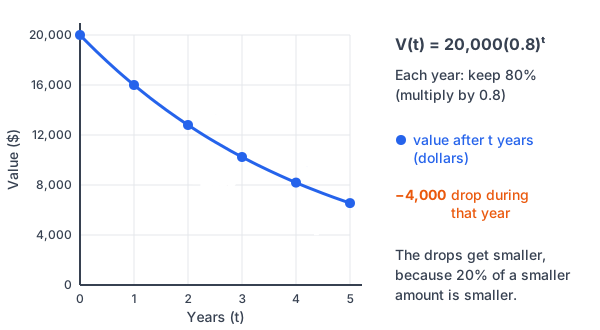
Answer: After 2 years the car is worth $12,800. After 3 years it is worth $10,240.
Example 4: Half-Life
A patient takes 80 mg of a medicine. Every 6 hours, half of it leaves the body. How much is left after 24 hours?
Step 1. Half is left each time, so the factor is \tfrac{1}{2}. The factor applies every 6 hours, so in t hours there are \tfrac{t}{6} half-lives.
A(t) = 80\left(\tfrac{1}{2}\right)^{t/6}Step 2. Write the function (see exponential functions).
\frac{24}{6} = 4Step 3. For t = 24, find the exponent.
A = 80\left(\tfrac{1}{2}\right)^4Step 4. Substitute the exponent.
A = 80 \cdot \tfrac{1}{16}Step 5. Find the power: \left(\tfrac{1}{2}\right)^4 = \tfrac{1}{16}.
80 \cdot \tfrac{1}{16} = 5Step 6. Multiply.
Answer: 5 mg is left after 24 hours.
Example 5: Find the Rate from Data
A mobile game had 1,200 players at the start. One year later it had 900 players. Two years later it had 675. Find the rate of decay, write a function, and predict the number of players after 3 years.
\frac{900}{1200} = 0.75, \quad \frac{675}{900} = 0.75Step 1. Find the factor by dividing each year by the year before.
0.75 = 1 - 0.25
Step 2. The factor is the same both times, so this is exponential decay. Write the factor as 1 minus the rate.
N(t) = 1200(0.75)^t
Step 3. The rate is 0.25, or 25% per year. Write the function.
N(3) = 675 \cdot 0.75 = 506.25
Step 4. For 3 years, multiply the year-2 value by the factor once more.
Step 5. You can’t have part of a player, so round to the nearest whole number: about 506.
Answer: The game loses 25% of its players each year. After 3 years it will have about 506 players.
Common Mistakes
| Mistake | Example of the error | Fix |
|---|---|---|
| Using r as the factor | Growth of 4%: y = 500(0.04)^t | Add 1: y = 500(1.04)^t |
| Adding for decay | Decay of 20%: y = a(1.2)^t | Subtract: y = a(0.8)^t |
| Not changing the percent to a decimal | Growth of 6%: y = a(1 + 6)^t | 6% is 0.06: y = a(1.06)^t |
| Subtracting the same amount each year | 20% of 20,000 is 4,000, so year 2 is 20{,}000 - 8000 = 12{,}000 | Take 20% of the new amount: 20{,}000(0.8)^2 = 12{,}800 |
| Wrong number of periods | Half-life of 6 hours, after 24 hours: 80\left(\tfrac{1}{2}\right)^{24} | Count half-lives: \frac{24}{6} = 4, so 80\left(\tfrac{1}{2}\right)^4 |
Growth Factors and Rates at a Glance
| Situation | Rate | Factor | Equation (start 100) |
|---|---|---|---|
| Grows 5% per year | 5% | 1.05 | y = 100(1.05)^t |
| Doubles each period | 100% | 2 | y = 100(2)^t |
| Shrinks 30% per year | 30% | 0.70 | y = 100(0.7)^t |
| Halves each period | 50% | 0.5 | y = 100(0.5)^t |
Money in a savings account grows the same way. When interest is added more than once a year, use the compound interest formula in the next lesson. A one-time percent increase or decrease is percent change.
Practice Problems
- Is y = 300(1.07)^t growth or decay? What is the rate?
- Is y = 45(0.9)^t growth or decay? What is the rate?
- A city has 1,500 trees. The number grows 6% each year. Write a function for the trees after t years.
- A pond has 60 fish. The number drops 15% each year. Write a function for the fish after t years.
- Find the value of 5000(1.2)^t when t = 2.
- A $900 laptop loses 10% of its value each year. What is it worth after 2 years?
- A sample has 150 bacteria. The number doubles every 3 hours. How many are there after 12 hours?
- A substance has a half-life of 5 days. You start with 64 grams. How much is left after 15 days?
- An account has $250. One year later it has $300. What is the yearly growth rate?
- A town of 8,000 people shrinks 5% each year. What is the population after 2 years?
Show answers
1.
The factor is 1.07, and 1.07 \gt 1, so it is growth
1.07 = 1 + 0.07
Write the factor as 1 plus the rate.
Growth. The rate is 7%.
2.
The factor is 0.9, and 0.9 \lt 1, so it is decay
0.9 = 1 - 0.1
Write the factor as 1 minus the rate.
Decay. The rate is 10%.
3.
The start is 1,500 and the rate is 6% = 0.06
1 + 0.06 = 1.06
It is growth, so the factor is.
T(t) = 1500(1.06)^t
Write the function.
4.
The start is 60 and the rate is 15% = 0.15
1 - 0.15 = 0.85
It is decay, so the factor is.
F(t) = 60(0.85)^t
Write the function.
5.
5000(1.2)^2
Substitute t = 2.
1.2 \cdot 1.2 = 1.44
Find the power.
5000 \cdot 1.44 = 7200
Multiply.
6.
1 - 0.10 = 0.9
It is decay, so the factor is.
900(0.9)^2
Substitute t = 2.
0.9 \cdot 0.9 = 0.81
Find the power.
900 \cdot 0.81 = 729
Multiply.
It is worth $729.
7.
\frac{12}{3} = 4Count the doubling periods.
150 \cdot 2^4
Write the amount.
2^4 = 16
Find the power.
150 \cdot 16 = 2400
Multiply.
There are 2,400 bacteria.
8.
\frac{15}{5} = 3Count the half-lives.
64\left(\tfrac{1}{2}\right)^3Write the amount.
\left(\tfrac{1}{2}\right)^3 = \tfrac{1}{8}Find the power.
64 \cdot \tfrac{1}{8} = 8Multiply.
8 grams are left.
9.
\frac{300}{250} = 1.2Find the factor by dividing.
1.2 = 1 + 0.2
Write the factor as 1 plus the rate.
The rate is 0.2, or 20% per year.
10.
1 - 0.05 = 0.95
It is decay, so the factor is.
8000(0.95)^2
Substitute t = 2.
0.95 \cdot 0.95 = 0.9025
Find the power.
8000 \cdot 0.9025 = 7220
Multiply.
The population is 7,220 people.
Want more practice? The Algebra 1 Unit 6 Practice Pack has 49 pages of problems on this and the other lessons in the unit, with step-by-step answers and a cheat sheet.
FAQ
What is the difference between the growth rate and the growth factor?
The rate is the percent change, like 8%. The factor is what you multiply by, which is 1 + r. A rate of 8% gives a factor of 1.08.
How can you tell growth from decay in an equation?
Look at the number being raised to the power. If it is more than 1, it is growth. If it is between 0 and 1, it is decay.
What is half-life?
Half-life is the time it takes for half of an amount to be gone. After each half-life, multiply by \tfrac{1}{2}. So the exponent is the time divided by the half-life.
Why does exponential decay never reach zero?
Each period, you keep a fraction of what is left. A fraction of a positive amount is still positive. The amount gets very small but never reaches 0.
Summary
- Growth: y = a(1 + r)^t. Decay: y = a(1 - r)^t.
- a is the starting amount, r is the rate as a decimal, and t is the number of periods.
- The growth factor is more than 1. The decay factor is between 0 and 1.
- For doubling or half-life, divide the time by the length of one period to get the exponent.
- Each period takes the percent of the new amount, not the starting amount.
Previous lesson: Exponential Functions
Next lesson: Compound Interest
Back to the Algebra 1 Index