
Polynomials
A polynomial is an expression made of one or more terms added or subtracted. Each term is a number times variables with whole-number exponents, like 4x^3 - 2x + 7. Polynomials are named by their number of terms and their degree, which is the highest exponent.
Before this lesson: You should know algebraic expressions, combining like terms, and exponent rules.
Extra practice: The Algebra 1 Unit 7 Practice Pack (Part 1) has printable problems, answer keys and a cheat sheet for this unit.
What Is a Polynomial?
Think of polynomials as things built from small blocks. Each block is a monomial: a number, a variable, or a number times variables with whole-number exponents. Examples are 7, x, -3x^2 and 4ab^3.
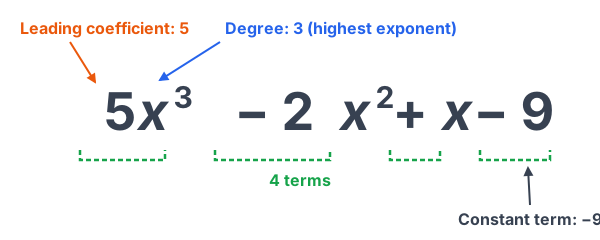
Add or subtract monomials and you get a polynomial. Each monomial is called a term. The number in front of a term is its coefficient, and a term with no variable is the constant term.
Polynomial Rules: Degree, Names and Standard Form
What Counts as a Polynomial
| Polynomial | Not a polynomial | Why not |
|---|---|---|
| 3x^2 - 5x + 1 | \frac{4}{x} + 2 | A variable is in the denominator. |
| \frac{1}{2}y^3 - 7 | x^{-2} + x | A negative exponent is the same as dividing by x^2. |
| 0.4m + 6 | \sqrt{x} + 1 | A square root of a variable is not a whole-number exponent. |
| 8 | 2^x | The variable is in the exponent. That is an exponential function. |
Coefficients can be fractions, decimals or negative numbers. Only the exponents on the variables have to be whole numbers (0, 1, 2, 3, …).
Degree
The degree of a term is the exponent on its variable. If a term has more than one variable, add their exponents: 3x^2y^4 has degree 2 + 4 = 6. A constant like 8 has degree 0.
The degree of a polynomial is the highest degree of any of its terms.
Naming Polynomials
| Degree | Name | Example |
|---|---|---|
| 0 | Constant | -6 |
| 1 | Linear | 2x + 5 |
| 2 | Quadratic | x^2 - 4x + 1 |
| 3 | Cubic | x^3 + 8 |
| 4 | Quartic | 3x^4 - x |
| 5 | Quintic | x^5 + 2x^2 |
| Number of terms | Name | Example |
|---|---|---|
| 1 | Monomial | 9x^2 |
| 2 | Binomial | 4x - 3 |
| 3 | Trinomial | x^2 + 6x + 9 |
| 4 or more | Polynomial with that many terms | x^3 - x^2 + x - 1 |
Put the two names together. For example, x^2 + 6x + 9 is a quadratic trinomial.
Standard Form
A polynomial is in standard form when its terms go from the highest degree to the lowest. The first term is the leading term, and its coefficient is the leading coefficient.
7 + 2x^3 - x \quad \longrightarrow \quad 2x^3 - x + 7
- Combine any like terms.
- Find the degree of each term.
- Write the terms from highest degree to lowest. Keep each sign with its term.
- Read off the degree, the leading coefficient and the number of terms.
Worked Examples
Example 1: Is it a polynomial?
Decide whether each expression is a polynomial.
Step 1. Look at the exponent on each variable. In a polynomial, every exponent is a whole number (0, 1, 2, 3, …), and no variable is in a denominator. Check each expression.
| Expression | Polynomial? | Reason |
|---|---|---|
| 3x^2 - 5x + 1 | Yes | Every exponent is a whole number. |
| \frac{4}{x} + 2 | No | Dividing by x is the same as 4x^{-1}. |
| \frac{1}{2}y^3 - 7 | Yes | A fraction coefficient is fine. |
| x^{-2} + x | No | It has a negative exponent. |
| \frac{x}{5} + 3 | Yes | \frac{x}{5} = \frac{1}{5}x. The 5 is a number, not a variable. |
Answer: 3x^2 - 5x + 1, \frac{1}{2}y^3 - 7 and \frac{x}{5} + 3 are polynomials. \frac{4}{x} + 2 and x^{-2} + x are not.
Example 2: Write in standard form and name it
Write 7 + 2x^3 - x in standard form. Then give its degree, leading coefficient and name.
Step 1. Find the degree of each term. The term 7 has degree 0, 2x^3 has degree 3, and -x has degree 1.
7 + 2x^3 - x = 2x^3 - x + 7
Step 2. Write the terms from the highest degree to the lowest. Keep each term’s sign with it.
Step 3. The highest exponent is 3, so the degree is 3.
Step 4. The first term is 2x^3, so the leading coefficient is 2.
Step 5. Count the terms. There are 3, so it is a trinomial.
Answer: 2x^3 - x + 7. It has degree 3 and leading coefficient 2, so it is a cubic trinomial.
Example 3: Combine like terms first
Simplify 4x^2 + 3x - x^2 + 5 - 3x and name the result.
4x^2 + 3x - x^2 + 5 - 3x = 4x^2 - x^2 + 3x - 3x + 5
Step 1. Move like terms next to each other (see combining like terms).
= 3x^2 + 3x - 3x + 5
Step 2. Combine the x^2-terms: 4x^2 - x^2 = 3x^2.
= 3x^2 + 0x + 5
Step 3. Combine the x-terms: 3x - 3x = 0x.
= 3x^2 + 5
Step 4. Drop the 0x, since it equals 0.
Step 5. Name it. The degree is 2 and there are 2 terms.
Answer: 3x^2 + 5, a quadratic binomial. Always simplify before you name a polynomial.
Example 4: Degree with two variables
Find the degree of 3x^2y^3 - 4xy + y^2.
Step 1. Find the degree of each term. Add the exponents of all the variables in the term. In xy, each variable has exponent 1.
| Term | 3x^2y^3 | -4xy | y^2 |
|---|---|---|---|
| Degree | 2 + 3 = 5 | 1 + 1 = 2 | 2 |
Step 2. The highest term degree is 5, so the polynomial has degree 5.
Step 3. Count the terms. There are 3, so it is a trinomial.
Answer: The degree is 5. It is a trinomial of degree 5.
Example 5: Word problem
A ball is thrown up from a 5-foot platform. Its height in feet after t seconds is h(t) = -16t^2 + 48t + 5. Name the polynomial, and find the height after 1, 2 and 3 seconds.
Step 1. Name it. The degree is 2 and there are 3 terms, so it is a quadratic trinomial. The leading coefficient is −16.
h(1) = -16(1)^2 + 48(1) + 5
Step 2. Find h(1). Substitute 1 for t.
= -16(1) + 48(1) + 5
Step 3. Do the exponent first (see order of operations).
= -16 + 48 + 5
Step 4. Multiply.
\begin{aligned}
&= 32 + 5 \\
&= 37
\end{aligned}
Step 5. Add from left to right.
\begin{aligned}
h(2) &= -16(2)^2 + 48(2) + 5 \\
&= -16(4) + 48(2) + 5 \\
&= -64 + 96 + 5 \\
&= 32 + 5 \\
&= 37
\end{aligned}
Step 6. Find h(2) the same way: substitute, square, multiply, then add. Each line does one of these.
\begin{aligned}
h(3) &= -16(3)^2 + 48(3) + 5 \\
&= -16(9) + 48(3) + 5 \\
&= -144 + 144 + 5 \\
&= 0 + 5 \\
&= 5
\end{aligned}
Step 7. Find h(3) the same way.
Answer: It is a quadratic trinomial. The ball is 37 feet high at 1 second and again at 2 seconds, once going up and once coming down. At 3 seconds it is back to 5 feet, the height of the platform.
Common Mistakes
| Mistake | Example of the error | Fix |
|---|---|---|
| Using the number of terms as the degree | x^5 + 2 has degree 2 | The degree is the highest exponent, 5. It has 2 terms. |
| Taking the first term as the leading term | The leading coefficient of 3x + 4x^2 is 3 | Write it in standard form first: 4x^2 + 3x. The leading coefficient is 4. |
| Dropping the sign | The coefficient of -x^3 is 1 | The sign goes with the term. The coefficient is −1. |
| Using the biggest exponent in a term with two variables | x^2y^3 has degree 3 | Add the exponents: 2 + 3 = 5. |
| Calling every expression a polynomial | \frac{6}{x} - 1 is a binomial | A variable in the denominator means it is not a polynomial. |
| Naming before simplifying | x^2 + 3x - x^2 is a quadratic trinomial | Combine like terms first: it is 3x, a linear monomial. |
Polynomials as Functions
You can write a polynomial with function notation, like p(x) = x^2 - 4x + 1. The degree tells you a lot about the graph:
- Degree 1: the graph is a straight line, as in slope-intercept form.
- Degree 2: the graph is a U-shape called a parabola. You saw one in key features of functions.
- Degree 3 or more: the graph can turn more than once.
Don’t mix up polynomials with exponential functions. In x^2 the variable is the base. In 2^x the variable is the exponent, so it is not a polynomial.
Practice Problems
- Is 6x^4 - x + 2 a polynomial? If so, name it.
- Is 3x^{-1} + 4 a polynomial?
- Is 0.5m^2 - \frac{3}{4} a polynomial? If so, name it.
- Write 9 - 4x^2 + x^5 in standard form. Give the degree and leading coefficient.
- Write 3x - 8x^3 + 2 - x^2 in standard form. Give the degree, leading coefficient and number of terms.
- Simplify 5x^3 + 2x - 5x^3 + 7 and name the result.
- Find the degree of 4a^3b^2 + 2ab^4 - 9.
- What is the degree of the constant -12?
- Evaluate p(x) = 2x^3 - x^2 + 4 at x = -2.
- A box has volume V(x) = 4x^3 - 36x^2 + 80x cubic inches. Name the polynomial and find V(2).
Show answers
1.
Check the exponents: 4, 1 and 0 are whole numbers, so it is a polynomial
Find the degree: the highest exponent is 4
Count the terms: there are 3
It is a quartic trinomial.
2.
Check the exponents: 3x^{-1} has the exponent -1, which is not a whole number (see negative exponents)
3x^{-1} = \frac{3}{x}Rewrite it to see why.
No. The variable is in a denominator, so it is not a polynomial.
3.
Check the exponents: 2 and 0 are whole numbers. Decimal and fraction coefficients are fine, so it is a polynomial
Find the degree: the highest exponent is 2
Count the terms: there are 2
Yes. It is a quadratic binomial.
4.
Find each term’s degree: 9 has degree 0, -4x^2 has degree 2, and x^5 has degree 5
x^5 - 4x^2 + 9
Order the terms from highest to lowest degree.
Find the degree: the highest exponent is 5
Find the leading coefficient: x^5 means 1x^5, so it is 1
Degree 5, leading coefficient 1.
5.
Find each term’s degree: 3x has degree 1, -8x^3 has degree 3, 2 has degree 0, and -x^2 has degree 2
-8x^3 - x^2 + 3x + 2
Order the terms from highest to lowest degree.
Find the degree: the highest exponent is 3
Find the leading coefficient: the first term is −8x³, so it is −8
Count the terms: there are 4
Degree 3, leading coefficient −8, 4 terms.
6.
5x^3 - 5x^3 + 2x + 7
Move like terms together.
0x^3 + 2x + 7
Combine the x^3-terms.
2x + 7
Drop the zero term.
Name it: the degree is 1 and there are 2 terms
It is a linear binomial.
7.
3 + 2 = 5
Find the degree of 4a^3b^2.
1 + 4 = 5
Find the degree of 2ab^4.
Find the degree of -9: it has no variable, so its degree is 0
Pick the highest term degree: 5
The degree is 5.
8.
A constant has no variable. You can think of it as −12x⁰, and the exponent is 0
The degree is 0.
9.
p(-2) = 2(-2)^3 - (-2)^2 + 4
Substitute −2 for x.
= 2(-8) - 4 + 4
Do the exponents, since (-2)^3 = -8 and (-2)^2 = 4.
= -16 - 4 + 4
Multiply.
= -20 + 4
Subtract.
= -16
Add.
So p(-2) = -16.
10.
Name it: the degree is 3 and there are 3 terms, so it is a cubic trinomial
V(2) = 4(2)^3 - 36(2)^2 + 80(2)
Substitute 2 for x.
= 4(8) - 36(4) + 80(2)
Do the exponents.
= 32 - 144 + 160
Multiply.
= -112 + 160
Subtract.
= 48
Add.
The volume is 48 cubic inches.
Want more practice? The Algebra 1 Unit 7 Practice Pack (Part 1) has 37 pages of problems on this and the other lessons in the unit, with step-by-step answers and a cheat sheet.
FAQ
What is a polynomial in simple terms?
A polynomial is a sum of terms like 3x^2, -5x and 7. Each term is a number times variables with whole-number exponents.
Is a single number a polynomial?
Yes. A number like 8 is a monomial with degree 0. It is called a constant.
How do you find the degree of a polynomial?
Find the degree of each term, adding exponents if a term has more than one variable. The highest one is the degree of the polynomial.
Why can’t a polynomial have a negative exponent?
A negative exponent means dividing by the variable, like x^{-1} = \frac{1}{x}. Polynomials only multiply variables, so their exponents must be 0, 1, 2, 3, and so on.
Summary
- A polynomial is one or more terms added or subtracted, with whole-number exponents on the variables.
- The degree is the highest exponent. For a term with two variables, add the exponents.
- Name it by degree (constant, linear, quadratic, cubic) and by number of terms (monomial, binomial, trinomial).
- Standard form lists terms from highest degree to lowest. The first coefficient is the leading coefficient.
- Simplify first, then name the polynomial.
Previous lesson: Linear vs. Exponential Functions
Next lesson: Adding and Subtracting Polynomials
Back to the Algebra 1 Index