
Adding and Subtracting Polynomials
Adding and subtracting polynomials comes down to combining like terms. To add, drop the parentheses and combine terms with the same variable and exponent. To subtract, change the sign of every term in the second polynomial, then add. For example, (3x^2 + 2x) - (x^2 - 5x) = 2x^2 + 7x.
Before this lesson: You should know polynomials, combining like terms, and the distributive property.
Extra practice: The Algebra 1 Unit 7 Practice Pack (Part 1) has printable problems, answer keys and a cheat sheet for this unit.
How Adding and Subtracting Polynomials Works
Think of each kind of term as a different coin. x^2-terms are quarters, x-terms are dimes, and constants are pennies. You can add quarters to quarters, but 2 quarters and 3 dimes are not 5 of anything.
Like terms have the same variables raised to the same exponents, like 4x^2 and -7x^2. Only like terms can be combined. You add or subtract their coefficients and keep the variable part the same.
Subtracting is the tricky part. The minus sign in front of the parentheses applies to every term inside, not just the first one. It works like multiplying by −1.
Rules and Steps
| Operation | Rule | Example |
|---|---|---|
| Adding | Drop the parentheses. Every sign stays the same. | (2x + 1) + (x - 4) = 3x - 3 |
| Subtracting | Change the sign of every term in the second polynomial, then add. | (2x + 1) - (x - 4) = x + 5 |
-(a - b + c) = -a + b - c
Steps to Add or Subtract Polynomials
- If you are subtracting, change the sign of every term in the second polynomial. The minus becomes a plus.
- Remove the parentheses.
- Group like terms together. Keep each sign with the term after it.
- Add the coefficients of each group of like terms.
- Write the answer in standard form, from the highest degree to the lowest.
You can also line up like terms in columns, like adding big numbers. This is the vertical method. Leave a gap or write a 0 term when a power is missing.
Worked Examples
Example 1: Add two trinomials
Add (4x^2 + 3x - 7) + (2x^2 - 5x + 1).
4x^2 + 3x - 7 + 2x^2 - 5x + 1
Step 1. Remove the parentheses. Adding doesn’t change any signs.
= (4x^2 + 2x^2) + (3x - 5x) + (-7 + 1)
Step 2. Group the like terms (see combining like terms).
= 6x^2 + (3x - 5x) + (-7 + 1)
Step 3. Add the x^2-terms: 4x^2 + 2x^2 = 6x^2.
= 6x^2 - 2x + (-7 + 1)
Step 4. Add the x-terms: 3x - 5x = -2x.
= 6x^2 - 2x - 6
Step 5. Add the constants: -7 + 1 = -6.
Answer: 6x^2 - 2x - 6
Example 2: Add with the vertical method
Add (3x^3 - 2x + 5) + (x^3 + 4x^2 - 6).
Step 1. Write the terms in columns by degree. The first polynomial has no x^2-term and the second has no x-term, so write 0x^2 and 0x to hold their places.
Step 2. Add each column: 3x^3 + x^3 = 4x^3, 0x^2 + 4x^2 = 4x^2, -2x + 0x = -2x and 5 - 6 = -1.
| x^3 | x^2 | x | Constant | |
|---|---|---|---|---|
| First | 3x^3 | 0x^2 | -2x | +5 |
| Second | x^3 | +4x^2 | 0x | -6 |
| Sum | 4x^3 | +4x^2 | -2x | -1 |
4x^3 + 4x^2 - 2x - 1
Step 3. Read the sum row from left to right.
Answer: 4x^3 + 4x^2 - 2x - 1
Example 3: Subtract two trinomials
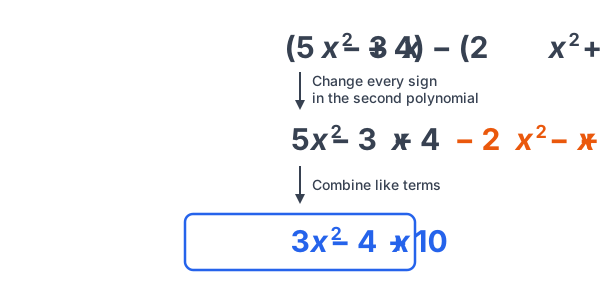
Subtract (5x^2 - 3x + 4) - (2x^2 + x - 6).
5x^2 - 3x + 4 - 2x^2 - x + 6
Step 1. The minus sign multiplies every term in the second polynomial by -1, so change every sign in it (see distributive property).
= (5x^2 - 2x^2) + (-3x - x) + (4 + 6)
Step 2. Group the like terms.
= 3x^2 + (-3x - x) + (4 + 6)
Step 3. Combine the x^2-terms: 5x^2 - 2x^2 = 3x^2.
= 3x^2 - 4x + (4 + 6)
Step 4. Combine the x-terms: -3x - x = -4x.
= 3x^2 - 4x + 10
Step 5. Combine the constants: 4 + 6 = 10.
Answer: 3x^2 - 4x + 10
Check: Use x = 1. The first polynomial is 5 - 3 + 4 = 6 and the second is 2 + 1 - 6 = -3. Their difference is 6 - (-3) = 9. The answer gives 3 - 4 + 10 = 9. It matches.
Example 4: Subtract with two variables
Subtract (6a^2b - 2ab + b^2) - (-a^2b + 4ab - 3b^2).
6a^2b - 2ab + b^2 + a^2b - 4ab + 3b^2
Step 1. Change every sign in the second polynomial.
= (6a^2b + a^2b) + (-2ab - 4ab) + (b^2 + 3b^2)
Step 2. Group the like terms. The terms a^2b and ab are not like terms, because the exponents on a are different.
= 7a^2b + (-2ab - 4ab) + (b^2 + 3b^2)
Step 3. Combine the a^2b-terms.
= 7a^2b - 6ab + (b^2 + 3b^2)
Step 4. Combine the ab-terms.
= 7a^2b - 6ab + 4b^2
Step 5. Combine the b^2-terms.
Answer: 7a^2b - 6ab + 4b^2
Example 5: Word problem
A bakery sells x boxes of cookies. Its revenue in dollars is R(x) = -2x^2 + 50x and its cost is C(x) = 10x + 120. Profit is revenue minus cost. Write a polynomial for the profit, and find the profit for 10 boxes.
P(x) = (-2x^2 + 50x) - (10x + 120)
Step 1. Write profit as revenue minus cost.
= -2x^2 + 50x - 10x - 120
Step 2. Change the signs in the cost polynomial.
= -2x^2 + 40x - 120
Step 3. Combine the x-terms: 50x - 10x = 40x.
P(10) = -2(10)^2 + 40(10) - 120
Step 4. Substitute 10 for x.
= -2(100) + 40(10) - 120
Step 5. Do the exponent first (see order of operations).
= -200 + 400 - 120
Step 6. Multiply.
\begin{aligned}
&= 200 - 120 \\
&= 80
\end{aligned}
Step 7. Add and subtract from left to right.
Answer: P(x) = -2x^2 + 40x - 120. The profit for 10 boxes is $80.
Check: Revenue is $300 and cost is $220, and $300 − $220 = $80.
Common Mistakes
| Mistake | Example of the error | Fix |
|---|---|---|
| Changing only the first sign | (4x + 3) - (x + 2) = 3x + 5 | The minus goes to every term: 4x + 3 - x - 2 = 3x + 1. |
| Combining unlike terms | 3x^2 + 2x = 5x^3 | They are not like terms. 3x^2 + 2x is already simplified. |
| Adding the exponents | x^2 + x^2 = x^4 | Add the coefficients only: x^2 + x^2 = 2x^2. You add exponents only when you multiply, as in the exponent rules. |
| Missing a double negative | (x - 5) - (2x - 3) = -x - 8 | -(-3) = +3, so the answer is -x - 2. |
| Lining up the wrong columns | Putting 4x^2 under -2x | Line up by matching powers, and write 0 terms for missing ones. |
Subtracting “From” and Checking Your Answer
Word order matters. “Subtract A from B” means B - A. For example, “subtract 2x + 1 from 5x - 3” means (5x - 3) - (2x + 1) = 3x - 4.
To check any answer, pick a small number like x = 1 or x = 2. Put it into the original problem and into your answer, just like evaluating an expression. If you get different results, look for a sign error.
Adding polynomials is the first step toward multiplying them. Next you will use the distributive property to multiply binomials, and you will still combine like terms at the end.
Practice Problems
- Simplify (2x + 5) + (3x - 8).
- Simplify (x^2 - 4x + 2) + (3x^2 + x - 9).
- Simplify (7y^3 + 2y) + (-3y^3 + y^2 - 2y).
- Simplify (6x - 4) - (2x + 3).
- Simplify (3x^2 + 5x - 1) - (x^2 - 2x + 4).
- Simplify (-2m^2 + m - 8) - (-5m^2 - 3m - 8).
- Subtract 4x^2 - x + 3 from 9x^2 + 2x - 1.
- Simplify (2a^2 - 3ab + b^2) + (a^2 + 5ab - 4b^2).
- Simplify (x^3 + 2x - 7) - (3x^3 - x^2 + 2x).
- A triangle has sides x^2 + 2x, 3x - 1 and x^2 - x + 5 inches long. Write its perimeter as a polynomial. Then find the perimeter when x = 3.
Show answers
1.
2x + 5 + 3x - 8
Remove the parentheses.
(2x + 3x) + (5 - 8)
Group like terms.
5x + (5 - 8)
Combine the x-terms.
5x - 3
Combine the constants.
2.
(x^2 + 3x^2) + (-4x + x) + (2 - 9)
Group like terms.
4x^2 + (-4x + x) + (2 - 9)
Combine the x^2-terms.
4x^2 - 3x + (2 - 9)
Combine the x-terms.
4x^2 - 3x - 7
Combine the constants.
3.
(7y^3 - 3y^3) + y^2 + (2y - 2y)
Group like terms.
4y^3 + y^2 + (2y - 2y)
Combine the y^3-terms.
4y^3 + y^2 + 0y
Combine the y-terms. They cancel.
4y^3 + y^2
Drop the zero term.
4.
6x - 4 - 2x - 3
Change the signs in the second polynomial.
(6x - 2x) + (-4 - 3)
Group like terms.
4x + (-4 - 3)
Combine the x-terms.
4x - 7
Combine the constants.
5.
3x^2 + 5x - 1 - x^2 + 2x - 4
Change the signs in the second polynomial.
(3x^2 - x^2) + (5x + 2x) + (-1 - 4)
Group like terms.
2x^2 + (5x + 2x) + (-1 - 4)
Combine the x^2-terms.
2x^2 + 7x + (-1 - 4)
Combine the x-terms.
2x^2 + 7x - 5
Combine the constants.
6.
-2m^2 + m - 8 + 5m^2 + 3m + 8
Change the signs in the second polynomial. Subtracting a negative makes it positive (see adding and subtracting integers)
(-2m^2 + 5m^2) + (m + 3m) + (-8 + 8)
Group like terms.
3m^2 + (m + 3m) + (-8 + 8)
Combine the m^2-terms.
3m^2 + 4m + (-8 + 8)
Combine the m-terms.
3m^2 + 4m + 0
Combine the constants. They cancel.
3m^2 + 4m
Drop the zero.
7.
(9x^2 + 2x - 1) - (4x^2 - x + 3)
“Subtract A from B” means B − A, so write the second polynomial first.
9x^2 + 2x - 1 - 4x^2 + x - 3
Change the signs in the polynomial being subtracted.
(9x^2 - 4x^2) + (2x + x) + (-1 - 3)
Group like terms.
5x^2 + (2x + x) + (-1 - 3)
Combine the x^2-terms.
5x^2 + 3x + (-1 - 3)
Combine the x-terms.
5x^2 + 3x - 4
Combine the constants.
8.
(2a^2 + a^2) + (-3ab + 5ab) + (b^2 - 4b^2)
Group like terms.
3a^2 + (-3ab + 5ab) + (b^2 - 4b^2)
Combine the a^2-terms.
3a^2 + 2ab + (b^2 - 4b^2)
Combine the ab-terms.
3a^2 + 2ab - 3b^2
Combine the b^2-terms.
9.
x^3 + 2x - 7 - 3x^3 + x^2 - 2x
Change the signs in the second polynomial.
(x^3 - 3x^3) + x^2 + (2x - 2x) - 7
Group like terms.
-2x^3 + x^2 + (2x - 2x) - 7
Combine the x^3-terms.
-2x^3 + x^2 + 0x - 7
Combine the x-terms. They cancel.
-2x^3 + x^2 - 7
Drop the zero term.
10.
(x^2 + 2x) + (3x - 1) + (x^2 - x + 5)
The perimeter is the sum of the three sides.
(x^2 + x^2) + (2x + 3x - x) + (-1 + 5)
Group like terms.
2x^2 + (2x + 3x - x) + (-1 + 5)
Combine the x^2-terms.
2x^2 + 4x + (-1 + 5)
Combine the x-terms.
2x^2 + 4x + 4
Combine the constants.
2(3)^2 + 4(3) + 4
Substitute 3 for x.
2(9) + 4(3) + 4
Do the exponent.
18 + 12 + 4
Multiply.
34
Add.
Check: at x = 3 the sides are 15, 8 and 11 inches: 15 + 8 + 11 = 34
The perimeter is 34 inches.
Want more practice? The Algebra 1 Unit 7 Practice Pack (Part 1) has 37 pages of problems on this and the other lessons in the unit, with step-by-step answers and a cheat sheet.
FAQ
How do you subtract polynomials?
Change the sign of every term in the polynomial being subtracted. Then remove the parentheses and combine like terms.
Can you add polynomials with different degrees?
Yes. Combine the like terms you have and bring the others down unchanged. For example, (x^3 + 2) + (5x - 1) = x^3 + 5x + 1.
What are like terms in polynomials?
Like terms have exactly the same variables with the same exponents, such as 3x^2y and -x^2y. The coefficients can be different.
Is subtracting a polynomial the same as adding its opposite?
Yes. The opposite of a polynomial has every sign switched. So A - B is the same as A + (-B).
Summary
- Only like terms can be combined: same variables, same exponents.
- To add, remove the parentheses and combine like terms.
- To subtract, change the sign of every term in the second polynomial, then add.
- The vertical method lines up like terms in columns. Use 0 terms for missing powers.
- Check your answer by putting a small number in for the variable.
Previous lesson: Polynomials
Next lesson: Multiplying Binomials
Back to the Algebra 1 Index