
Multiplying Binomials
Multiplying binomials means multiplying each term of the first binomial by each term of the second, then combining like terms. The FOIL method helps you remember all four products: First, Outer, Inner, Last. The two middle products are often like terms, so most answers end up with three terms. For example, (x + 3)(x + 5) = x^2 + 8x + 15.
Before this lesson: You should know the distributive property, exponent rules, and adding and subtracting polynomials.
Extra practice: The Algebra 1 Unit 7 Practice Pack (Part 1) has printable problems, answer keys and a cheat sheet for this unit.
What Does It Mean to Multiply Binomials?
A binomial is a polynomial with two terms, like x + 3 or 2x - 5. To multiply two binomials, every term in the first one must multiply every term in the second one. That makes 4 products.
An area model shows why. Picture a rectangle that is x + 3 tall and x + 5 wide. Split it into 4 smaller rectangles. The whole area is the sum of the 4 pieces.
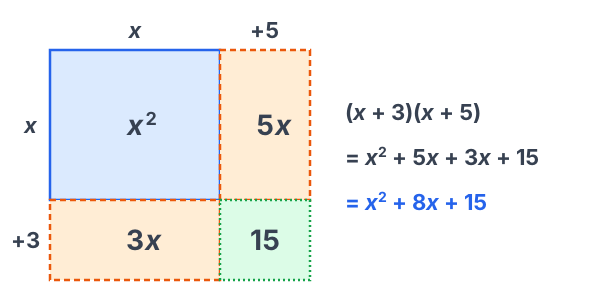
The two middle pieces, 5x and 3x, are like terms. That is why most answers have 3 terms, not 4.
How to Multiply Binomials
Every method uses the same rule. It is the distributive property used twice:
(a + b)(c + d) = ac + ad + bc + bd
| Method | How it works | Best for |
|---|---|---|
| FOIL | Multiply the First terms, Outer terms, Inner terms and Last terms. | Two binomials, done fast |
| Distributive | Distribute the first term, then the second term, across the other binomial. | Seeing why it works |
| Box method | Put one binomial across the top and one down the side. Multiply to fill each box. | Keeping signs organized |
Steps (FOIL)
- First: multiply the first term of each binomial.
- Outer: multiply the two terms on the outside.
- Inner: multiply the two terms on the inside.
- Last: multiply the last term of each binomial.
- Combine like terms. Usually the outer and inner products combine.
Keep the sign with each term. In (x - 4), the second term is -4, not 4.
Worked Examples
Example 1: Two simple binomials
Multiply (x + 3)(x + 5).
x \cdot x = x^2
Step 1. Multiply the First terms. When you multiply powers of x, add the exponents (see exponent rules).
x \cdot 5 = 5x
Step 2. Multiply the Outer terms.
3 \cdot x = 3x
Step 3. Multiply the Inner terms.
3 \cdot 5 = 15
Step 4. Multiply the Last terms.
(x + 3)(x + 5) = x^2 + 5x + 3x + 15
Step 5. Write the four products as a sum.
= x^2 + 8x + 15
Step 6. Combine the like terms 5x and 3x (see combining like terms).
Answer: x^2 + 8x + 15
Check: Use x = 2. The original gives (2 + 3)(2 + 5) = 5 \cdot 7 = 35. The answer gives 2^2 + 8(2) + 15 = 4 + 16 + 15 = 35. They match.
Example 2: Negative numbers
Multiply (x - 6)(x + 2).
x \cdot x = x^2
Step 1. Multiply the First terms.
x \cdot 2 = 2x
Step 2. Multiply the Outer terms.
-6 \cdot x = -6x
Step 3. Multiply the Inner terms. Keep the negative sign with the 6.
-6 \cdot 2 = -12
Step 4. Multiply the Last terms. A negative times a positive is negative (see multiplying and dividing integers).
(x - 6)(x + 2) = x^2 + 2x - 6x - 12
Step 5. Write the four products as a sum.
= x^2 - 4x - 12
Step 6. Combine the like terms: 2x - 6x = -4x.
Answer: x^2 - 4x - 12
Example 3: A coefficient on x
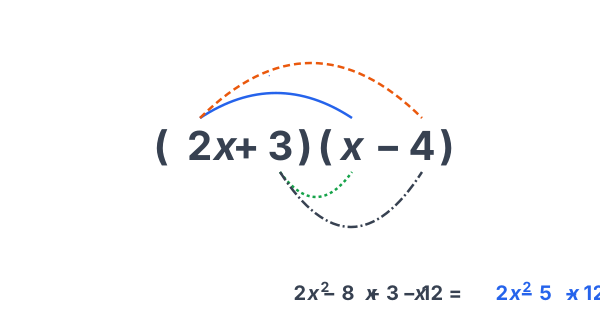
Multiply (2x + 3)(x - 4).
Step 1. Find the four FOIL products. Multiply the numbers, then the variables.
| F | O | I | L |
|---|---|---|---|
| 2x \cdot x = 2x^2 | 2x \cdot (-4) = -8x | 3 \cdot x = 3x | 3 \cdot (-4) = -12 |
(2x + 3)(x - 4) = 2x^2 - 8x + 3x - 12
Step 2. Write the four products as a sum.
= 2x^2 - 5x - 12
Step 3. Combine the middle terms: -8x + 3x = -5x.
Answer: 2x^2 - 5x - 12
Example 4: The box method with two variables
Multiply (3a - 2b)(a - 5b).
Step 1. Draw a 2 by 2 box. Write 3a and -2b down the side and a and -5b across the top. Keep each sign with its term.
Step 2. Fill each box with its row term times its column term. The box for (-2b)(-5b) is positive, because a negative times a negative is positive.
| × | a | -5b |
|---|---|---|
| 3a | 3a^2 | -15ab |
| -2b | -2ab | 10b^2 |
3a^2 - 15ab - 2ab + 10b^2
Step 3. Add the four boxes.
= 3a^2 - 17ab + 10b^2
Step 4. Combine the like terms: -15ab - 2ab = -17ab.
Answer: 3a^2 - 17ab + 10b^2
Example 5: Word problem
A square garden has sides of x feet. The owner makes it 4 feet longer and 1 foot narrower. Write a polynomial for the new area. Then find the new area when x = 10.
Step 1. Write the new sides. The length is x + 4 feet and the width is x - 1 feet.
A = (x + 4)(x - 1)
Step 2. Area is length times width (see area of rectangles).
= x^2 - x + 4x - 4
Step 3. Find the four products: x \cdot x = x^2, x \cdot (-1) = -x, 4 \cdot x = 4x and 4 \cdot (-1) = -4.
= x^2 + 3x - 4
Step 4. Combine the like terms: -x + 4x = 3x.
A = 10^2 + 3(10) - 4
Step 5. Substitute 10 for x.
= 100 + 3(10) - 4
Step 6. Do the exponent first (see order of operations).
= 100 + 30 - 4
Step 7. Multiply.
\begin{aligned}
&= 130 - 4 \\
&= 126
\end{aligned}
Step 8. Add and subtract from left to right.
Answer: A = x^2 + 3x - 4. When x = 10, the new area is 126 square feet.
Check: The garden is 10 + 4 = 14 feet by 10 - 1 = 9 feet, and 14 \cdot 9 = 126.
Common Mistakes
| Mistake | Example of the error | Fix |
|---|---|---|
| Squaring each term | (x + 3)^2 = x^2 + 9 | Write it as (x + 3)(x + 3) and use FOIL: x^2 + 6x + 9. |
| Skipping the outer or inner product | (x + 2)(x + 7) = x^2 + 14 | There are always 4 products: x^2 + 7x + 2x + 14 = x^2 + 9x + 14. |
| Losing a negative sign | (x - 6)(x + 2) = x^2 - 4x + 12 | (-6)(2) = -12, so the answer is x^2 - 4x - 12. |
| Forgetting the exponent | 2x \cdot x = 2x | x \cdot x = x^2, so 2x \cdot x = 2x^2. |
| Not combining like terms | x^2 + 5x + 3x + 15 | Combine the middle terms: x^2 + 8x + 15. |
Choosing a Method and What Comes Next
All three methods give the same answer, so use the one you trust most. FOIL is fast for two binomials. The box method is great when there are negatives, because each sign sits in its own box.
FOIL only works for two binomials. To multiply bigger polynomials, like a binomial times a trinomial, you use the distributive property or a bigger box. That is the next lesson, Multiplying Polynomials.
Some products come up so often that they have shortcuts, like (x + 3)^2 and (x + 3)(x - 3). You will learn these special products later in this unit. Later, you will also run FOIL backward to factor.
Practice Problems
- Multiply (x + 2)(x + 7).
- Multiply (x - 3)(x - 8).
- Multiply (x + 5)(x - 9).
- Multiply (y - 4)(y + 4).
- Multiply (3x + 1)(x + 6).
- Multiply (2x - 5)(3x + 2).
- Multiply (4m - 3)(2m - 1).
- Multiply (x + 6)^2.
- Multiply (2a + b)(a - 3b).
- A rug is 2x + 1 feet long and x + 3 feet wide. Write its area as a polynomial. Then find the area when x = 4.
Show answers
1.
Find the four products. F: x \cdot x = x^2, O: x \cdot 7 = 7x, I: 2 \cdot x = 2x, L: 2 \cdot 7 = 14
x^2 + 7x + 2x + 14
Write them as a sum.
x^2 + 9x + 14
Combine the like terms.
2.
Find the four products. F: x \cdot x = x^2, O: x(-8) = -8x, I: -3 \cdot x = -3x, L: (-3)(-8) = 24
x^2 - 8x - 3x + 24
Write them as a sum.
x^2 - 11x + 24
Combine the like terms.
3.
Find the four products. F: x \cdot x = x^2, O: x(-9) = -9x, I: 5 \cdot x = 5x, L: 5(-9) = -45
x^2 - 9x + 5x - 45
Write them as a sum.
x^2 - 4x - 45
Combine the like terms.
4.
Find the four products. F: y \cdot y = y^2, O: y \cdot 4 = 4y, I: -4 \cdot y = -4y, L: -4 \cdot 4 = -16
y^2 + 4y - 4y - 16
Write them as a sum.
y^2 - 16
Combine the like terms. The middle terms cancel.
5.
Find the four products. F: 3x \cdot x = 3x^2, O: 3x \cdot 6 = 18x, I: 1 \cdot x = x, L: 1 \cdot 6 = 6
3x^2 + 18x + x + 6
Write them as a sum.
3x^2 + 19x + 6
Combine the like terms.
6.
Find the four products. F: 2x \cdot 3x = 6x^2, O: 2x \cdot 2 = 4x, I: -5 \cdot 3x = -15x, L: -5 \cdot 2 = -10
6x^2 + 4x - 15x - 10
Write them as a sum.
6x^2 - 11x - 10
Combine the like terms.
7.
Find the four products. F: 4m \cdot 2m = 8m^2, O: 4m(-1) = -4m, I: -3 \cdot 2m = -6m, L: (-3)(-1) = 3
8m^2 - 4m - 6m + 3
Write them as a sum.
8m^2 - 10m + 3
Combine the like terms.
8.
(x + 6)^2 = (x + 6)(x + 6)
Write the square as a product of two binomials.
Find the four products. F: x \cdot x = x^2, O: x \cdot 6 = 6x, I: 6 \cdot x = 6x, L: 6 \cdot 6 = 36
x^2 + 6x + 6x + 36
Write them as a sum.
x^2 + 12x + 36
Combine the like terms.
It is not x^2 + 36. The middle term 12x comes from the outer and inner products.
9.
Find the four products. F: 2a \cdot a = 2a^2, O: 2a(-3b) = -6ab, I: b \cdot a = ab, L: b(-3b) = -3b^2
2a^2 - 6ab + ab - 3b^2
Write them as a sum.
2a^2 - 5ab - 3b^2
Combine the like terms.
10.
A = (2x + 1)(x + 3)
Area is length times width.
Find the four products. F: 2x \cdot x = 2x^2, O: 2x \cdot 3 = 6x, I: 1 \cdot x = x, L: 1 \cdot 3 = 3
2x^2 + 6x + x + 3
Write them as a sum.
2x^2 + 7x + 3
Combine the like terms.
2(4)^2 + 7(4) + 3
Substitute 4 for x.
2(16) + 7(4) + 3
Do the exponent.
32 + 28 + 3
Multiply.
60 + 3 = 63
Add.
Check: the rug is 9 feet by 7 feet: 9 \cdot 7 = 63
The area is 63 square feet.
Want more practice? The Algebra 1 Unit 7 Practice Pack (Part 1) has 37 pages of problems on this and the other lessons in the unit, with step-by-step answers and a cheat sheet.
FAQ
What does FOIL stand for?
FOIL stands for First, Outer, Inner, Last. It is a reminder to multiply all four pairs of terms when you multiply two binomials.
Do you have to use FOIL?
No. FOIL is just the distributive property in a set order. The box method or distributing twice gives the same answer.
Why isn’t (x + 3)² equal to x² + 9?
Squaring means multiplying (x + 3)(x + 3). FOIL gives x^2 + 3x + 3x + 9 = x^2 + 6x + 9. The middle term 6x comes from the outer and inner products.
What is the box method?
Write one binomial across the top of a 2-by-2 grid and the other down the side. Multiply to fill each box, then add the boxes and combine like terms.
Summary
- To multiply binomials, multiply each term in the first by each term in the second. That gives 4 products.
- FOIL means First, Outer, Inner, Last.
- The box method and distributing twice give the same answer.
- Keep each sign with its term, and remember x \cdot x = x^2.
- Combine like terms at the end. The outer and inner products usually combine.
Previous lesson: Adding and Subtracting Polynomials
Next lesson: Multiplying Polynomials
Back to the Algebra 1 Index