
Multiplying Polynomials
Multiplying polynomials means multiplying every term of one polynomial by every term of the other, then combining like terms. You can use the distributive property or a box (grid) to keep track of the products, and count them so you don’t miss one. For example, (x + 2)(x^2 + 3x - 1) = x^3 + 5x^2 + 5x - 2.
Before this lesson: You should know multiplying binomials, the exponent rules, and combining like terms.
Extra practice: The Algebra 1 Unit 7 Practice Pack (Part 1) has printable problems, answer keys and a cheat sheet for this unit.
How Multiplying Polynomials Works
When you multiplied two binomials, you made 4 products. The same idea works for any polynomials: every term must meet every other term once.
So you can count the products before you start. A binomial times a trinomial gives 2 \cdot 3 = 6 products. A trinomial times a trinomial gives 3 \cdot 3 = 9. If you end up with fewer, you missed one.
Each product uses the product rule for exponents: multiply the coefficients and add the exponents. For example, (-4x)(2x) = -8x^2.
Rules for Multiplying Polynomials
| Type | Rule | Example |
|---|---|---|
| Monomial × polynomial | Distribute the monomial to every term. | 2x(x^2 + 3) = 2x^3 + 6x |
| Binomial × binomial | 4 products (FOIL works here). | (x + 1)(x + 4) = x^2 + 5x + 4 |
| Any polynomial × polynomial | Every term times every term, then combine. | (x + 1)(x^2 - x + 1) = x^3 + 1 |
A handy fact: the degree of the product is the sum of the degrees. A degree-1 polynomial times a degree-2 polynomial gives degree 3.
Steps
- Count the terms in each polynomial. Multiply the counts to know how many products to expect.
- Take the first term of the first polynomial and multiply it by every term of the second.
- Repeat with each remaining term of the first polynomial. Keep each sign with its term.
- Combine like terms.
- Write the answer in standard form, from the highest power down.
Worked Examples
Example 1: Monomial times a trinomial
Multiply 3x^2(2x^2 - 5x + 4).
3x^2(2x^2 - 5x + 4) = 3x^2 \cdot 2x^2 + 3x^2 \cdot (-5x) + 3x^2 \cdot 4
Step 1. Multiply 3x^2 by each term inside the parentheses (see distributive property).
= 6x^4 - 15x^3 + 12x^2
Step 2. Multiply each pair. Multiply the coefficients and add the exponents (see exponent rules): 3x^2 \cdot 2x^2 = 6x^4, 3x^2 \cdot (-5x) = -15x^3 and 3x^2 \cdot 4 = 12x^2.
Step 3. Look for like terms. Each product has a different power, so there is nothing to combine.
Answer: 6x^4 - 15x^3 + 12x^2
Example 2: Binomial times a trinomial
Multiply (x + 2)(x^2 + 3x - 1). Expect 2 \cdot 3 = 6 products.
(x + 2)(x^2 + 3x - 1) = x(x^2 + 3x - 1) + 2(x^2 + 3x - 1)
Step 1. Split the binomial. Multiply each of its terms by the whole trinomial.
= x^3 + 3x^2 - x + 2x^2 + 6x - 2
Step 2. Distribute x: x^3 + 3x^2 - x. Distribute 2: 2x^2 + 6x - 2. That makes 6 products.
= x^3 + (3x^2 + 2x^2) + (-x + 6x) - 2
Step 3. Group the like terms (see combining like terms).
= x^3 + 5x^2 + 5x - 2
Step 4. Combine each group.
Answer: x^3 + 5x^2 + 5x - 2
Check: Use x = 1. The original gives (1 + 2)(1 + 3 - 1) = 3 \cdot 3 = 9. The answer gives 1 + 5 + 5 - 2 = 9.
Example 3: The box method
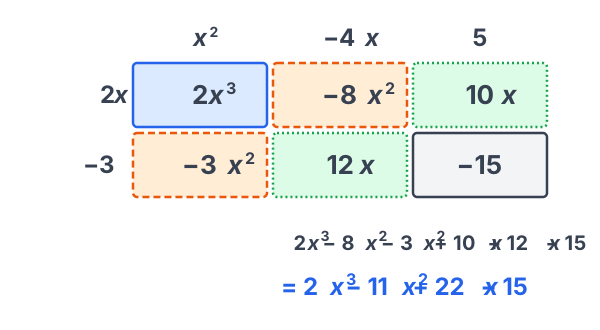
Multiply (2x - 3)(x^2 - 4x + 5).
Step 1. Make a 2 by 3 box. Put 2x and -3 down the side and x^2, -4x and 5 across the top.
Step 2. Fill each box with row term times column term. Notice (-3)(-4x) = 12x, because a negative times a negative is positive (see multiplying and dividing integers).
| × | x^2 | -4x | 5 |
|---|---|---|---|
| 2x | 2x^3 | -8x^2 | 10x |
| -3 | -3x^2 | 12x | -15 |
2x^3 - 8x^2 + 10x - 3x^2 + 12x - 15
Step 3. Write all six boxes as a sum.
= 2x^3 + (-8x^2 - 3x^2) + (10x + 12x) - 15
Step 4. Group the like terms. They sit on the diagonals of the box.
= 2x^3 - 11x^2 + 22x - 15
Step 5. Combine each group: -8x^2 - 3x^2 = -11x^2 and 10x + 12x = 22x.
Answer: 2x^3 - 11x^2 + 22x - 15
Example 4: Trinomial times a trinomial
Multiply (x^2 + 2x - 1)(x^2 - 3x + 2). Expect 3 \cdot 3 = 9 products.
x^2(x^2 - 3x + 2) + 2x(x^2 - 3x + 2) - 1(x^2 - 3x + 2)
Step 1. Multiply each term of the first trinomial by the whole second trinomial.
= x^4 - 3x^3 + 2x^2 + 2x^3 - 6x^2 + 4x - x^2 + 3x - 2
Step 2. Distribute each part. Count the products: there should be 9.
= x^4 + (-3x^3 + 2x^3) + (2x^2 - 6x^2 - x^2) + (4x + 3x) - 2
Step 3. Group the like terms by power.
= x^4 - x^3 - 5x^2 + 7x - 2
Step 4. Combine each group: -3 + 2 = -1, 2 - 6 - 1 = -5 and 4 + 3 = 7.
Answer: x^4 - x^3 - 5x^2 + 7x - 2
Example 5: Word problem with three factors
A box is x inches tall, x + 2 inches wide and x + 5 inches long. Write its volume as a polynomial. Then find the volume when x = 3.
V = x(x + 2)(x + 5)
Step 1. Volume is height times width times length.
(x + 2)(x + 5) = x^2 + 5x + 2x + 10 = x^2 + 7x + 10
Step 2. Multiply the two binomials first (see multiplying binomials).
V = x(x^2 + 7x + 10)
Step 3. Put that product back in.
V = x^3 + 7x^2 + 10x
Step 4. Distribute x.
V = 3^3 + 7(3)^2 + 10(3)
Step 5. Substitute 3 for x.
= 27 + 7(9) + 10(3)
Step 6. Do the exponents first (see order of operations).
= 27 + 63 + 30
Step 7. Multiply.
= 120
Step 8. Add.
Answer: V = x^3 + 7x^2 + 10x. When x = 3, the volume is 120 cubic inches.
Check: The box is 3 by 5 by 8 inches, and 3 \cdot 5 \cdot 8 = 120.
Common Mistakes
| Mistake | Example of the error | Fix |
|---|---|---|
| Missing products | (x + 2)(x^2 + 3x - 1) with only 4 products | A binomial times a trinomial needs 6 products. Count them. |
| Forgetting the exponent on x | x \cdot x^2 = x^2 | Add the exponents: x^1 \cdot x^2 = x^3. |
| Multiplying the exponents | x^2 \cdot x^3 = x^6 | Add them: x^2 \cdot x^3 = x^5. |
| Dropping a negative | (-3)(-4x) = -12x | A negative times a negative is positive: 12x. |
| Cubing each term | (x + 1)^3 = x^3 + 1 | Multiply it out: (x + 1)^3 = x^3 + 3x^2 + 3x + 1. |
The Vertical Method and Checking Your Work
You can also multiply polynomials like multi-digit numbers. Write one polynomial above the other. Multiply by each bottom term on its own row, and line up like terms in columns. Then add the columns.
| x^3 | x^2 | x | Constant | |
|---|---|---|---|---|
| 2 \cdot (x^2 + 3x - 1) | 2x^2 | 6x | -2 | |
| x \cdot (x^2 + 3x - 1) | x^3 | 3x^2 | -x | |
| Sum | x^3 | 5x^2 | 5x | -2 |
This is Example 2 again, and it gives the same answer. To check any product, put a small number like x = 1 or x = 2 into the problem and into your answer. The two results must match, just like when adding and subtracting polynomials.
Practice Problems
- Multiply 4x(3x^2 - 2x + 7).
- Multiply -2y^2(y^3 - 4y + 1).
- Multiply (x + 4)(x^2 - x + 3).
- Multiply (x - 1)(x^2 + x + 1).
- Multiply (3x + 2)(2x^2 - x - 4).
- Multiply (a - 2b)(a^2 + 3ab - b^2).
- Multiply (x^2 + 2)(x^2 - 3x + 1).
- Multiply (x + 1)^3.
- Without multiplying everything out, find the degree and leading coefficient of (2x^3 + x - 5)(x^4 - 7x^2 + 1).
- A box is x feet tall, x - 1 feet wide and x + 4 feet long. Write its volume as a polynomial, and find the volume when x = 5.
Show answers
1.
4x \cdot 3x^2 + 4x \cdot (-2x) + 4x \cdot 7
Distribute 4x to each term.
12x^3 - 8x^2 + 28x
Multiply each pair.
There are no like terms to combine.
2.
-2y^2 \cdot y^3 + (-2y^2)(-4y) + (-2y^2)(1)
Distribute -2y^2 to each term.
-2y^5 + 8y^3 - 2y^2
Multiply each pair. Each sign flips, because the monomial is negative.
3.
x(x^2 - x + 3) + 4(x^2 - x + 3)
Split the binomial.
x^3 - x^2 + 3x + 4x^2 - 4x + 12
Distribute.
x^3 + (-x^2 + 4x^2) + (3x - 4x) + 12
Group like terms.
x^3 + 3x^2 - x + 12
Combine.
4.
x(x^2 + x + 1) - 1(x^2 + x + 1)
Split the binomial.
x^3 + x^2 + x - x^2 - x - 1
Distribute.
x^3 + (x^2 - x^2) + (x - x) - 1
Group like terms.
x^3 - 1
Combine. The middle terms all cancel.
5.
3x(2x^2 - x - 4) + 2(2x^2 - x - 4)
Split the binomial.
6x^3 - 3x^2 - 12x + 4x^2 - 2x - 8
Distribute.
6x^3 + (-3x^2 + 4x^2) + (-12x - 2x) - 8
Group like terms.
6x^3 + x^2 - 14x - 8
Combine.
6.
a(a^2 + 3ab - b^2) - 2b(a^2 + 3ab - b^2)
Split the binomial.
a^3 + 3a^2b - ab^2 - 2a^2b - 6ab^2 + 2b^3
Distribute.
a^3 + (3a^2b - 2a^2b) + (-ab^2 - 6ab^2) + 2b^3
Group like terms.
a^3 + a^2b - 7ab^2 + 2b^3
Combine.
7.
x^2(x^2 - 3x + 1) + 2(x^2 - 3x + 1)
Split the binomial.
x^4 - 3x^3 + x^2 + 2x^2 - 6x + 2
Distribute.
x^4 - 3x^3 + (x^2 + 2x^2) - 6x + 2
Group like terms.
x^4 - 3x^3 + 3x^2 - 6x + 2
Combine.
8.
(x + 1)^3 = (x + 1)(x + 1)(x + 1)
Write the cube as three factors.
(x + 1)(x + 1) = x^2 + x + x + 1 = x^2 + 2x + 1
Multiply the first two factors.
(x + 1)(x^2 + 2x + 1) = x(x^2 + 2x + 1) + 1(x^2 + 2x + 1)
Multiply by the third factor.
x^3 + 2x^2 + x + x^2 + 2x + 1
Distribute.
x^3 + (2x^2 + x^2) + (x + 2x) + 1
Group like terms.
x^3 + 3x^2 + 3x + 1
Combine.
9.
2x^3 \cdot x^4 = 2x^7
The highest-degree term of the product comes from the two leading terms. Multiply them.
3 + 4 = 7
Find the degree: add the degrees.
The degree is 7 and the leading coefficient is 2.
10.
V = x(x - 1)(x + 4)
Volume is height times width times length.
(x - 1)(x + 4) = x^2 + 4x - x - 4 = x^2 + 3x - 4
Multiply the two binomials.
V = x^3 + 3x^2 - 4x
Distribute x.
5^3 + 3(5)^2 - 4(5)
Substitute 5 for x.
125 + 3(25) - 4(5)
Do the exponents.
125 + 75 - 20
Multiply.
200 - 20 = 180
Add and subtract.
Check: the box is 5 by 4 by 9 feet: 5 \cdot 4 \cdot 9 = 180
The volume is 180 cubic feet.
Want more practice? The Algebra 1 Unit 7 Practice Pack (Part 1) has 37 pages of problems on this and the other lessons in the unit, with step-by-step answers and a cheat sheet.
FAQ
How do you multiply polynomials?
Multiply each term of the first polynomial by each term of the second. Then combine like terms and write the answer in standard form.
How many terms do you get before combining?
Multiply the number of terms in each polynomial. A binomial times a trinomial gives 6 terms before you combine like terms.
Can you use FOIL to multiply polynomials?
Only when both are binomials. For anything bigger, use the distributive property, the box method or the vertical method.
How do you multiply three polynomials?
Multiply two of them first. Then multiply that answer by the third one. For example, x(x + 2)(x + 5) = x(x^2 + 7x + 10).
Summary
- Multiply every term of one polynomial by every term of the other.
- The number of products equals the number of terms in the first times the number in the second.
- Multiply coefficients and add exponents for each product.
- Combine like terms and write the answer in standard form.
- The box and vertical methods help you keep track of terms and signs.
Previous lesson: Multiplying Binomials
Next lesson: Special Products of Binomials
Back to the Algebra 1 Index